Fears of petrol price spike in Ireland as US and Israel's attacks on Iran reverberate
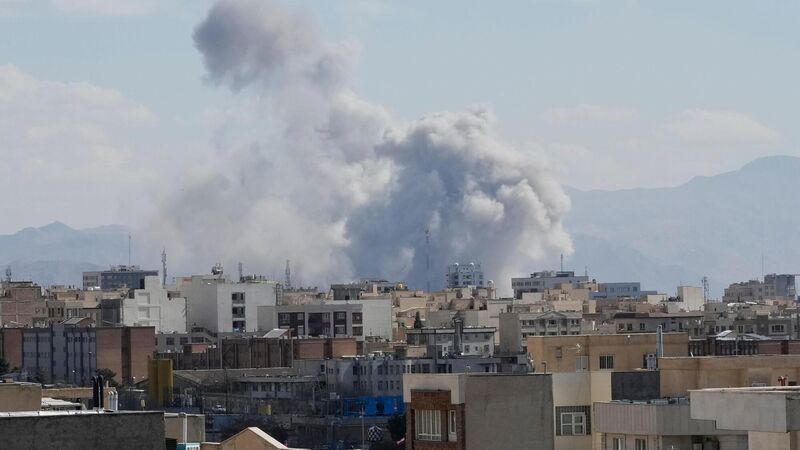
Smoke rises up after an air strike in Tehran on Sunday. A representative body for the oil and petrol industry in Ireland said there is "no indication" that this weekend’s attacks by the US and Israel on Iran events will lead to dramatic or sustained increases in Irish pump prices.
Irish motorists are bracing for a surge in petrol prices after the US and Israel's attacks on Iran and the death of Iran's Ayatollah Ali Khamenei sparked fears of a wider conflict which could last months.
Iran's supreme leader died in weekend air strikes which hit Iran, while killed hundreds of people. Iran responded with attacks on Israel, and in Dubai, Qatar, Bahrain, and Kuwait.
February average prices were €1.73 for petrol and €1.72 for diesel, according to the AA. Events in the Middle East could lead to a knock-on effect to Irish petrol prices and some Irish garages have already raised their fuel prices at the weekend.
Brent crude jumped 10% to about $80 a barrel over the counter on Sunday, oil traders said, while analysts predicted that prices could climb as high as $100 after US and Israeli strikes on Iran plunged the Middle East into a new war.
Industry body Fuels for Ireland, formerly known as the Irish Petroleum Industry Association, said it is monitoring developments in international markets but maintained there is "no indication" yet of a dramatic or sustained increases in Irish pump prices. Chief executive Kevin McPartlan said retail prices would move in line with underlying international market trends.
“International oil markets often react quickly to geopolitical developments, but history shows that not every market movement translates into significant or lasting changes at the pump. Ireland’s fuel supply chains are robust and reliable, and the market is well accustomed to managing short-term volatility," said Mr McPartlan.
Meanwhile EY Ireland co-head of geopolitical strategy Simon MacAllister said the weekend’s developments in the Middle East have the potential to have broader economic consequences.
"We will be watching closely to see if oil and energy prices elevate in the immediate term, while key global supply chain and shipping routes may also be impacted. If the conflict persists, it could have a materially disruptive impact on the wider global economy. Coming on the heels of the recent decision by the US Supreme Court on IEEPA tariffs, it caps what has already been a remarkable period of global geopolitical instability.
"Businesses have been focused on building resilience following the elevated uncertainty of the past year, and recent events only reinforce the importance of scenario planning, flexibility, and the ability to move quickly when geopolitical circumstances change.”
The OPEC+ group of oil producers agreed on Sunday to raise output by 206,000 barrels per day (bpd) from April, a modest increase representing less than 0.2% of global demand.
"While the military attacks are themselves supportive for oil prices, the key factor here is the closing of the Strait of Hormuz," said Ajay Parmar, director of energy and refining at ICIS.
Most tanker owners, oil majors, and trading houses have suspended crude oil, fuel, and liquefied natural gas shipments via the Strait of Hormuz, trade sources said, after Tehran warned ships against moving through the waterway. More than 20% of global oil is moved through the Strait of Hormuz.
"We expect prices to open (after the weekend) much closer to $100 a barrel and perhaps exceed that level if we see a prolonged outage of the Strait," Mr Parmar said.
Middle East leaders have warned Washington that a war on Iran could lead to oil prices jumping to more than $100 a barrel, said RBC analyst Helima Croft. Barclays analysts also said prices could hit $100.
While some alternate infrastructure could be used to bypass the Strait of Hormuz, the net impact from its closure would be a loss of 8m to 10m barrels per day of crude oil supply even after diverting some flows through Saudi Arabia's East-West pipeline and Abu Dhabi pipeline, said Rystad energy economist Jorge Leon. Rystad expects prices to rise by $20 to about $92 a barrel when trade opens.
The Iran crisis also prompted Asian governments and refiners to assess oil stockpiles and alternative shipping routes and supplies.
Additional reporting by Reuters

CONNECT WITH US TODAY



Be the first to know the latest news and updates