The booming prediction markets is prompting confusion and concern
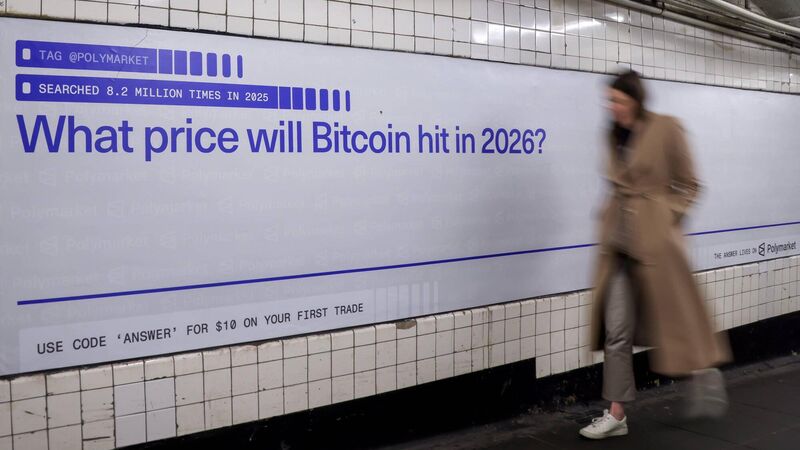
A Polymarket advertisement asking what price Bitcoin will hit in 2026 in a subway station in New York. Picture: Michael Nagle/Bloomberg
Betting on prediction markets has been around for a while since 2019, but the craze surrounding these platforms is rapidly gathering steam.
Users can bet on virtually anything, from the outcome of the Super Bowl to the Ireland vs Italy match or whether the US will invade Greenland, every second of every day.
Hundreds of millions are now wagered each week, generating odds that users promptly screenshot, post and meme far and wide, from social media feeds to mainstream news networks.
Polymarket and Kalshi, two of the leading platforms, collectively saw about $1.2bn (€1bn) in trading volume on Sunday, according to analysis by Piper Sandler, as the Super Bowl in the US spurred a betting frenzy.
Gambling, at least in the conventional sense, is closely scrutinised – and, in some cases, significantly limited – by regulators in various countries. In the US, in Las Vegas, for example, you must be 21 to place a bet in a casino. Legalised sports betting platforms remain banned in some states, such as California and Texas, and are also prevented from serving users under the age of 21 in many of the states where they are allowed.
Prediction markets are different. They allow users as young as 18 to place bets. And they are not restricted to certain areas, like sports betting.
As more and more money is bet on these platforms, whether or not they are, indeed, gambling platforms – and treated as such – is the subject of fierce debate. Should they be regarded as a legitimate, federally regulated product, or as a sneaky loophole that rewires gambling regulation?
“These types of markets have been around for quite a long time,” said Harry Crane, a statistics professor at Rutgers University. But in the US, he added, they “have historically been limited to US gambling laws and betting laws, which are very restrictive”. But the leading platforms – like Polymarket and Kalshi – argue what their users are doing is more akin to investment.
For years, the industry fought with the Commodity Futures Trading Commission, the US federal agency responsible for overseeing financial derivative markets, for its leading operators to be treated as derivatives platforms, rather than betting platforms.
Prediction markets say they offer “event contracts”, tied to events where the payoff structure is binary. Either the event occurs and a payment is made, or it does not and no payment is made. If you bet the Seahawks would clinch Sunday’s Super Bowl, you’d receive winnings; if you bet on the Patriots, you would not.
They are regulated as financial products, despite the fact that they can look and feel indistinguishable from gambling.
The Biden administration tried to crack down on the market. In November 2024, the FBI raided the home of Shayne Coplan, the CEO of Polymarket, for allegedly allowing US-based users to bet on the site despite a ban. Polymarket claimed the raid was retaliation for its users betting overwhelmingly that Donald Trump would win the election.
The Trump administration has taken a markedly less tough stance on the industry, with which it has close ties. Donald Trump Jr, the president’s eldest son, is currently both an investor in and an unpaid adviser to Polymarket, as well as a paid adviser to Kalshi. And Trump’s social media company, the Trump Media & Technology Group, recently announced it would start its own platform called Truth Predict.
The president’s business empire is getting involved in an industry which is an increasingly visible force in politics. Less than two years ago, prediction markets dominated discussion around the presidential election campaign as Trump boasted that “gambling polls” put him far further ahead than convention opinion polls. Now a string of established media outlets have signed partnership deals with Polymarket and Kalshi, lending them a fresh layer of legitimacy by quoting their odds in news coverage.
Crane, the Rutgers professor, suggested that prediction markets have benefited from traditional media outlets and polling organisations losing credibility with a large segment of the population. People are still “interested in knowing the truth” about outcomes, he said. “Finding an alternative that’s not relying on the legacy media and the legacy polling outlets is appealing.”
“Lots of people are very interested in politics, and they want to know what the true state of the world is,” said Grant Ferguson, a political science instructor at Texas Christian University. A key draw of prediction markets is their speed and constant availability. “That market updates all the time. It’s not like the stock market that has set hours. It’s open all the time, 24/7,” Ferguson said.
During election campaigns, Ferguson noted, prices can swing “during debates or when early voting returns start coming in”, delivering an always-on indicator that feels more immediate than a poll that could be released days after it was initially collected.
Unlike sports betting, where professional athletes who typically decide the outcome of bets are more often than not banned from placing bets themselves, prediction markets in politics allow users to gamble on elections whose outcome their votes can help decide. And through feedback loops, these markets could (and probably have) influenced the very events they claim to predict.
Widely cited market odds one way or another could “absolutely” influence voters or political narratives in a campaign, said Ferguson. For example, if a market suggested one party would win an election with an overwhelming probability, some voters might not see a point in casting their individual votes. “The vast majority of people do not understand prediction markets to the same degree as they think they might,” he cautioned.
Concerns of insider trading also loom large.
Prediction markets thrive on what Crane called “the moment the first person finds the information”, and are designed to reward people who are “better at getting information, faster at getting information”, oftentimes in ways that appear suspicious.
Bets on the Venezuelan opposition leader María Corina Machado winning the 2025 Nobel Peace Prize spiked shortly before the official announcement, for example, prompting allegations of insider trading. It was later determined that the leak was probably created by scraping already public metadata from the Nobel Prize website.
“The information was, for all intents and purposes, publicly available, even if it wasn’t readily available,” Crane said, raising questions about where the line is drawn for what should and shouldn’t be considered insider trading in the world of prediction markets.
The New York representative Ritchie Torres introduced draft legislation in January – designed to curb the risk of insider trading by federal officials and their staff – after what his office described as a suspicious Polymarket trade timed around the US operation in Venezuela. A new account placed a bet of more than $30,000 on Polymarket that Nicolás Maduro would be removed from office hours before the raid began.
“People do not like the idea of members of Congress engaging in any kind of financial transactions that might border on corruption,” said Ferguson.
There is widespread concern that prediction markets carry the same dangers as gambling. “The buying and selling of futures contracts via prediction markets carries substantially similar levels of risk to the consumer as traditional sports betting, including risks associated with chasing losses, impulsive behaviour, financial harm, and the development or escalation of gambling-related harm,” said Cait Huble, director of public affairs at the National Council on Problem Gambling.
She added: “As consumers engaging with prediction markets may not recognise their activity as functionally gambling, irrespective of whether legally defined as such, they may be less likely to demonstrate responsible gambling behaviour or seek support for a gambling problem.” Prediction markets should come with a warning, according to Azra. “The same way we see people with cancer from smoking, I think we should be the same way about prediction markets, explaining how this is a form of gambling along with all the consequences,” he said. “People should know you most likely won’t make money from this.” While none of his friends currently partake in prediction markets, Azra doesn’t think it’ll stay that way for long. “I see a future where they get more and more popular,” he said. “And I think eventually almost everybody will be into them trying to make quick money if precautions and restrictions aren’t taken.” Without intervention, odds are he’s right.
The Guardian
CONNECT WITH US TODAY



Be the first to know the latest news and updates