Ireland’s focused R&D strategy is attracting global enterprise
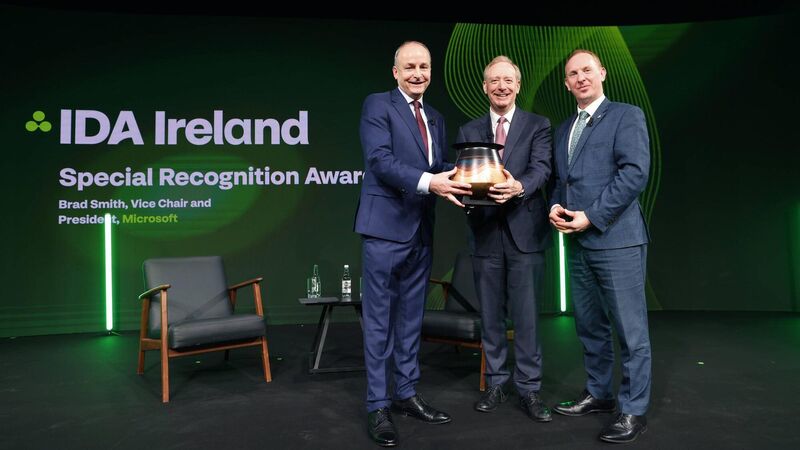
Taoiseach Micheál Martin alongside IDA chief executive Michael Lohan presenting the IDA Ireland Special Recognition Award, to Brad Smith, Microsoft vice chair and president as Microsoft celebrates its 50th anniversary worldwide and 40 years in Ireland. Picture: Julien Behal
Ireland has long been a country that global corporations have wanted to do business with. Increasingly, it has become a country that companies feel they need to do business with.
American companies have never been more eager to invest in Ireland, and the appeal extends well beyond quality-of-life considerations for relocated personnel. Many firms view Ireland as a strategically sound business decision. For Ireland, it has been equally strategic to bring American corporations and their investments here.

Ireland has become an indispensable partner to the United States, a development that reflects sustained policy choices and long-term planning. American companies such as IBM, PayPal, Johnson & Johnson, Motorola Solutions, and Microsoft continue to establish and expand operations in Ireland because of the comprehensive value the country offers. While industry specific tax credits and grants certainly play a role, many of Ireland’s advantages are structural, developed over decades and difficult to replicate elsewhere.
Ireland’s universities and research centres consistently rank among the world’s leading institutions, creating tangible benefits for multinational companies. Firms can participate in well-established university and industry partnerships that give businesses access to advanced research and skills emerging from classrooms, laboratories, and incubators.
Equally important, thanks to Ireland’s elite education ecosystem, there’s a highly skilled domestic talent pool ready to be tapped into. While U.S.-based firms often transfer staff to Ireland, they also hire extensively within the local workforce benefitting from Ireland’s appeal as a location of choice for skilled staff across the world.
Approximately 970 American companies directly employ about 210,000 Irish citizens, with many more thousands employed indirectly, supplying goods and services. American firms, in fact, make up about half of the 1,800 multinational companies that have a footprint and contribute greatly to Ireland’s economic development. Likewise, Ireland is among the largest sources of foreign direct investment in the United States with Irish companies employing over 110,000 people across every state in the U.S. The Ireland-America economic relationship has very deep and long-lasting roots.
Business clusters refer to geographic concentrations of companies operating within the same or related industries. Well-known examples include Silicon Valley in the United States or Seoul’s electronics sector. In Ireland, Cork has emerged as a pharmaceutical hub, Dublin as a global technology center, and Galway as a recognized medtech cluster. While proximity to competitors may appear counterintuitive, most executives understand that clusters offer shared infrastructure, specialized talent, and accelerated innovation.
Ireland’s business environment is shaped by necessity as much as ambition. The country has made deliberate choices to balance economic development with environmental stewardship. As a result, growth has been driven by human capital rather than natural resources. This has fostered a culture characterized by resilience, innovation, and long-term thinking.
American companies and their stakeholders value that. No CEO wants to expand their operations into a culture that doesn’t prize innovation and ambition. Executives search for partners who are equally invested in their own success. That most often happens in a market-driven, entrepreneurial climate.
Ireland’s position as a global business hub did not emerge overnight. In 1949, the Department of Industry & Commerce established IDA Ireland, to stimulate and support export-led business and enterprise in Ireland, covering both indigenous and foreign investment.
Since at least the 1960s, the country has worked deliberately to open its economy to international investment and attract high-value manufacturing. That sustained effort has shaped a formidable international reputation and competitive standing, allowing Ireland to compete with pro-business powerhouse nations such as Switzerland and Singapore.
Ireland has much to celebrate beyond its business success. Still, it should be noted that year after year, it continues to improve its value proposition for international companies looking to grow, especially among American corporations.
From an economic standpoint, the American-Irish corporate relationship stands as one of the country’s most significant achievements. It is often said that an organization is judged by the company it keeps. By that measure, Ireland’s standing among global enterprises speaks for itself.
# Brian Conroy serves as executive vice-president and director, North America at IDA Ireland, based in New York City. He works with North American leadership teams to establish and expand European platforms in Ireland, supporting investment across AI, digital transformation, and R&D-led growth.
CONNECT WITH US TODAY



Be the first to know the latest news and updates