OECD exempts US from global minimum tax rules
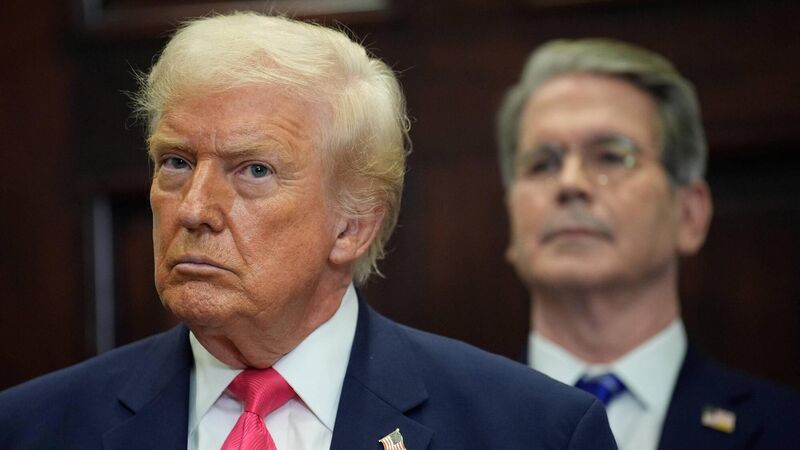
US President Donald Trump, left, and Scott Bessent, US treasury secretary. Photographer: Yuri Gripas/CNP/Bloomberg via Getty Images
The Department of Finance has welcomed an agreement exempting US multinational corporations from the 15% global minimum tax negotiated through the Organisation for Economic Co-operation & Development (OECD).
The global minimum tax was created to prevent multinational companies from dodging tax bills by locating operations and reporting income in low-tax countries.

The framework aims for companies to pay at least 15% in every country where they operate. The plan also has enforcement rules that allow other countries to collect tax from a company if its local jurisdiction isn’t charging at least a 15% rate. The rate applies to multinationals with at least €750m in revenue.
In December 2023, Ireland raised its corporation tax rate for large enterprises to 15% from a previous 12.5% as part of the agreement, following years of criticism from EU counterparts arguing that Ireland's outlier low rate encouraged tax avoidance and profit-shifting among large multinationals.
Last year, US President Donald Trump pulled the country out of a framework to implement the 15% global tax minimum, which was negotiated in 2021 during President Joe Biden's administration.
Under the agreement, other countries will effectively be blocked from imposing additional taxes on foreign subsidiaries of US companies to compensate for profits that are under-taxed in other jurisdictions.
US officials have argued that American multinationals already face a minimum tax regime, both through a 15% federal corporate minimum tax imposed on companies with at least $1bn in profits and the US international tax regime, which imposes levies ranging from 12.6% to 14% on a corporation’s foreign profits.
US Treasury Secretary Scott Bessent secured an agreement from G7 allies in June to exempt American companies in exchange for persuading congressional Republicans to remove a “revenge tax” provision in a draft of Trump’s “One Big, Beautiful” tax bill that passed Congress last year.
The revenge tax would have allowed the US to impose taxes on companies with foreign owners, as well as on investors from countries judged as charging unfair foreign taxes on US companies. The agreement to exempt US companies effectively sidelines threats made by congressional Republicans to revive the revenge tax plan, which has proved to be deeply unpopular amongst economists and Wall Street.
Speaking on Monday, tánaiste and finance minister Simon Harris welcomed the approval of the global minimum tax package, stating: "As a member of the OECD/G20 Inclusive Framework on Base Erosion and Profit Shifting (BEPS), Ireland joined the global consensus in agreeing a Side-by-Side system which acknowledges the robustness of both the US tax system and the global minimum tax, while preserving the original objectives of the OECD international tax agreement.”
"This package was carefully negotiated in response to the US’ concerns and the mandate that followed from the G7 and G20.
"Maintaining a stable international tax architecture is vital: firstly, to preserve the important gains we have made over the past decade or so in addressing base erosion and profit shifting, and secondly, to provide the clarity and certainty required by businesses and tax administrations who must implement these complex rules.”
"Ireland welcomes the commitment to continue work at the OECD on further simplification, in recognition of the compliance burden faced by those implementing the Global Minimum Tax rules and supports work to reduce the complexity of the framework."