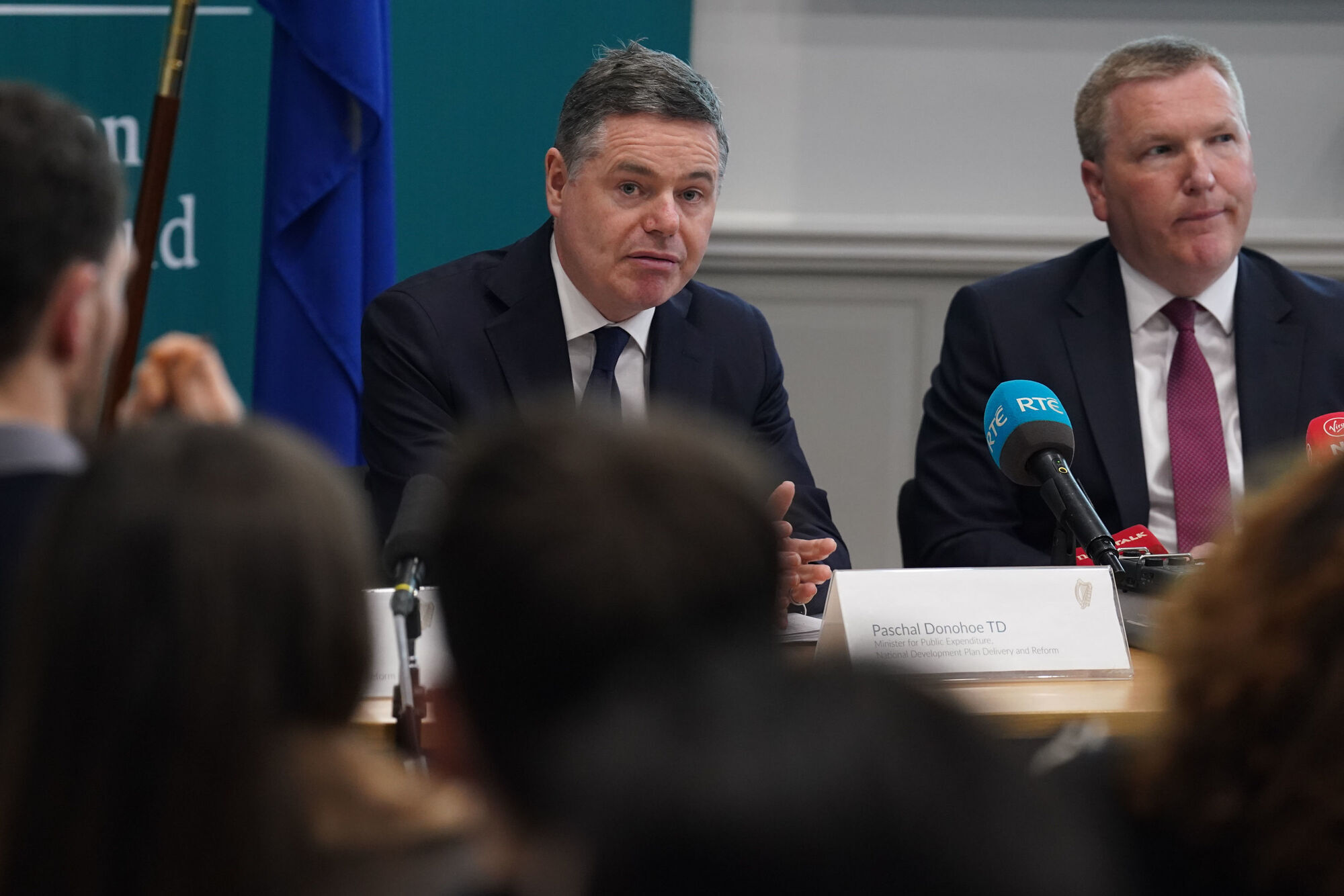
This week the Government published its stability programme update, a functional document but one which will impact the finances of every household in the country. It sets out the Department of Finance’s forecasts for where the economy is heading.
Also, the document sets out the early parameters of the coming budget.
Speculation about Budget 2025 has kicked off in earnest this year, fuelled by anticipation of a general election.
The stability programme update has one clear message — the Government will have less money available in the coming budget than it has had in recent years. Because of this, the Government faces a critical decision about whether to set out a vision for the country beyond the election or to cave to runaway expectations of a giveaway.
The basic arithmetic is this — to keep in line with their 5% spending rule, the Government expects to increase permanent public spending by no more than €4.5bn next year.
This is enough extra money to do the basics of keeping public services upright; meeting cost inflation and providing for demographic pressures in areas like pensions.

A little over €1bn will be needed to raise tax bands and credits in line with wages. These both involve government decisions.
A failure to do either would represent a real cut in services or a rise in taxes. After the basics are done, there is a little under €9bn of a remaining surplus which they can then save for the future or use for real tax cuts or for ‘one-off’ spending.
The Government has already made one consequential decision by committing €6bn of this surplus to their two new funds which will store up cash to meet future needs, the Future Ireland Fund and the Infrastructure, Climate and Nature Fund.
After setting aside this money for a rainy day, the Government retains around €3bn for budget day spending without having to borrow.
To put it in context, a repeat of one-off measures announced in last October’s budget — like electricity credits or one-off welfare payments — alone would cost almost €2.5bn.
The Government is always likely to find some extra spare cash before budget day. Yet still, the available money is clearly tight enough that they will have to make clear choices.
Recent budgets have been all about helping with cost-of-living challenges by introducing the oxymoron of repeated one-off measures.
As inflation falls to 2%, the justification for another round of one-off supports is very weak. We need to decide which of these measures might usefully be permanent, like reductions in public transport costs.
Equally, we need to end the untargeted giveaways, like energy credits, which have no place outside an emergency period only.
The understandable pre-election temptation, however, will be to have one more for the road. The Government should heed the old advice and know the one that’s one too many.
Spending the whole surplus — or, worse still, borrowing to continue with temporary giveaways to households who don’t all need them — would be a roll of the dice with the public finances. We are entering a period of major change in the global economy. Revenues may be volatile; we need to leave room for risk.
The budget will be an opportunity to set out a vision for the country we are building in the next five years, rather than a sugar rush for five months. Setting aside €6bn into the funds for the very long-term future is one part of this, but there must also be more immediate ambition.
There is room to do something imaginative on developing our skills base, without taking fiscal risks.
The National Training Fund, funded by a 1% levy on employer payrolls, is nearing a surplus of €2bn. T his is unsustainable when our labour market is facing significant changes through technology like AI and we need thousands more skilled workers to meet climate and housing goals. A training voucher scheme is one way we could both help people today and show vision.
- Gerard Brady is chief economist with Ibec

Subscribe to access all of the Irish Examiner.
Try unlimited access from only €1.50 a week
Already a subscriber? Sign in
CONNECT WITH US TODAY
Be the first to know the latest news and updates