Cork's outdoor dining and pedestrianisation experiment to continue
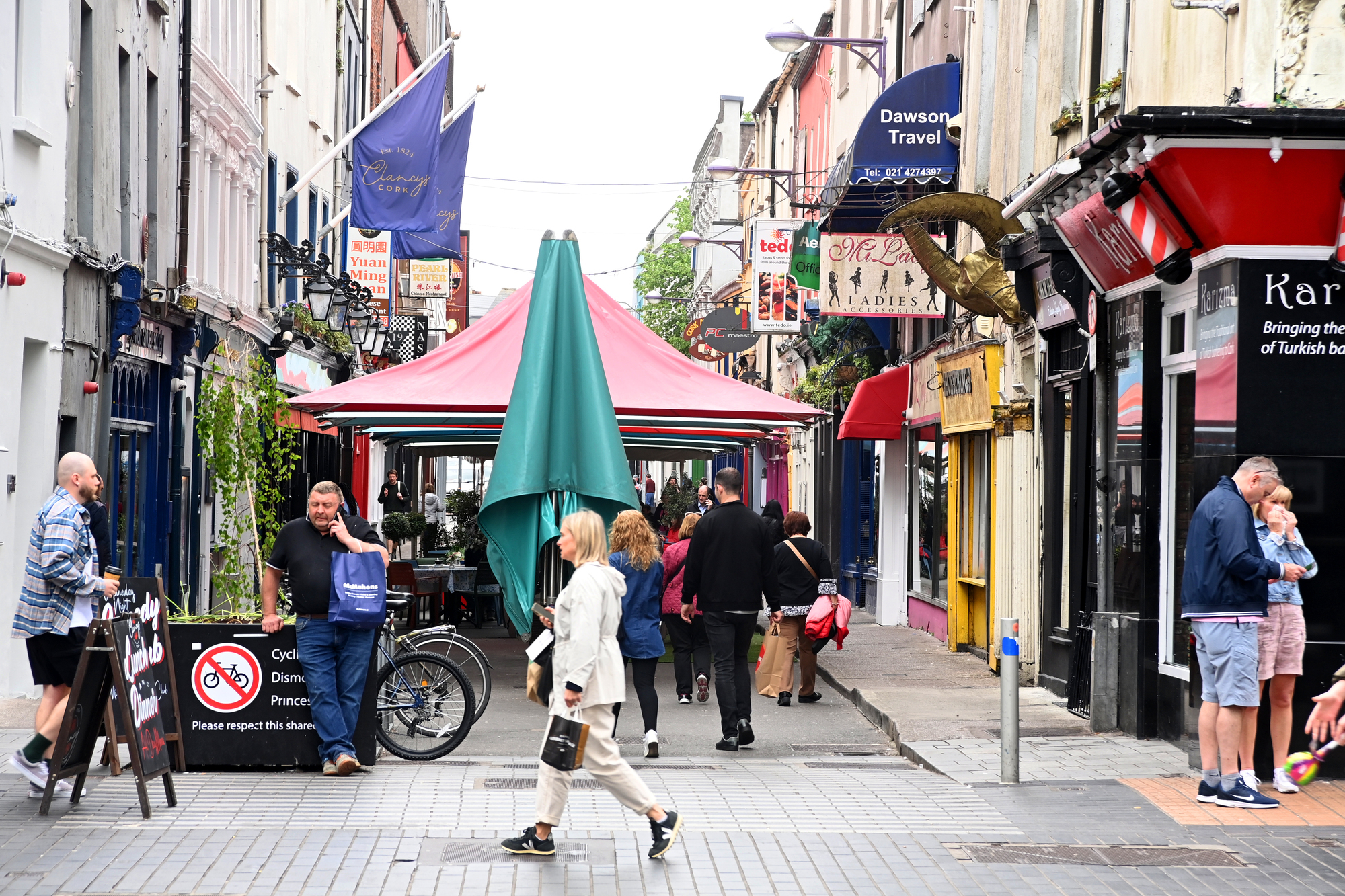
Views of Princes Street, Cork City. Pic Larry Cummins
“As chairs and tables were coming off trucks on Princes Street that first day three years ago, people just sat down. There was a huge response to it, and it’s developed to become nearly iconic in Cork,” said publican Paul Montgomery.
Now almost three years since a web of city centre streets were claimed back for pedestrians and outdoor diners, he is one of countless business owners who have reaped the rewards of the ‘reimagining’ of Cork city.

First introduced as a lifeline in 2020 for hospitality businesses struggling with public health restrictions, Cork City Council invested €1.3m in drawing the public back into the city to drink and dine al fresco as part of the ‘Reimagining Cork City’ programme.
Availing of Fáilte Ireland’s Weatherproofing & Dining Enhancement Scheme, bespoke outdoor infrastructure was put in place on five city centre streets (Princes Street, Caroline Street, Beasley, Pembroke Street and Union Quay) and the Council approved over 200 outdoor dining grants for city centre traders.
Off the back of initial success, the following year 17 streets were permanently closed off to traffic, and over the course of 2021 Cork City Council say tens of thousands of people enjoyed the facilities on Princes Street alone.
Now three years on from the pedestrianisation experiment, Cork City Council say outdoor dining is set to be a “permanent feature of Cork’s tourism and hospitality offering”, and it is open to requests from businesses for further pedestrianisation.

It was 1971 when Cork’s Princes Street became the first pedestrian-only street in Ireland. More than 50 years later, the thoroughfare lined with colourful parasols is the poster boy for the pandemic-triggered reimagination of the city centre.
“Tourists come into Cork city and they’ve heard about Princes Street… it’s an iconic street in the city now,” said Paul Montgomery, owner of several establishments on newly pedestrianised streets in the city centre, including Clancy’s and An Síbín on Princes Street, as well as Conway’s Yard and Atlas.
“We had pedestrianised streets long before covid-19. Before on Princes Street and other streets, there was still no traffic during the day, but people were just walking by. It’s the fact that you can actually sit and dine on them now, it’s a place that you can stop, and it’s something that we can certainly be proud of,” he said.
Mr Montgomery said that it is important not to lose the unique atmosphere created by the measures introduced during the pandemic, and to keep building on its success.
“We could do a lot more with bookending the streets, talking about the streets that are pedestrianised in the city, to keep building off of the success. We need to show ourselves off internationally,” he said, calling on both Cork City Council and Fáilte Ireland to promote the Cork streets that are now a “national treasure”.
As well as the boost that pedestrianisation brought for businesses that were operating on these city centre streets since before the pandemic, the heightened footfall along these routes is attracting new traders to set up shop.
Corine Ngandeu, owner of Cork Niche Fragrances on Princes Street, said that the fact the street was pedestrianised was one of the main reasons she decided to open up her perfume shop there in January.

“Because of the restaurants and everyone being able to sit outside it’s a busy, busy street, and that was the main factor to be honest. Footfall is very important, and there’s definitely great traffic here, so it was the major reason I decided to open my store [on Princes Street],” she said.
Even though she is able to rely on a certain amount of custom seeking her out as the only niche perfume supplier in the city, Ms Ngandeu says her location on Princes Street puts her business in a “very, very good position”.
“If I was on a different street I would probably still have somewhat of a business, but Princes Street is there, you can’t miss it. The amount of people that pass through is unreal in a day, and when the weather is nice it’s even crazier, so the street does make a difference,” she said.
Kevin Herlihy, President of Cork Business Association, said that overall businesses in the city centre are very positive about the changes to the streetscape.
“It’s had a fantastic effect on a lot of businesses, and it really has created a lovely ambience and a lovely atmosphere in the city,” he said.
“I have friends that have central retail in other cities in Ireland and they’re very envious of Cork. We were the shining light when the whole thing started on Princes Street back in 2020, and other cities are certainly jealous of what Cork has been able to do,” he added.
The move to prioritise the pedestrian has not come without its challenges and trade-offs, as the lack of vehicular access on the network of 17 streets for most of the day has made it more difficult for traders shuttling supplies in and refuse out, and for customers who can no longer travel door to door by car.
Green Party city councillor Dan Boyle has also highlighted that the setting out of dining chairs and tables on streets has created some accessibility issues.
“There are a few laneways that in effect have been closed and devoted to the adjacent businesses, stopping through ways on the likes of Grafton Street, and sections off Washington Street onto Little Hanover Street,” he said.
“Part of the licensing arrangement is there is a pathway that people can walk past, but [in some cases] it’s not wide enough for two people coming in opposite directions, and I would question whether its wide enough for wheelchairs,” he added.
Councillor Boyle also said that in the rush to use street space there may be too much “cramming” of on-street furniture, which could restrict access to outdoor facilities for those with restricted mobility.
He said that he is a supporter of the ‘Reimagining Cork City’ project, but that its continued rollout needs to be nuanced to make it as effective as possible for all citizens.
Audits of street furniture licenses carried out by the City Council with the Cork Access Group in 2021 and 2022 didn’t find any significant accessibility issues, with a further audit due to be carried out this summer.

Across the river from the 17 streets already pedestrianised, MacCurtain Street and the surrounding Victorian Quarter (VQ) is next in line for a major transformation, as the MacCurtain Street Public Transport Improvement Scheme is set to be completed in time for Christmas.
Shane Clarke, Director of Operations for the VQ, said that the project will “turn the hierarchy upside-down” on the street which had two to three lanes for traffic before works got underway, and will reclaim space for the public realm and pedestrians.
“About 60 to 70% of the traffic volume will be taken out… [and] the widths of the pavements are effectively doubled from what they were before covid-19,” he said.

Mr Clarke said it is an “omelettes and eggs situation” for traders in the area who are currently enduring incremental works along the street, but the hope is it will result in increased footfall in the entire quarter, as well as enlivening nearby areas around Kent Station, Penrose Wharf and Horgan’s Quay.
While plans for a revamp of MacCurtain Street and the wider area were in the pipeline for over a decade, Mr Clarke said that the pandemic really accelerated a change in how people think about the development of the city.
“Cork is rediscovering that it actually has a pretty stunning city centre… The 17 streets that were pedestrianised were just brilliant, and although MacCurtain Street is not going to be pedestrianised it’s going to have a much different atmosphere. I think the city is, and will, see the benefit of investing in place-making, [MacCurtian Street] is a continuation of what’s happened in the city centre, and I’d love to see it happen elsewhere,” he said.
A spokesperson for Cork City Council said that the feedback from both businesses and the public from the outset of the pandemic pedestrianisation has been “overwhelmingly positive”, and that the council does intend to pedestrianise more streets in future.
“Cork is recognised by the WHO as a Healthy City and increasing pedestrianisation will only improve the city centre experience for those living in, working in and visiting the city,” they said.
“Other businesses have seen the success of the pedestrianisation of the 17 streets and have indicated that they are interested in exploring the potential to pedestrianise their streets. Cork City Council will consider any requests for further pedestrianisation which will have to consider numerous factors including traffic movement in the city and the City Development Plan,” they added.
A collection of the latest business articles and business analysis from Cork.