G7 vaccine pledges to developing countries may fall short
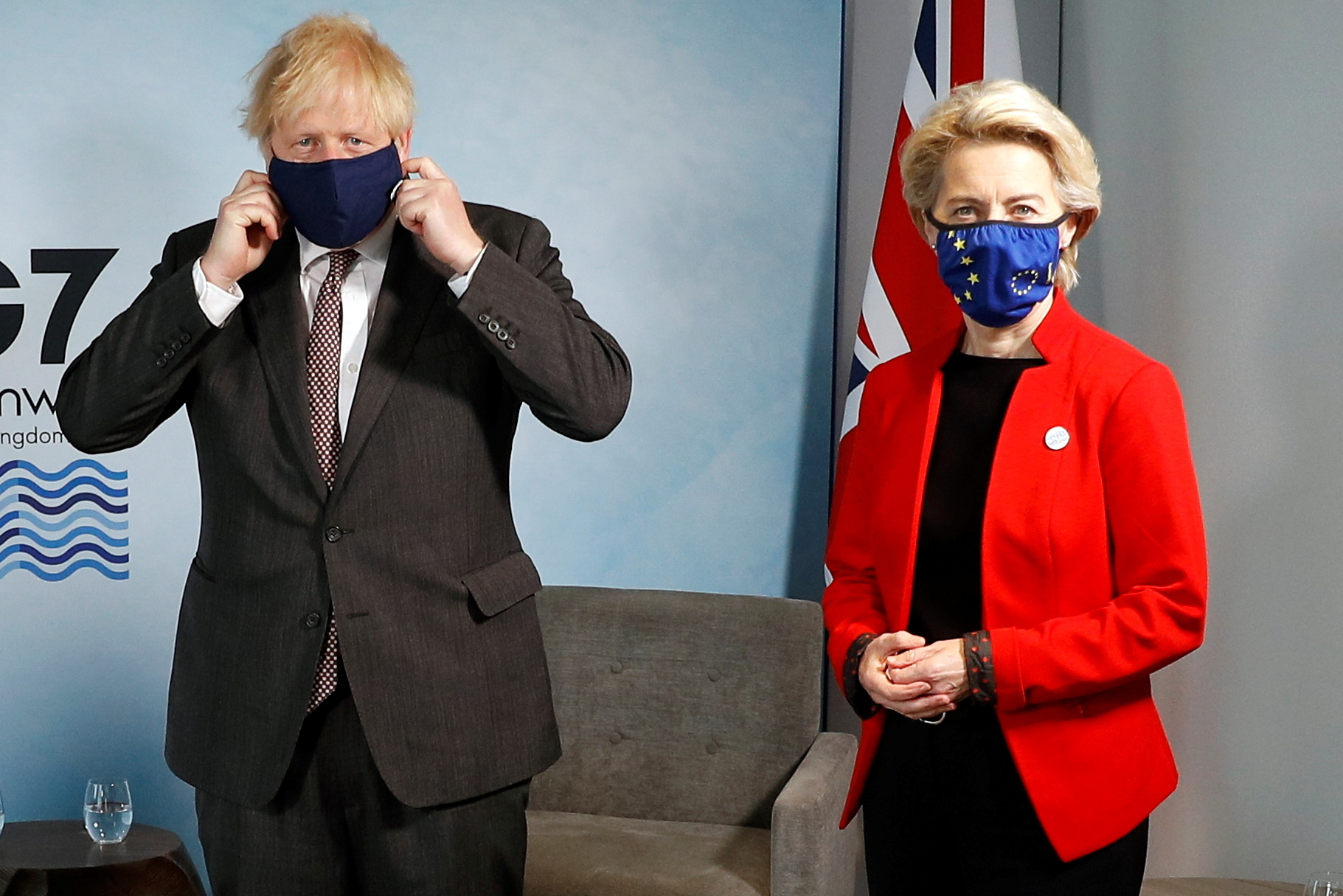
UK prime minister Boris Johnson with European Commission president Ursula von der Leyen at the G7 summit.
Questions have grown over whether rich nations are pledging anything new in their promises to deliver Covid vaccines to developing countries.
The G7 plan to donate one billion Covid vaccine doses to poorer countries will have limited impact because it includes some previous pledges, but it still offers a small lifeline to a global vaccine-buying system, some experts said.
On Saturday, German leader Angela Merkel said the G7 would collectively distribute 2.3 billion vaccine doses to developing countries by the end of next year.
An EU official told reporters that that pledge would be a combination of direct sharing of doses, contributions to the Covax programme, and exports.
A US initiative announced on Thursday to donate 500 million doses of the Pfizer and BioNTech vaccine is part of the G7 pledge.
Many of the promised doses will flow through Covax, a global vaccine- buying system backed by the World Health Organisation and Gavi, the vaccine alliance.
The pledge does not represent entirely new resources, and the donation is far short of the five billion to six billion shots needed by poorer nations. Moreover, the plan does not address distribution gaps that could make it difficult to deliver doses.
However, experts said it is still a much-needed boost to Covax, which has so far only distributed 83 million shots worldwide.
Covax has struggled to secure deliveries as wealthy nations reserve enough shots to vaccinate their populations several times over.
"It's going to rescue Covax from its pretty dire predicament right now, so it's a very significant step," said Stephen Morrison, the director of the Global Health Policy Centre at the Centre for Strategic and International Studies, a think-tank.
Even if the shots are acquired and shipped, they risk overwhelming developing countries' limited distribution infrastructure, especially if many are delivered together late this year.
The World Bank extended a $12bn (€10bn) line of credit for developing countries to build out vaccine distribution infrastructure, but governments have drawn down only about $3bn.
Reuters and Bloomberg