Eamon Quinn: Unpacking the G7 tax plan for multinationals reveals sting in tail for Ireland
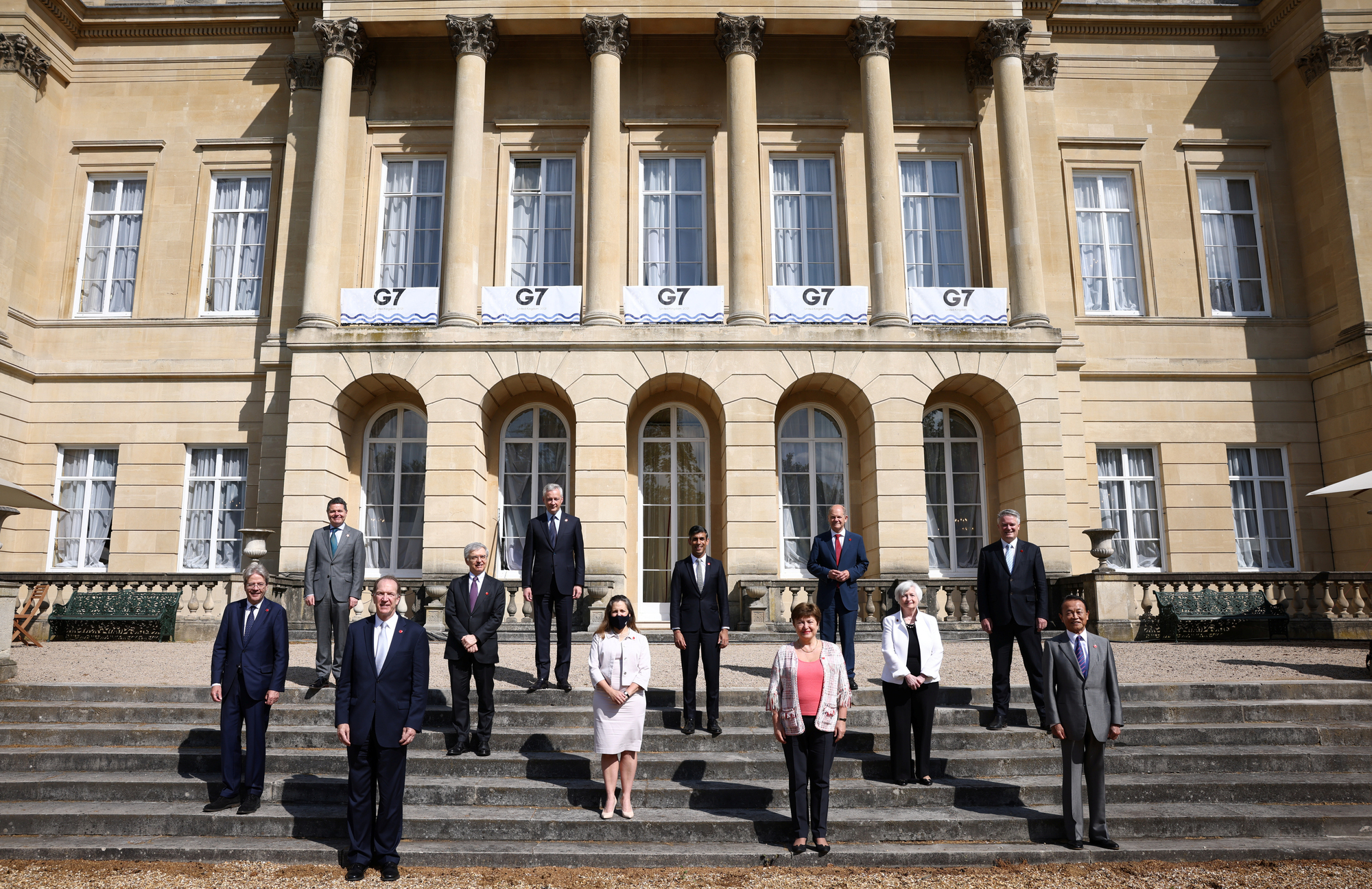
(Left to right) EU's Economy Commissioner Paolo Gentiloni, Eurogroup President Paschal Donohoe, World Bank President David Malpass, Italy's Finance Minister Daniele Franco, French Finance Minister Bruno Le Maire, Canada's Finance Minister Chrystia Freeland, Britain's Chancellor of the Exchequer Chancellor Rishi Sunak, Managing Director of the IMF Kristalina Georgieva, Germany's Finance Minister Olaf Scholz, US Treasury Secretary Janet Yellen, Secretary-General of the Organisation for Economic Co-operation and Development (OECD) Mathias Cormann, Japan's Finance Minister Taro Aso.
It accounts for only 150 of many thousands of words in its communiqué, but the G7 agreement on Saturday afternoon on new ways to tax global multinationals has enormous implications for Ireland even as it remains unclear what those effects will be.
The sting in the tail for Ireland is not the plan to set up a global minimum tax rate at at least 15% but in the way the G7 wants to go about applying the new tax rules for multinationals.
Ireland’s transformation from the debt-laden 1980s has been anchored on an industrial policy that has never been very far from global tax and the multinationals. The tax regime has been based on attracting enormous flows of foreign investment mostly from the US and for those foreign-owned companies to create thousands of jobs.
More significantly, the industrial policy of the State has effectively widened way beyond jobs that the foreign firms will create in factories and facilities. The Government is now increasingly relying on the multinationals to provide it with many billions in corporate tax revenues that are assessed on a small slice of the huge worldwide revenues they are pumping through Irish companies.
For one reason or another, the amount of corporate taxes collected by the State has ballooned from €4bn seven years ago to a bounty of €12bn last year. Though the specific amounts are kept secret from voters, a large part of the annual tax haul is collected from a handful of presumably US-owned multinationals that include all the well-known corporate names.
Corporate tax receipts account for 20% of all tax revenues that help to go to fund government spending. This adds up to the State effectively doubling down on its bet on US multinationals, including Apple, Pfizer, Google, and Microsoft, which all have set up substantial European head offices and bases in Ireland, for reasons that include the benefits available to them from the current global tax order.
A global tax system based to a large extent on taxing multinationals where they decide to locate substantial facilities has paid out big for the State, and increasingly so in recent years. And any proposal that plans to upend the global taxation for multinationals will be of huge interest to a small country like Ireland.
That is even more the case when the people who want to do the upending are from the powerful market economies and populous group of seven of the western wealthiest countries that encompasses the US, Japan, Germany, France, the UK, Italy, and Canada. Rarely have 150 words been more important for this State.
The small section in Saturday’s communiqué devoted to global tax from the G7 finance ministers was in itself telling. Much vaguer on detail than many thought, it was nonetheless explosive in its ambition to build a new global system for taxing multinationals that will upend the current order.
The G7 proposal has the interests of its own wealthy countries at heart but for it to succeed it must build agreement among other rapidly growing economies, such as India.
It therefore sets out to secure support from the G20 (which includes the EU and the increasingly influential economies like India, Brazil, South Korea, and Turkey) and wants the backing of as many countries as possible represented in a much broader tax initiative driven by OECD of 135 countries.
Without wider support, the G7 plan for a new start to taking global companies will fail as proposals driven by the European Commission have failed in the past.
“We commit to reaching an equitable solution on the allocation of taxing rights, with market countries awarded taxing rights on at least 20% of profit exceeding a 10% margin for the largest and most profitable multinational enterprises.”
And among this explosive sentence in the communiqué is the word 'market' in the accord that many ahead of the two-day London gathering had thought was impossible for the big wealthy economies to agree on.
Translated, it means the G7 has agreed among the big seven to tax all multinationals, not only the digital companies and advertising-selling machines such as Google and Amazon, but also pharmaceutical giants for their profits on the basis of where they generate the bulk of their sales revenue. In European terms, that means the big countries such as Germany, France, and the UK.
For the iPhone giant Apple or pharmaceutical maker Pfizer, which have significant facilities and employ thousands of people in the Cork region and pay substantial but publicly undisclosed amounts in corporation tax to the exchequer, the implications of the G7 plan for the State could not be clearer.