John O'Brennan: Member states must share blame in EU's handling of Covid crisis
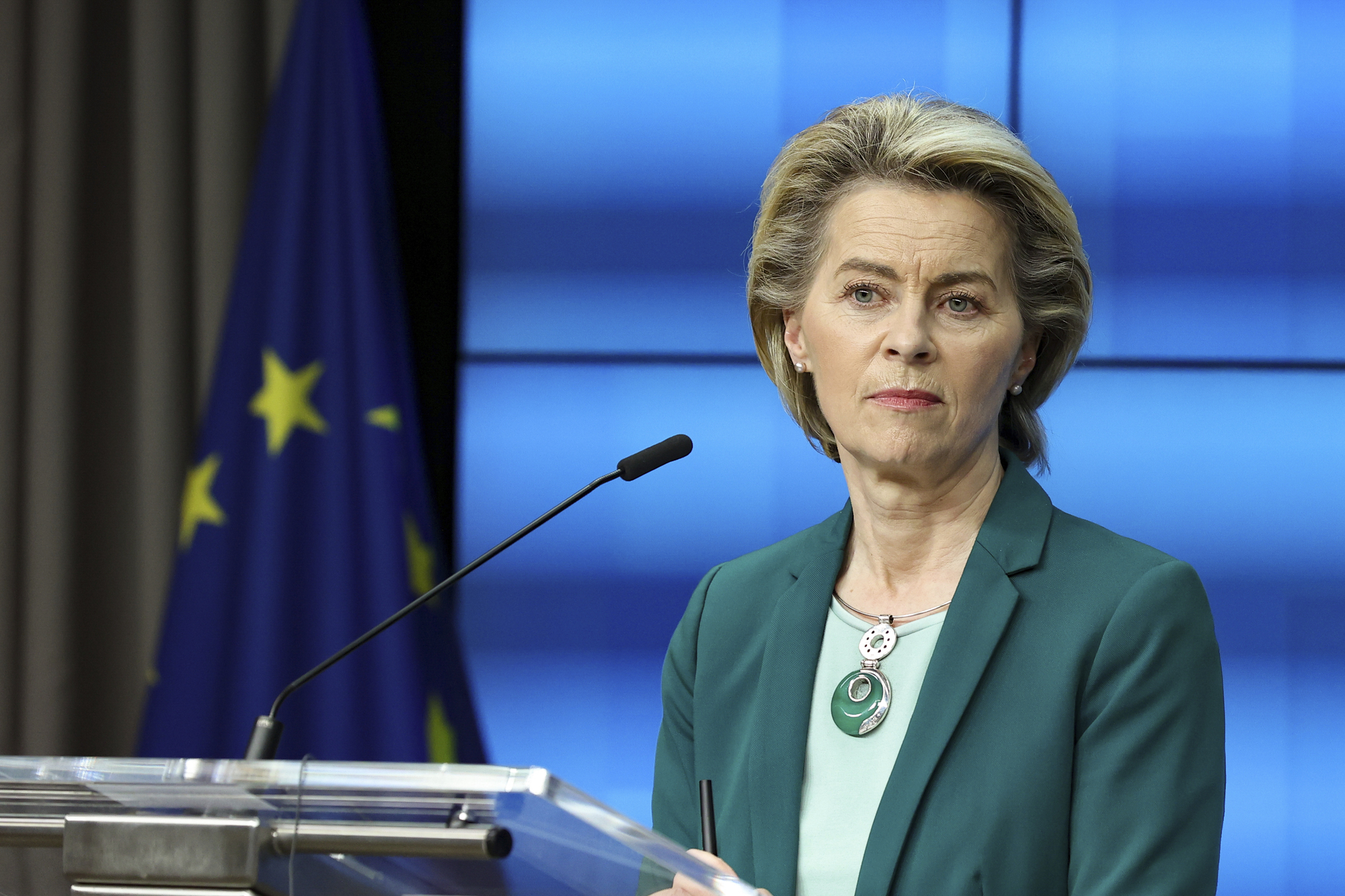
European Commission president Ursula von der Leyen. The commission was in a very poor position to take charge of the crisis because healthcare is a sector where there is very little EU competence; nevertheless, within a short period, the commission began to co-ordinate an increasingly effective response.
Tens of millions of people around Europe are spending a second Easter in lockdown, after a devastating resurgence of the Covid virus in different parts of the continent.
In many countries, there is palpable disappointment at the failure of the EU to “get a grip” on a crisis that has cost hundreds of thousands of lives and accelerating economic damage.
This raises the question about how the EU has managed the Covid emergency and which actors bear responsibility for those elements of the response that have gone wrong.
When the crisis first hit in March 2020, the initial EU reaction was one of confusion and bitterness as arguments raged among member states about how to procure PPE and ventilators.
Germany was accused of withholding vital protective equipment from Austria, while Poland put strict restrictions on what medical equipment could be exported. A general shortage of chemical reagents for laboratory testing of swabs impacted nearly all member states.
At the centre of the storm, the European Commission struggled to co-ordinate the EU response.
But the commission was in a very poor position to take charge of the crisis because healthcare is a sector where there is very little EU competence: the member states are responsible for their own healthcare systems and the EU has little capacity for intervention.
Nevertheless, within a short period, the commission began to co-ordinate an increasingly effective response, using, for example, the EU Civil Protection Mechanism to deploy medical staff to Italy, and enabling cross-national distribution of face masks, disinfectant, and other vital equipment. A European Covid-19 data platform was launched to enable the rapid collection and sharing of available research data.
Economic measures included a suspension of the EU’s normal rules on state aid, allowing member states to provide direct aid to the airline sector, for example, which was gravely threatened by protracted lockdowns. The rapid deployment of a solidarity instrument, called SURE, allowed member states to subvent furlough schemes and protect jobs across their economies.
Perhaps the most important step taken was the agreement to institute a €750bn EU Recovery Fund, a much-needed fiscal ‘bazooka’ that signalled the EU’s determination to avoid the errors which accompanied the eurozone crisis after 2008.
It seems clear that the EU will have to provide further ‘bazookas’ to aid economic recovery in the years to come but that will be difficult given the trenchant opposition of the Netherlands and other member states to further debt collectivisation.
The EU’s more recent failures on vaccine distribution have been well aired.
By far the most common reaction has been to blame the commission — from the charge that it negotiated a very imperfect contract with AstraZeneca to the alleged inequities in vaccine allocations across the member states.
Scapegoating Brussels is much easier for governments than owning up to failures at the national level of decision-making.
Summing up, the EU response to the challenges thrown up by Covid has been uneven and, at times, unsatisfactory.
But we are much more likely to arrive at satisfactory explanations for the EU’s failures by looking to national capitals rather than to Brussels.
- Professor John O’Brennan holds the Jean Monnet Chair of European Integration in the Department of Sociology at Maynooth University and is director of the Maynooth Centre for European and Eurasian Studies.
CONNECT WITH US TODAY



Be the first to know the latest news and updates