Sharp fall in consumer and business confidence due to fresh lockdown
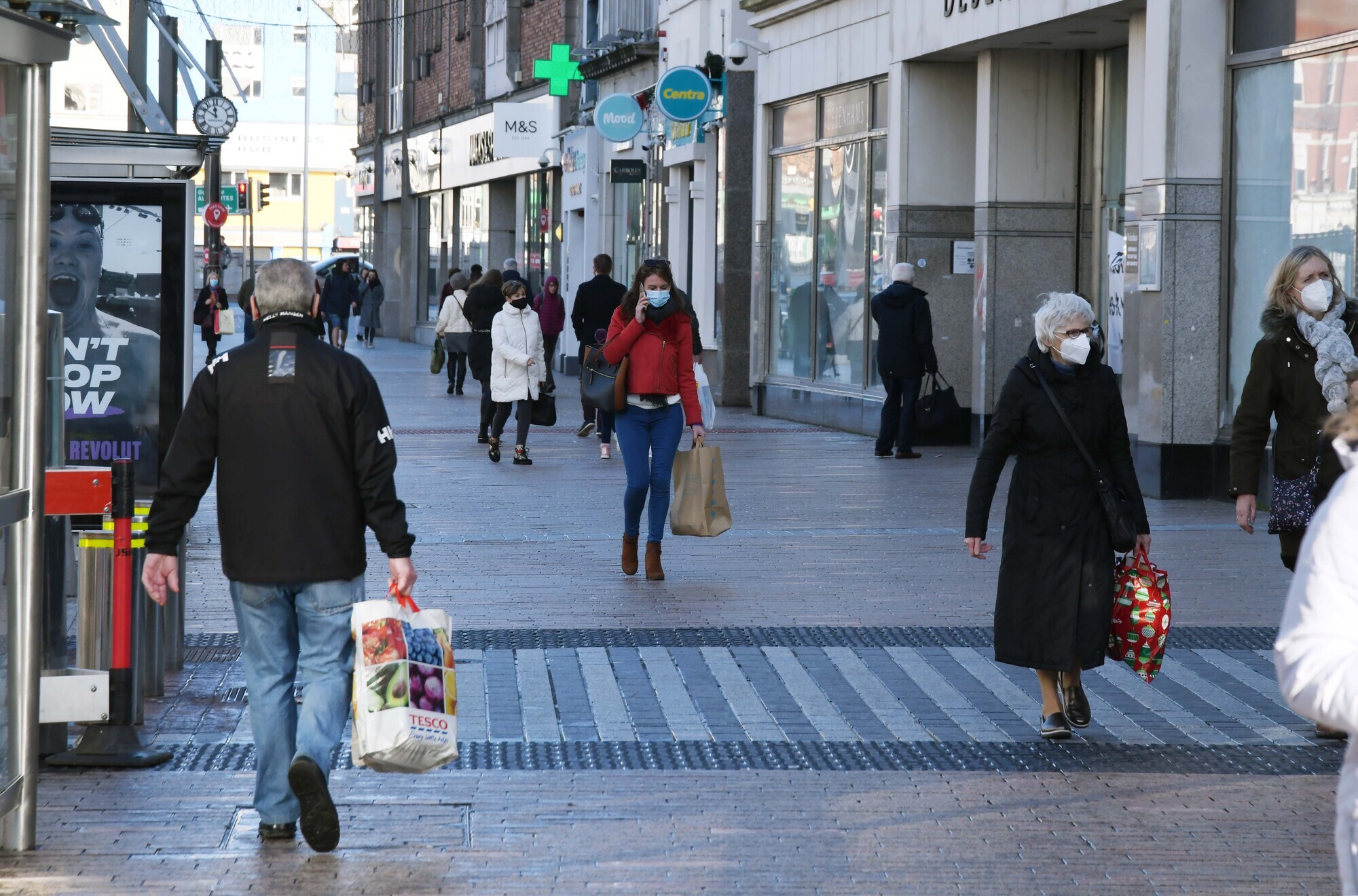
Shoppers on St Patrick's St, Cork. Picture: Denis Minihane
Confidence among Irish consumers and businesses has fallen sharply because of the deterioration in the public-health situation and a return to Level-5 lockdown.
New data shows that more than a third of firms in Ireland expect business to decline in the next three months and 52% of households are holding out on spending, because they are not certain which way economic policy will go.
Bank of Ireland's latest monthly 'economic pulse' index stands at 61.6 in January, down 8.6 on last month and 24.5 lower than a year ago.
While the trade agreement reached by the EU and the UK has reduced Brexit-related uncertainty and the vaccine rollout has started, sentiment among households and firms has 'headed south' because of the latest lockdown and the rapid rise in Covid-19 cases and hospitalisations since Christmas.
"The scale of the drop in sentiment this month was similar to last October, but much less than last spring," Bank of Ireland's chief economist, Loretta O'Sullivan, said.
"The latest containment measures are not quite as stringent as those of the initial lockdown and there has been some adaption and innovation by households and firms since then," Ms O'Sullivan said.
"They still make for a challenging start to 2021, though, as do the difficulties currently being experienced in implementing the new trading arrangements with the UK."
Ms O'Sullivan said the "worst-case" Brexit outcome has been avoided.
"As the year progresses, the successful, widespread deployment of the Covid vaccine will be key to shoring up consumer and business confidence and the economic recovery."
The index combines the results of the separate consumer and business pulses. At 60.3 in January, the consumer pulse was down 5.9 on last month's reading and 22.3 lower than a year ago.
The recent surge in the virus has set households on edge, and with further restrictions put in place, they were gloomier about the economy, and their own finances, this month.
50% also indicated that they are holding out on spending, because they are not certain which way economic policy will go.
The business pulse came in at 61.9, down 9.3 on last month and 25.1 lower than a year ago. All four sectoral pulses posted weaker readings this month, with construction recording the biggest fall in sentiment.
While firms were downbeat in January about business prospects for the coming three months, the survey results show that growth ambitions further out were back at their pre-pandemic level.
Some 60% of firms said that they are planning on expanding in the next one-to-three years, with the Covid-19 vaccine and clarity on the post-Brexit trading relationship being tailwinds.
A separate economic forecast, from financial firm, Goodbody, predicts that consumer spending will drive the recovery once the country begins to emerge from the current pandemic restrictions.
Dermot O'Leary, chief economist with Goodbody, said the initial shock of the pandemic caused consumers to rein in spending aggressively at the start of the pandemic last year, with spending falling by over 40% from its pre-pandemic levels.
"Due to significant government transfers, disposable incomes have held up well," Mr O'Leary said.
"Indeed, Irish households experienced the fastest growth in disposable incomes in the EU in 2020. As a result, savings have soared among Irish households.
"As evidenced by the partial reopening in December, there is significant pent-up consumer demand, which will be unlocked once restrictions are eased.
"A normalisation of the savings ratio will, on its own, lead to a large rebound in consumer spending, with some unleashing of savings adding extra impetus to this trend."

CONNECT WITH US TODAY



Be the first to know the latest news and updates