ECB's Christine Lagarde warns over 'elevated uncertainty' from Covid-19 slump
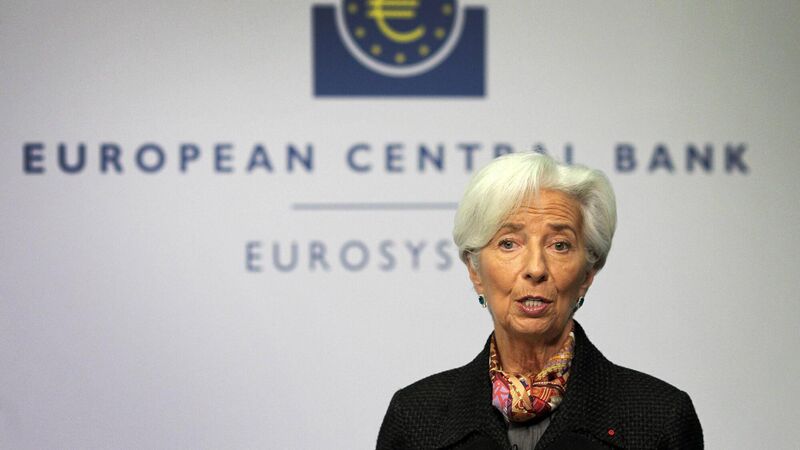
ECB President Christine Lagarde, warning of “elevated uncertainty” and slack in the economy because of the coronavirus, pledged to continue taking whatever steps needed to shore up growth and inflation.
The ECB chief spoke after her Governing Council agreed to keep their pandemic bond-buying programme unchanged at €1.35trn and the deposit rate at -0.5%.
“Actual and expected job and income losses and the exceptionally elevated uncertainty about the evolution of the pandemic and the economic outlook continue to weigh on consumer spending and business investment,” she told reporters in Frankfurt.
“Ample monetary stimulus remains necessary,” she said.
Ms Lagarde said the central bank expects to spend the full amount of its bond programme, in apparent contrast to some policymakers, including her executive board colleague, Isabel Schnabel, who recently said the full amount may not be needed.
Risks to the outlook remain “to the downside,” Ms Lagarde said. “The Governing Council remains fully committed to doing everything necessary within its mandate to support all citizens of the euro area through these extremely challenging times.”
With coronavirus cases contained in most of Europe and economies reopening, officials have time to judge if the recovery will be sustained.
Still, the outlook remains fragile and much depends on whether EU leaders can settle differences over a groundbreaking €750bn recovery fund when they meet in Brussels.
Dutch Prime Minister Mark Rutte has spearheaded resistance to the proposal in its current form, calling for stronger conditions tied to EU grants. He told members of parliament this week that he is “sombre” about the summit. Ms Lagarde said it is important for leaders to “quickly agree” on a package.
While ECB policy makers have started to sound slightly less pessimistic about the rebound in recent public appearances, they remain wary of another spike in infections - a risk underscored by local outbreaks in some regions and a resurgence in the US.
They’ve also warned that the path back to pre-crisis levels of activity will be arduous, marked by higher unemployment and bankruptcies that could increase sharply when government aid programs end.
Countries will have to work out how to deal with the massive debt burdens they’re building up.
“The European Central Bank is moving to a phase of managing the recovery from one of firefighting. This new stage in the battle against the economic devastation wreaked by Covid-19 will require more data to act than the Governing Council had today,” said Bloomberg economists David Powell and Maeva Cousin.
A recent ECB survey showed financial institutions nervous of the economic outlook preparing to tighten lending standards considerably, which could dampen growth.
Most economists surveyed by Bloomberg expect another €500bn to be added to the pandemic purchase programme by the end of this year.
The European Commission last week projected an economic contraction of almost 9% for the eurozone this year, in line with the ECB’s June assessment.
It also warned that southern European nations including Italy and Spain face a much bigger hit than northern countries such as Germany.
Ms Lagarde backed that view. “Before Covid-19 hit, there was already a divergence and degree of divergence among member states,” she said.
“There’s a risk that divergence persists, which should be avoided. That’s why we welcome the recovery fund.”
Europe’s economy will suffer more than previously estimated this year and take longer to recover because of a slow easing of coronavirus restrictions, according to the European Commission.
Officials sent the starkest warning yet about the impact of the pandemic, with the divergences between richer and poorer countries opening up even further than projected two months ago.
It now forecasts a contraction of 8.7% in the eurozone this year, a full percentage point deeper than previously predicted. Risks remain “exceptionally high and mainly to the downside,” the European Commission said.
CONNECT WITH US TODAY



Be the first to know the latest news and updates