Tesla's biggest challenge may no longer be BYD — it's Elon Musk
Improving Irish registrations contrast with growing uncertainty over Tesla's future as Elon Musk prioritises robotics, AI and SpaceX
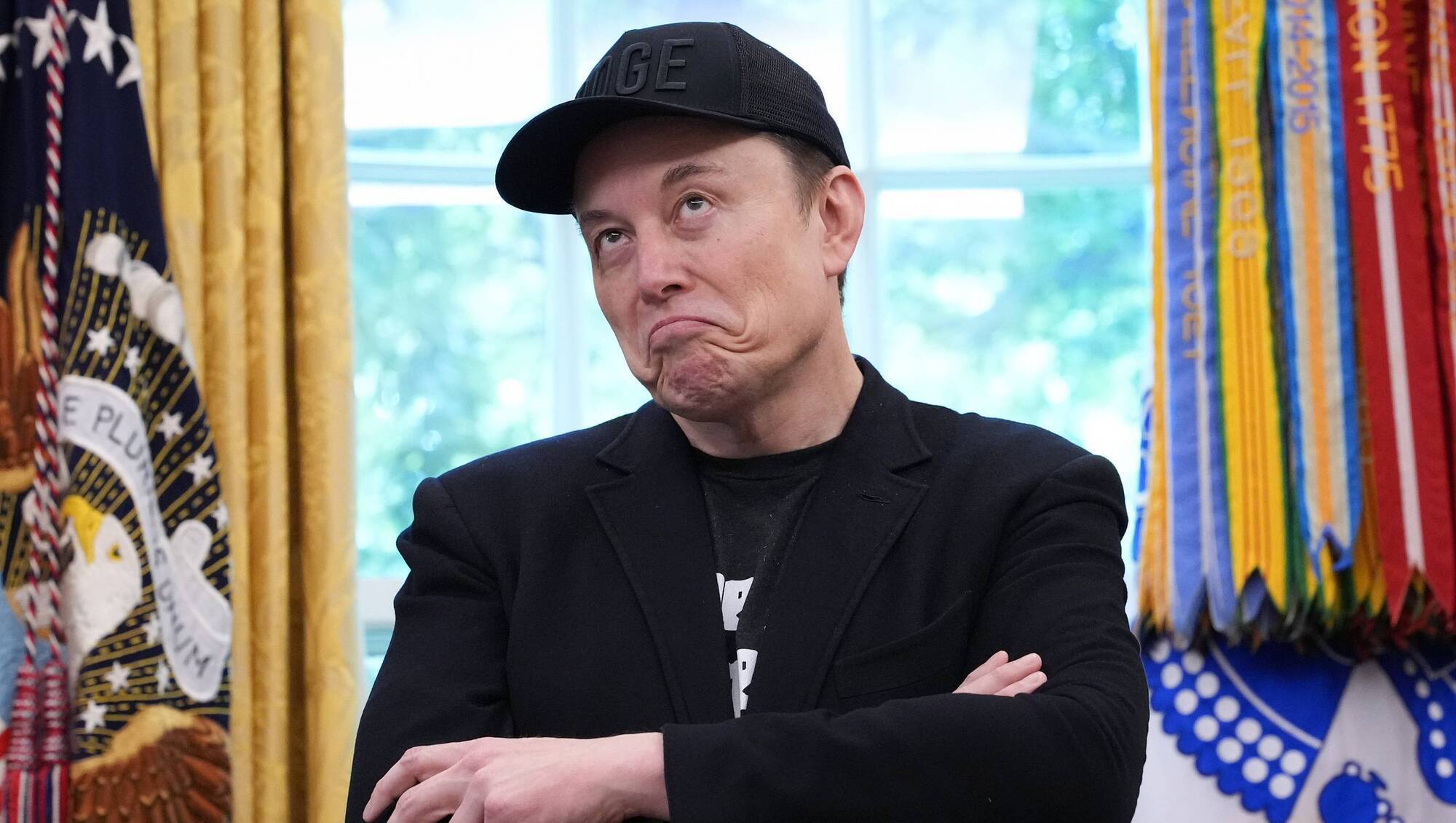
Tesla CEO Elon Musk speaks alongside US president Donald Trump to reporters in the Oval Office of the White House. Picture: Kevin Dietsch/Getty Images

Tesla CEO Elon Musk speaks alongside US president Donald Trump to reporters in the Oval Office of the White House. Picture: Kevin Dietsch/Getty Images

ONCE at the forefront of electric vehicle development, Tesla has lost the significant lead it has built over the years to upstart Chinese competitors as well as established European and Japanese brands.

The company’s sales have slumped in recent years, particularly in Europe, but recent sales data suggest that it might be in the midst of a turnaround.

With the conflict in the Middle East driving up petrol and diesel prices, consumers are making a noticeable shift towards electric vehicles. So far in Ireland this year, 20,164 new electric cars have been registered, representing a 48% increase compared to the same period in 2025.

Tesla’s reputation in Europe soured over the last few years largely as a result of its chief executive Elon Musk’s shift into politics, with his support of Donald Trump’s US presidential campaign in 2024 as well as his subsequent support of far-right political parties in Europe.

However, the company’s sales are experiencing a bit of a recovery so far this year, proving particularly popular in Ireland, just as Mr Musk signals that the company is looking to shift its focus away from electric cars. The once noted brand could also see its cars reduced in significance as a major player in the industry while its chief executive chases the latest fad.

Like a lot of other manufacturers, Tesla experienced a significant drop-off in sales during 2024 — with data from the Society of the Irish Motor Industry showing new electric car registrations in Ireland dropped 23.6%, to 17,460, compared to 2023.

Tesla registrations dropped from 3,371 in 2023 to 2,929 in 2024 across all of its models. But while the rest of the market experienced a resurgence during 2025 — with new registrations of electric cars increasing to 23,601 — Tesla did not experience a similar level of upswing and in fact it lost ground with registrations declining 5.37% to 2,769.

Changing markets in Europe

In 2023, the manufacturer was riding high in Europe. It experienced an 56.9% year-on-year growth across the region with just over 366,000 new cars sold. However, like in Ireland, this saw a significant collapse in 2024, down 10.3% to just under 327,000, coinciding with a decline in all electric vehicle sales across Europe.

According to data from the European Automobile Manufacturers Association — which includes car sales from all EU states as well as Britain, Iceland, Norway, and Switzerland — electric vehicle sales across the region fell from just under 2.02m to 1.99m, a decline of just 1.3%. So while the entire market receded during the year, Tesla saw a larger collapse than most.

Again, similar to Ireland, electric vehicle sales across Europe saw a resurgence in 2025 but Tesla did not benefit.

Throughout 2025, Tesla sales declined another 26.9% to just over 238,656 units, while electric car sales across the region increased nearly 30% to just under 2.6m. It was also during 2025 that Tesla’s main rival, Chinese manufacturer BYD, saw a near 270% increase in sales in the region, up from 50,912 in 2024 to 187,657 last year.

However, figures so far this year suggest that consumers are once again coming back to Tesla. Between January and June in Ireland, the number of new Tesla registrations in Ireland stood at 1,973 — a 28.7% increase compared to the same period in 2025. However, it still trails its 2023 highs.

Across Europe, in the first five months of 2026, 1.25m new battery-electric cars were registered, up 31.2%, of which just over 118,000 were Tesla vehicles — an increase of over 57% compared to the same period in 2025.

Tesla was once again outdone by BYD, which saw its sales during this time increase 145% to 135,307.

Rise of Chinese EVs

So while Tesla is climbing itself out of the hole its chief executive has dug, it has ceded a lot of ground to its main competitor; who once again took the top spot as the world’s largest electric car manufacturer earlier this month.

BYD delivered 557,090 battery-electric models in the three months through June. While fewer than in the same period last year it was enough to beat Tesla, which delivered 480,126.

Tesla is expected to post its financial results for the second quarter next week.

In Ireland, Tesla still has a sizable lead over BYD when it comes to fully electric cars. In the first six months of the year, Tesla sold 1,976 units, while BYD sold 1,385.

All this might be a moot point as while Tesla still makes the bulk of its money from car sales, Mr Musk no longer sees the company’s future in cars, rather he is attempting to shift the company’s focus more towards automation and robotics.

For a decade, Mr Musk has said that fully autonomous self-driving cars have been only a few years away but progress in this area for Tesla has been slow and as a result, it has lost ground to competitors.

A Tesla Robotaxi in Austin, Texas.Tesla has been operating its robotaxis in Miami, Dallas, Heuston, and Austin Picture: Kaylee Greenlee/Bloomberg

There are a number of companies in the US operating near fully autonomous taxi services in a number of US cities. These include Waymo, owned by Google, and Zoox, owned by Amazon.

Waymo, for example, is available in 11 US cities including Los Angeles, Orlando, and Dallas. The company is aiming for roll-out across a further 21 US cities. Zoox currently live in Las Vegas and San Francisco.

Tesla has been operating its robotaxis in Miami, Dallas, Houston, and Austin.

In May last year, he promised there would be 1,000 robotaxis available within a few months.

While the company continues its robotaxi efforts, it is planning to invest far more heavily in robotics.

In April, the company said it anticipates spending $25bn (€21.9bn) in capital expenditure this year. The investments will be put toward a dramatic expansion of factory operations, including production of Optimus humanoid robots, AI initiatives, and the autonomous Cybercab.

Musk may change direction

Mr Musk has been trying to hype up the potential of his Optimus robots amid the company’s declining auto sales over the last few years.

In January, Mr Musk said the company would be selling its Optimus robots to the public by the end of next year with an expected hefty cost.

While Mr Musk may be Tesla’s chief executive, his attention over the last few months has largely been on SpaceX — his satellite and AI company which also operates xAI, as well as the social media site X, formerly Twitter.

In June, SpaceX held an initial public offering (IPO) which valued the company at $1.77tn (€1.55tn) — the largest IPO in history, making Mr Musk in the process, on paper, the world’s first trillionaire.

On its first day of trading, the company’s market capitalisation increased even further to $2.1tn (€1.84tn).

Following a challenging year for Tesla shareholders — with the firm’s share price is down just under 10% so far this year — there has been speculation that Mr Musk might seek to merge Tesla with SpaceX, potentially creating a massive technology conglomerate in the process. Mr Musk owns reportedly 12% of Tesla’s shares.

However, the volatility of SpaceX’s stock price could be a huge hurdle to this deal actually going through. The initial share of the company started at $135 before reaching over $200 a couple of days after its IPO.

The share price has continued to fall and has been trading below $135 this week, with the potential for it to drop even further. Its market capitalisation was down to around $1.773tn yesterday. Tesla on the other hand was valued at around $1.48tn this week.

If the merger was to go ahead, Tesla — the brand which was once seen as the leading example of what electric cars could be — may be reduced to just
a segment in a broader company that is much more focused on robots, automation, AI, as well as the pipedream of data centres in space.

This lack of focus on the electric car product could lead to it falling even further behind its Chinese, Japanese, and European competitors in this area, despite a significant shift in customers moving towards electric vehicles.

Additional reporting Bloomberg

x

More in this section

The Business Hub

Newsletter

News and analysis on business, money and jobs from Munster and beyond by our expert team of business writers.

Cookie Policy Privacy Policy Brand Safety FAQ Help Contact Us Terms and Conditions

© Examiner Echo Group Limited