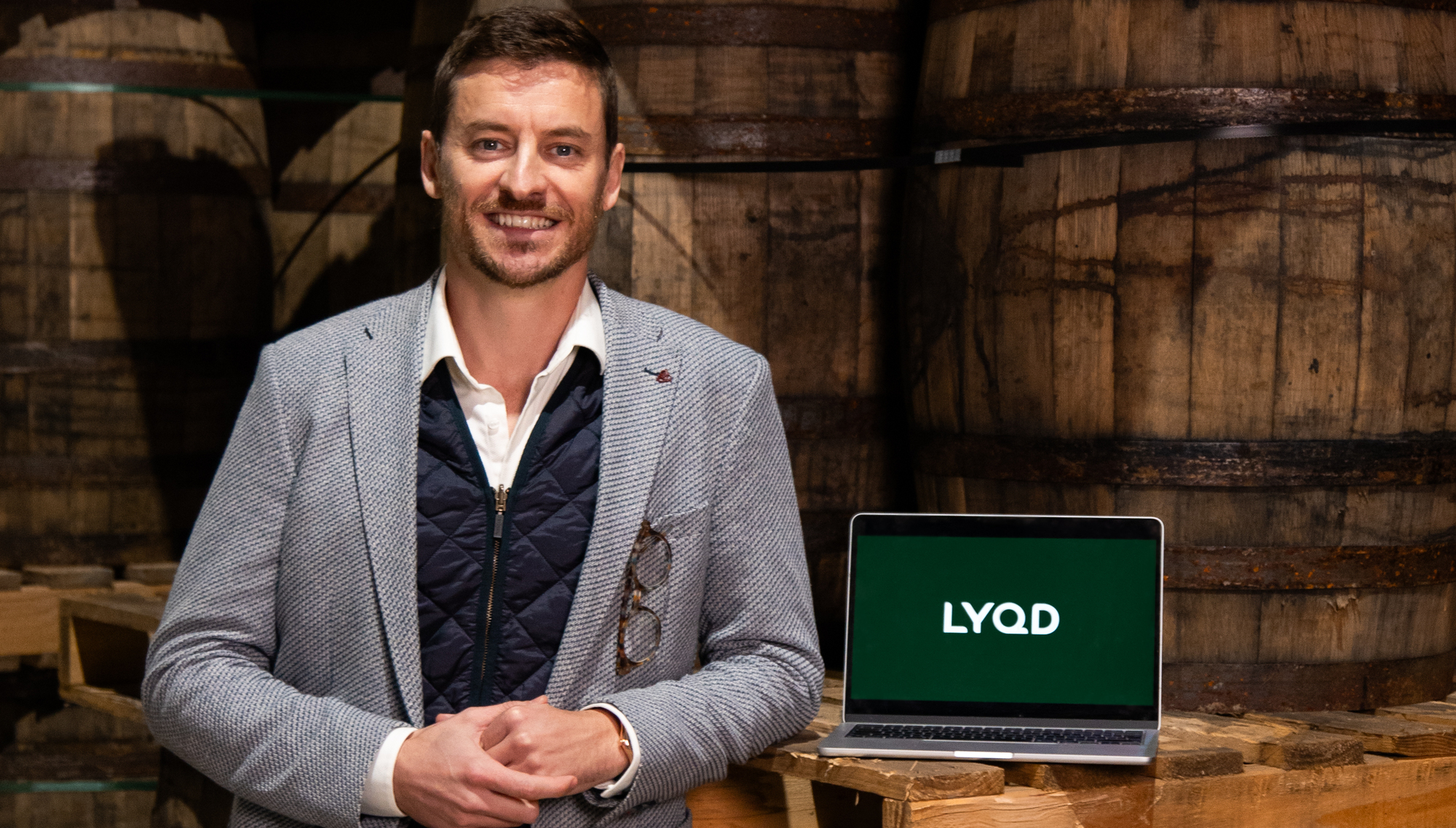
My Job: Closing the gap between Irish whiskey and Scotch
James Jardella, CEO & co-founder LYQD
: James Jardella
: CEO & co-founder LYQD
: LYQD is Ireland’s first digital exchange for whiskey casks, built for private collectors, cask owners and distilleries
Ireland has 4.5m maturing whiskey casks, or nine years of global supply, in warehouses, according to the LYQD Irish Whiskey Supply Report 2026.
The report, independently researched by Martin Purvis, of Commercial Spirits Intelligence, is one of the most detailed ever compiled on Irish whiskey supply, stock, and market dynamics.
“This a long-overdue report, and it offers a clearer future pathway for Irish whiskey,” says James Jardella, LYQD chief executive. “Irish whiskey has been one of the fastest-growing spirit categories in the world over the past decade, yet there has been remarkably little independent, data-driven analysis of where the industry actually stands.”
With much of the commentary anecdotal or driven by vested interests, LYQD worked with Mr Purvis, who has 20 years of experience across distilling, supply chains, and commercial strategy.
Read More
Mr Jardella say: “Without any sugar-coating, what came back was a balanced picture: Strong long-term fundamentals, but some real near-term tensions that the industry needs to face. It gives everyone — producers, brands, and buyers — a much clearer sense of where they stand.”
The 4.5m casks in bonded warehouses around Ireland confirmed what LYQD were seeing in the market. Mr Jardella says: “LYQD operates at the intersection of buyers and sellers, so we were aware that supply was building. But a number is just a number on its own; what matters is context. More important is what that inventory equates to in terms of demand: Somewhere between seven and nine years’ worth of supply at current consumption levels. That’s a couple of years ahead of where you’d ideally want to be.”
In 2025, distilleries across Ireland cut new production significantly, in line with the 35% reductions seen across Scotch and US variants in the same period. “If the category returns to the growth rates of the prior decade, those two levers together could shift the supply picture relatively quickly.”
Irish whiskey represents only 14% of Scotch sales globally, despite being a highly compelling product, Mr Jardella says. “This is the central opportunity for the category. The gap isn’t driven by quality, but by distribution, brand investment, and awareness. The good news is that the headroom is enormous.” India, South-East Asia, and Latin America are significantly under-served markets.
“Closing the gap requires the industry to tell better, more varied stories, and for those distilleries and brands with genuine provenance and real craft behind them, that is a tremendous asset. The diversity of origin, style, and character now produced across more than 40 distilleries on the island is remarkable, a striking contrast to the landscape of Irish whiskey just 20 years ago.”
Mr Jardella is a founder, operator, and brand builder with experience across technology, consumer goods, and international retail. Having begun his career in data-led environments, before moving in to commercial roles, he founded Skin Sapiens, scaling it from concept to a recognised European brand through product development, digital commerce, and strategic retail partnerships. At LYQD, he leads growth and strategy, drawing on a mix of brand experience and operational depth to ensure the platform is built with scale in mind.
While there is an over-reliance on the US market, he sees further capacity for increased sales in North America. “Absolutely. Ireland sells more than its fair share of whiskey in the US market, but still has considerable room to grow. Tariff uncertainty creates short-term headwinds, but if trade friction eases, the US remains one of the most receptive whiskey markets in the world for Irish product. The same tariff tensions open opportunities in places like Canada as well.”
In terms of other global markets with the greatest future potential for Irish whiskey exports, Mr Jardella is focused on the largest whiskey-consuming country in the world by volume: “India is the one I keep coming back to, and Irish whiskey barely registers there yet.”
To put the scale of that opportunity in context, Scotch whisky exports to India are larger than total Irish whiskey sales worldwide.
“That is the scale of the opportunity, if the category can make genuine inroads there. I would also point to parts of South-East Asia, Vietnam, the Philippines, and selected African markets as important growth frontiers. Price accessibility matters enormously,” he says.
In tandem with its export opportunities, Mr Jardella sees the Irish whiskey sector as having significant job-creation potential.
“Very much so, and not just in distilling. The supply chain around whiskey — cooperage, warehousing, logistics, tourism, hospitality, and retail — is substantial. With much being said about the threat to jobs from AI, it’s difficult to see an algorithm replacing the skills involved in the physical movement of goods, the craft of the stillhouse, or the warmth of a well-run visitor experience.”
Irish whiskey is an under-utilised tourism resource. “This is a personal passion. The Guinness Storehouse attracts over a million visitors a year and is one of the most visited attractions in Europe. Irish whiskey has all the ingredients to build something comparable. There’s genuine pride running through this industry: Pride in the quality of what’s being made, pride in a tradition that stretches back centuries, but also real excitement around innovation and the new generation of distilleries emerging across the island.” Done well, whiskey tourism does more than generate revenue: It creates ambassadors for the category.
“Someone who visits a distillery in Connemara or the Liberties goes home with a story they’ll remember for years. That kind of connection is incredibly powerful and difficult to manufacture.”
LYQD brings together buyers and sellers, whether that is trade between distilleries and brands, or individuals looking to acquire, mature, and sell Irish whiskey casks as an alternative asset, a market that has historically been largely opaque and inaccessible. Mr Jardella says: “The opportunity in Irish whiskey is genuine. The spirit matures in the warehouse, and when acquired at the right price, whiskey casks can represent an interesting long-term alternative asset that does not necessarily move in lockstep with equities or property.
. “The current environment, with supply running ahead of demand, creates a more favourable buying environment than we’ve seen for some time.”
However, cask ownership is not risk-free, and returns are never guaranteed. “Entry price, quality, provenance, and holding period all matter enormously. What LYQD provides is greater price discovery and transparency to help buyers and sellers make more informed decisions. As with any alternative asset, buyers should understand the risks involved and take independent advice where appropriate.”
The growth in new distilleries is positive for Irish whiskey, bringing diversity, different mash bills, house styles, and new stories to tell. The bigger question is supply.
“There’s no doubt we’ve produced a lot of young whiskey in a short period of time, and, in the near term, that creates pressure and opportunity in equal measure.
“Personally, I see the long-term impact as positive. A more mature, more diverse Irish whiskey will be better placed than ever to compete with Scotch on the global stage. There’s no denying the last 18 months have been a tough period for the industry, but when you look further ahead, everything is still very much to play for.”