Social commitments can enhance reputation and help retain talent
Social impact: Executives cite reputational gains (84%), community relations (65%), winning customers (46%) and attracting the best employees (43%) among gains for business 
Social commitments can enhance reputation and help retain talent

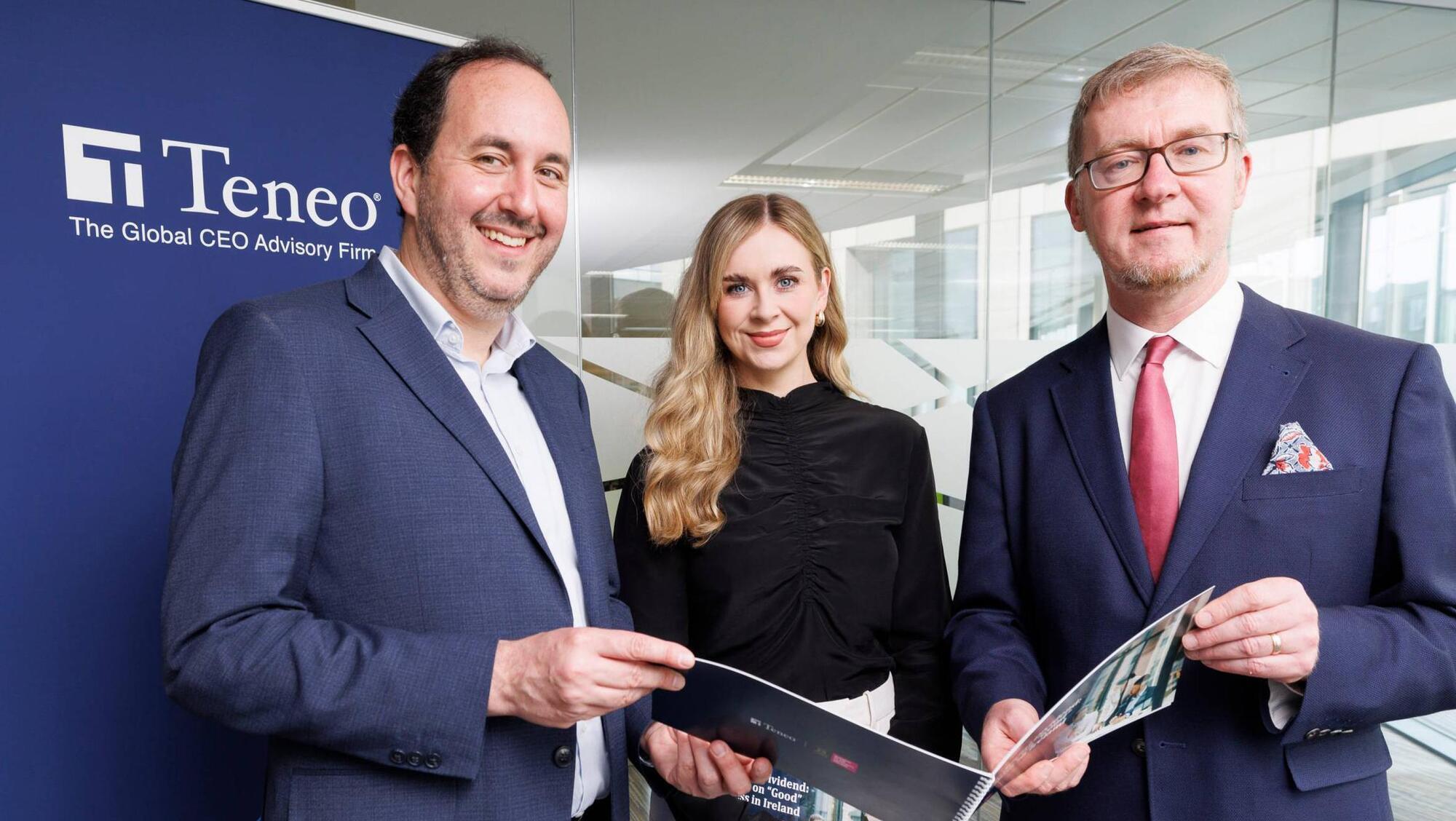
Tomás Sercovich, CEO of Business in the Community Ireland, a partner with Teneo in this research project; Orlaith Shinnick, director, strategy and communications at Teneo, Alan Tyrrell, senior managing director, strategy and communications at Teneo.

Engaging with social inclusion not only enhances reputation and helps community relations, it also helps businesses to win new customers and to retain and attract the best employees.

These are some of the key findings of ‘The Social Dividend, A Report on “Good” Business in Ireland’, newly published by PR and advisory firm Teneo and Business in the Community Ireland (bitc.ie), the sustainability and social inclusion organisation.

The report was authored by Alan Tyrrell and Orlaith Shinnick of Teneo with Tomás Sercovich and Linda O’Sullivan of bitc.ie. The 25 C-suite survey respondents ranged from Allianz, Bord na Mona and Calor to Heineken, Just Eat and RSA.

The report’s authors conclude that while social Impact remains a topic of heated debate globally, many businesses insist that social impact is not an optional extra that can be chopped and dropped.

In terms of the business benefits from social impact strategies, the executives cite reputational gains (84%), community relations (65%), satisfying compliance (57%), retaining best employees (48%), winning customers (46%), helping government relations (43%) and attracting best employees (43%).

However, while 18% of respondents have fully embedded social impact strategy into the core of their business operations, 33% have no plan or strategy in place for their social impact work, indicating an ad-hoc approach at best.

In the Q&A interview below, Alan Tyrrell, senior managing director with Teneo Ireland, explains how social impact drives competitive advantage, builds stakeholder trust, strengthens business resilience and creates value.

How does setting clear, quantifiable key performance indicators improve an employer’s overall
social impact?

Measurement is vital for social impact and comes in two strands. Firstly, there is calibration of social impact goals with business goals. The interviewees for our research made it clear that their companies demonstrate a strong commitment to measuring progress in real time. They establish clear, quantifiable KPIs on social impact — tracking volunteer hours, benchmarking employee engagement, monitoring community engagement and assessing the direct impact on the social issue being addressed. Additionally, they track the business benefits that result from these efforts.

Targets are fine to strive for, but the second strand of measurement is validation of the outcome. The true power of an effective social strategy lies in its ability to generate measurable benefits for both business and society. The leaders we spoke with are clear that ongoing validation of the impact of their social strategy is vital. Companies that really embed social impact test and report the outcomes with the same rigor as they do for sales, operations, margin, employee turnover, input costs and all other elements of their business model.

By setting clear, quantifiable KPIs and leveraging data-driven insights, these companies continuously refine their approach, ensuring that every initiative not only makes an internal impact but also builds credibility with external stakeholders — amplifying both business and social impact.

What do the most impactful CEOs and HR leaders do differently in the way they balance perceptions of benefits versus challenges with ESG?

To balance the benefits versus the challenges, leaders who succeed with social impact simply approach it like every other business decision. They look for a business case, they seek a return on investment, and they lead from the top to embed it throughout the organisation.

The deep integration of social impact permeates every layer of the business — from frontline to the board. In the boardrooms of the companies we spoke with, social impact (whether as part of the combined ESG actions or distinctly as the “S” in ESG) is a regular agenda item, discussed alongside strategy, innovation, risk, governance, and financial performance.

This level of oversight holds leaders accountable and, in many cases, ensures they have “skin in the game” by embedding social impact measures into executive scorecards, performance reviews and remuneration structures. Many leaders highlighted the interest among board members in being actively engaged in social impact work rather than simply seeing it in the board pack.

Can you expand on how leaders who ‘communicate with authenticity’ inspire their teams to see social impact as a business strategy and not as a feelgood initiative?

Leaders who communicate with authenticity on social impact communicate it as a business outcome, not simply a ‘nice thing to do’. And they follow three key principles. First, build trust and ensure stakeholders — be it employees, customers, shareholders, or the wider community, know your rationale, focus and desired outcomes for both social impact and business impact. Second, work only on programmes where you can deliver a clear social impact but also ideally generating a distinct competitive edge. And finally, candidly share the real-world benefits of the initiatives you undertake, highlighting the positive effect, any mistakes, what you learned and your ongoing commitment. By deploying an honest and authentic narrative, businesses can dispel concerns of virtue signaling and instead reinforce a credible, long-term commitment to making a difference.

Meanwhile, Tomás Sercovich, CEO of Business in the Community Ireland, who celebrate 25 years in business this year, said: “Over the past 25 years, we have seen a clear evolution in the importance and role of social impact in business strategy. Today, social impact is aligned to business metrics and objectives that drive innovation while simultaneously addressing societal needs and expectations.

“Businesses that model this behaviour are much needed if we want to tackle societal inequalities and ensure no-one is left behind in the climate transition. Businesses are powerful agents of change, and this report shows the key success factors of social impact that make a difference for individual companies and wider society.”

The Social Dividend: A Report on “Good” Business in Ireland | Teneo

x

More in this section

The Business Hub

Newsletter

News and analysis on business, money and jobs from Munster and beyond by our expert team of business writers.

Cookie Policy Privacy Policy Brand Safety FAQ Help Contact Us Terms and Conditions

© Examiner Echo Group Limited