Boeing’s pain spreads to customers as airlines cut back
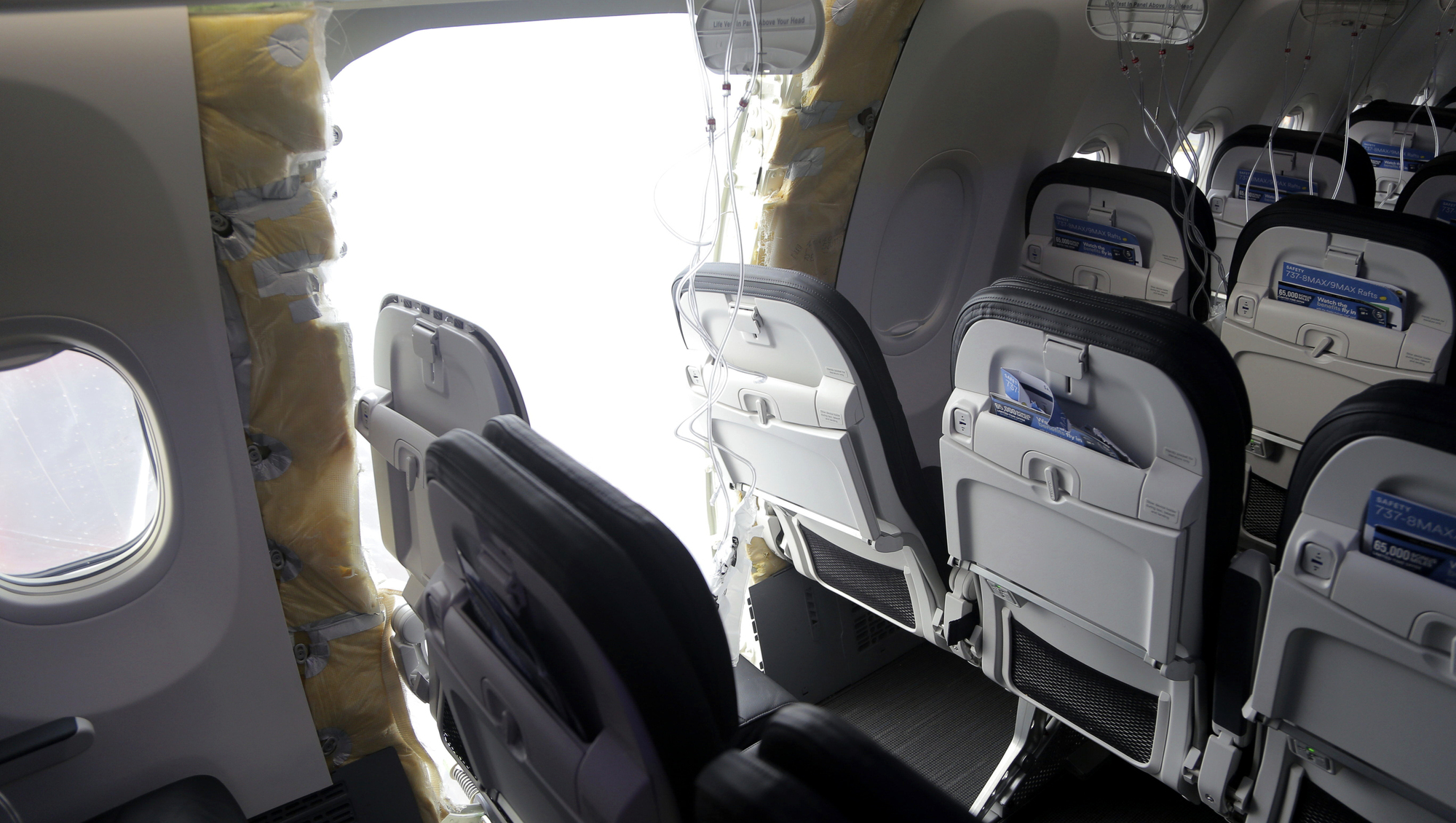
United Airlines, Southwest Airlines, and Ryanair are among the companies scrambling as Boeing focuses on fixing quality lapses exposed by the January 5 accident on an Alaska Airlines flight. Picture: National Transportation Safety Board via AP
Boeing’s disastrous start to 2024 is spilling over to airlines and their passengers, as production delays at the US planemaker exacerbate an already nascent shortage of single-aisle jets that form the backbone of commercial air travel.
United Airlines, Southwest Airlines, and Ryanair are among the companies scrambling to respond to reduced deliveries from Boeing, as the planemaker focuses on fixing quality lapses exposed by the January 5 accident on an Alaska Airlines flight.
With the busy summer travel season in view, carriers say they’re trimming schedules and looking for alternatives to 737s they’ve already ordered, while also contending with issues afflicting narrowbodies from Airbus.
Even Boeing seems uncertain when the planes will be ready, as an army of US inspectors sift through its factories, meaning the company can’t make any firm predictions when things might return to normal.
“All they’re saying is as you’d expect: ‘We are working as hard as we can. We are sorry for your disruption. We’re doing the best we can,’” the chief executive of aircraft leasing company Air Lease, John Plueger, said.
Airbus, Boeing’s main competitor, is largely sold out through the end of this decade, so there isn’t an obvious place for airlines to turn. Like Boeing, the European planemaker has been struggling to raise production back to pre-pandemic rates.
Boeing said in a comment that the company is “squarely focused on implementing changes to strengthen quality across our production system and taking the necessary time to deliver high quality airplanes that meet all regulatory requirements".
"We continue to stay in close contact with our valued customers about these issues and our actions to address them," the company added.
“This is not just a this-year problem. This has been a multi-year issue,” Steven Townend, who heads aircraft lessor BOC Aviation, said. “It is going to take several years to really catch back up again.”
For passengers, this will mean fewer flight options and potentially higher prices on at least some popular routes. The shortages chiefly affect single-aisle workhorses, like the Boeing 737 and Airbus A320-family jets that fly short to midrange distances and make up the bulk of the global fleet.
As a result, domestic and regional flights are seeing more of an impact than longer-distance journeys.
The agency projects business-class fares will rise as much as 8.5% on the busy coast-to-coast route during the peak summer season.
Between Seattle and San Francisco, prices in both business and economy are forecast to surge as much as 18% during the first half of the year, according to Amex, while fares between Chicago and Las Vegas may rise by 9.6%.
The broader outlook for ticket prices is less definitive. US fares skyrocketed in 2022 and early 2023, when travellers stormed back to the skies, but then fell back through most of last year as domestic demand weakened.
“You’ll see less flights and more full aircraft” during summer, Mr Plueger said. “It will probably mean higher fares.”
There is some good news for the flying public. Hopper, which tracks pricing trends, doesn’t expect summer fares to rise significantly above where they were in 2019 — the last normal travel year before the pandemic.
In Europe, Ryanair has said it will be short 17 Boeing jets that it had anticipated before the end of June. That will result in a slimmer summer schedule and 5m fewer passengers this year. The carrier plans to raise prices by up to 10% and cut back on services from Dublin, Milan, and Warsaw.
Boeing chief financial officer Brian West is expected to share an update in a March 20 presentation on the planemaker’s work to boost its quality controls and the effect on factory output.
- Bloomberg