AIB operating profit rises to €1.2bn at half way stage
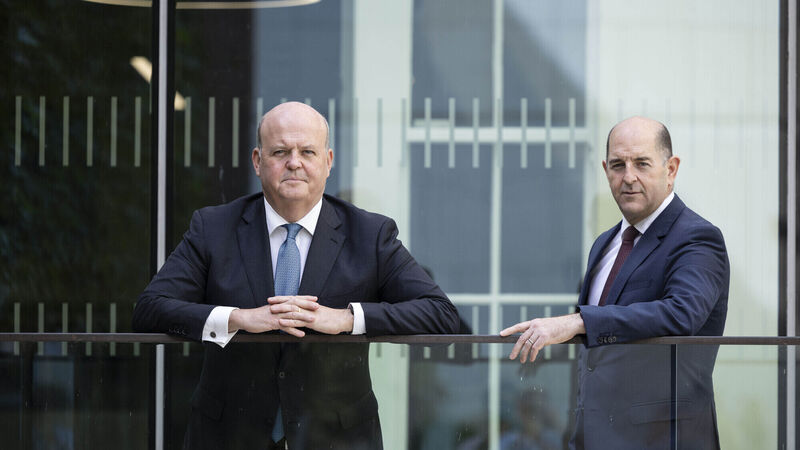
AIB Chief Executive Officer Colin Hunt and Chief Financial Officer Donal Galvin at AIB’s Molesworth Street headquarters as the Group announces its half year results. Picture by Shane O'Neill, Coalesce.
AIB posted an operating profit of more than €1.2bn for the first six months, as the bank looked forward to “a very good” outcome for the full year, helped by European Central Bank rate hikes and the departure of rivals Ulster Bank and KBC Bank from the market.
The bank is the first of the three remaining major lenders to report financial results at the half-way stage.
Net interest income surged to €1.77bn by the end of June, up from €895m a year earlier, and after-tax profits rose to €854m, the lender said.
In the earnings statement, AIB chief executive Colin Hunt said the bank had “delivered a strong financial and operational performance” helped by acquiring new customers “against the backdrop of an evolving banking market, a higher interest rate environment, and a resilient Irish economy”.
“2023 is expected to be a very strong year,” the bank said.
Rate hikes by the European Central Bank have lifted the fortunes of all the Irish banks.
And shrinking competition has also helped bolster AIB's share for new mortgage loans, which now stands at 30.7% AIB acquired mortgage and commercial loans from Ulster Bank, while Bank of Ireland and Permanent TSB also tapped billions of loans from the exit of the once fiercely competitive rivals.
Irish bank shares have been boosted hugely ever since the European Central Bank started hiking interest rates last July. The shares have been further driven by the lenders tightening their grip over mortgage and business lending in the Republic.
Ahead of Friday’s earnings statement, shares in AIB had risen 11% since the start of the year, and had surged by an enormous 88% from a year ago. That values the lender at more than €10.5bn on stock markets.
Analysts have raised questions about whether Irish bank shares can continue to rise strongly should the European Central Bank start cutting interest rate next year.
However, a rate hike by the European Central Bank yesterday, and a potential further rate increase when it next meets in September, will likely underpin the strong financial performances by the banks here.
The Government, which still has a minority stake of just under 47% in AIB, looks set to sell off its remaining shareholding in time.
“In a changed operating environment, out strategy has positioned us well for the future,” AIB said in the statement.
"2023 is expected to be a very strong year and, with a transformed group, we are now planning for the next strategic cycle,” the lender said.
Revised forecasts for it to generate over €3.6bn in net interest income for the full year are based on the European Central Bank’s deposit rate reaching 3.75%, and for a Bank of England rate of 5.5%, by the end of December.
The lender said it posted a net impairment charge of €91m at the half-year stage, which it attributed mostly to commercial property loans, “to address the potential adverse impacts from higher interest rates and lower valuations” in the sector.


CONNECT WITH US TODAY



Be the first to know the latest news and updates