Companies building strategies that align for people, planet and profitability
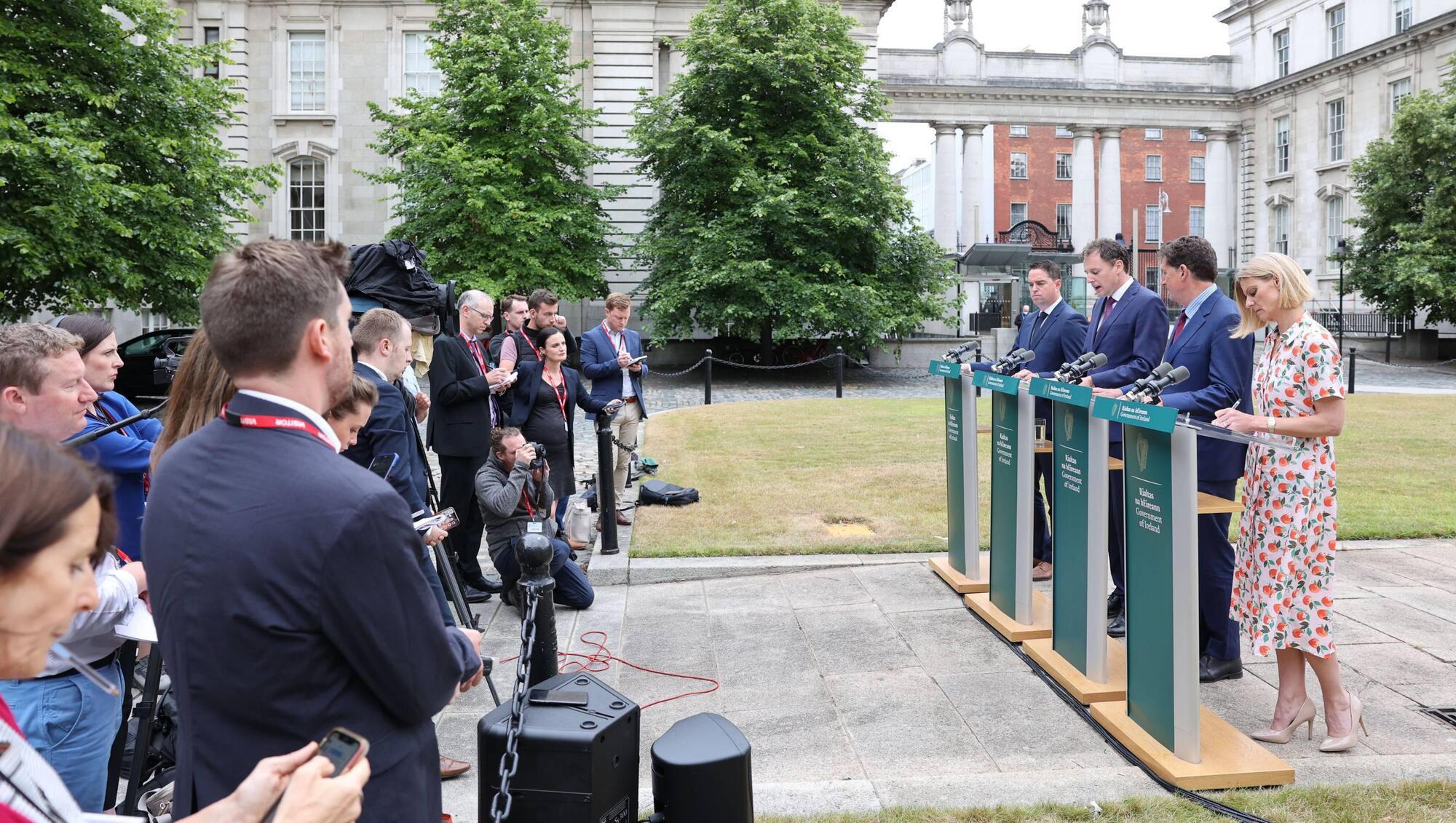
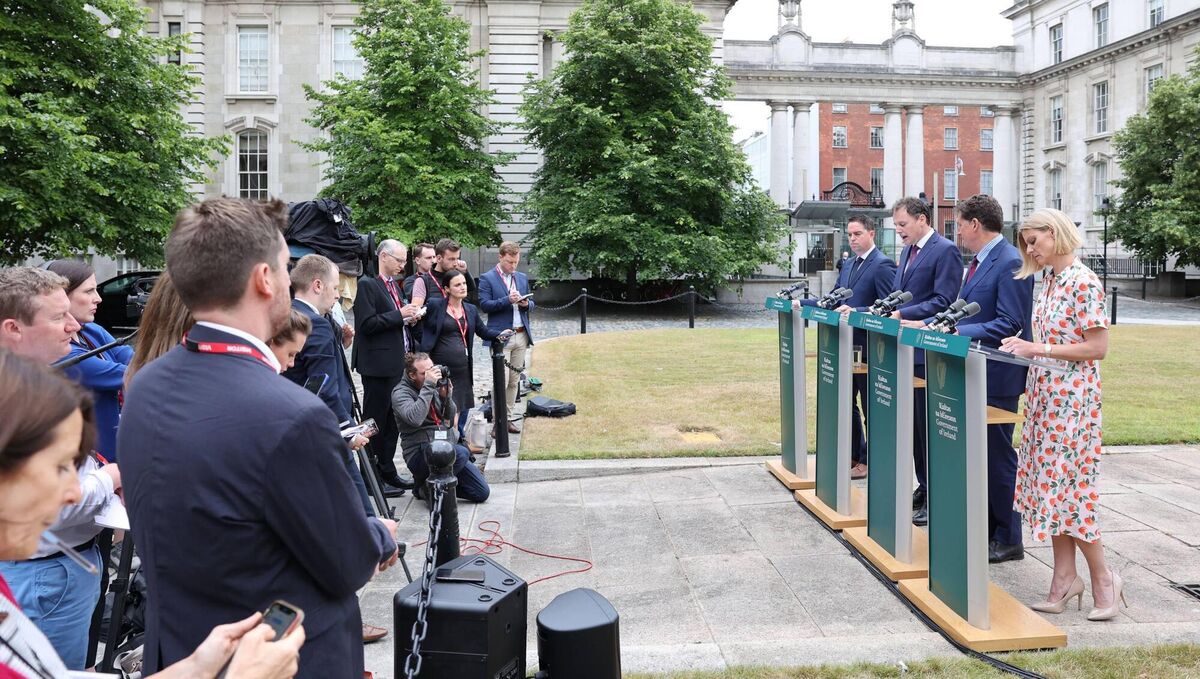
Ministers Martin Heydon, Charlie McConalogue, Eamon Ryan and Pippa Hackett in Government Buildings announcing Sectoral Emissions Ceilings, Ireland’s sector-focused plan to tackle climate change.
Businesses in Ireland have developed very innovative strategies that are successfully bringing their commitments to people and to global sustainability in line with their own profitability goals.
The same join-up thinking is evident at national level. For example, the government has reached agreement on Sectoral Emissions Ceilings, ensuring Ireland will play a leading role in combatting climate change.
The Emissions Ceilings set maximum limits on greenhouse gas emissions for each sector of the economy to the end of the decade, bringing cleaner air, warmer homes, and a better quality of life, with every sector playing its part.
The ceilings have been set for the electricity, transport, buildings, industry and agriculture sectors, involving a major transformation for all parts of society.
“We’ve seen this summer how temperatures across Europe have soared and tens of thousands of people have been evacuated because of wildfires,” said Minister for the Environment, Climate and Communications, Eamon Ryan.
“The planet is clearly heating up rapidly and we need to take action quickly. By setting these targets, across six critical sectors of our economy, Ireland is stepping up to the plate in reducing our impact on an increasingly fragile planet.”
Pointing out that the targets are going to be challenging for all sectors, the Minister added they are also fair, appropriate and based on what is achievable.
“We have also agreed additional resources and commitments to scale up and speed up our progress on solar, off-shore wind, anaerobic digestion for nature, and agro-forestry. This is not just the right thing to do for our environment and our planet; this is also the smart thing to do for our economy, and to protect ourselves against the high cost of fossil fuels.”
A new report by UCC Sustainable Futures says that only 10% of Irish businesses consider themselves to be truly sustainable.
In addition, just 22% of Irish businesses have committed to a net zero target, despite the Irish government aim for the country to become carbon neutral by 2050.
The report was commissioned by Microsoft Ireland to understand the level of business preparedness for a sustainable, net-zero future. Given that business will play an important role in the sustainability transformation, with their actions impacting on efforts to mitigate climate change, research from the report shows that while some organisations are already starting to embrace the transition, the majority have not yet done so.
Based on the findings of the report, there is significantly more that Irish businesses can do to work towards sustainability goals, starting with defining a sustainability strategy with firm net zero commitments.
Targets should be measured and monitored, with organisations needing an increased awareness of the new sustainability reporting obligations which will come into effect in the coming years.
The Corporate Sustainability Reporting Directive (CSRD) will require larger Irish businesses to publicly disclose information on their climate and environmental impact from January 1, 2024.
This new directive will impact around 50,000 European companies, with the aim of providing consumers and investors with more transparency on the sustainability practices of companies.
In order to direct money towards more environmentally-friendly organisations and activities, investors need to have this information to enable them to make informed decisions. The CSRD was established due to a need to review the existing rules introduced by the Non-Financial Reporting Directive, which came into effect in 2018.
Since its implementation, there has been evidence that the kinds of information that companies were reporting was not sufficient, at times omitting information that stakeholders and investors found to be important. Under the proposal, one of the factors that companies will need to report on is their ‘Scope 3’ emissions — these are indirect emissions that occur both upstream and downstream, including business travel, transportation and distribution of goods, waste disposal, and investments.
The CSRD lays out regulations stating that companies would need to report their reports in a format that matches with the European Single Electronic Format (ESEF), allowing for information to be presented in a standardised way which is more easily accessible and comparable across organisations.
While the CSRD will impact on thousands of companies, it will not place any new reporting requirements on small companies. SMEs with securities listed on regulated markets would need to comply, but with standards that are simplified compared to those used for larger organisations.
Another finding of the Sustainable Transformation report was around the use of digital technologies in a sustainability context.
At the moment, a third of Irish businesses say they have not yet made use of digital technologies to help transform their sustainability efforts; another third say that they are in the early stages of doing so; while a fifth say they are making progress.
Only 2%, however, consider themselves “an exemplar of best practice.” Irish business can harness digital technologies to reduce their carbon emissions, support biodiversity and ecosystem regeneration, increase energy or fuel efficiency, make supply chains transparent and sustainable, minimise waste and promote the circular economy.
The use of digital technologies presents a significant opportunity for businesses to work towards a net zero, and a positive future. These technologies can be leveraged to manage, monitor and track progress towards the business's sustainability goals and efforts.
The Irish Management Institute (IMI) is working closely with UCC (University College Cork) and is collaborating with industry to develop a leadership programme unlike any other currently on offer in the market.
“The focus of this consortia, team-based programme is to bring a peer network of senior leaders together to create a movement in sustainability that will accelerate the transformational change needed both to deliver on net zero targets and to build viable businesses and organisations into the future,” says Julie Ryan, Head of Customised Solutions, Irish Management Institute.
With over 25 years’ experience working with organisations on their talent strategy, she continues to advise on all aspects of talent development. She has also directed several accredited masters level leadership programmes and is also herself an accredited executive coach.
“The Leadership in Sustainability programme is designed for organisations who understand that there is a paradigm shift underway in how business is done. It will bring together senior leaders who, directly or indirectly, have a sustainability mandate and who recognise that they need support to bring this mandate to life across their organisation.”
IMI held several focus groups to design the programme and a key finding was the need to involve all senior leaders in an organisation.
Julie Ryan added: “The Heads of Sustainability cannot effect change without the understanding and involvement of other senior leaders in the business and they need to see that a paradigm shift is required.”
This is a team-based, blended learning journey including face-to-face and virtual workshops delivered by leading practitioners and academics in the field of sustainability, with input from local and international contributors.
- Learn from and network with peers in other organisations and industries
- Deepen their understanding of how to put best in class sustainability practices into action
- Be better equipped to influence stakeholders and achieve the buy-in necessary to make transformational change possible
- Be fully informed of the mechanisms to record and report progress, and have frameworks and tools to draw on
- Leadership in Sustainability launches in February 2023 and runs over a period of five months.

CONNECT WITH US TODAY



Be the first to know the latest news and updates