The power to issue a presidential pardon is a loaded gun
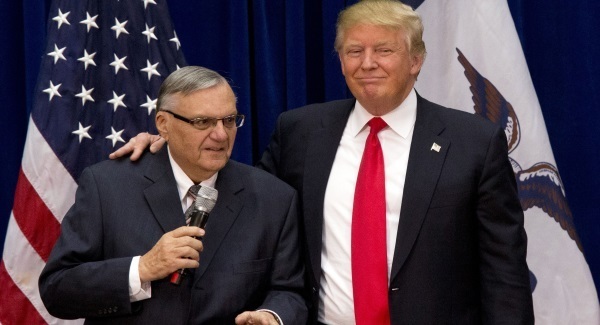
Joe Arpaio, the former sheriff of Maricopa County, Arizona, who was convicted of contempt of court for defying a federal judgeâs order to stop racially profiling and arbitrarily detaining Latinos in the name of catching illegal immigrants, is no stranger to controversy.
But it is US president Donald Trumpâs recent pardon of Arpaio that is spurring heated debate, as it raises fundamental questions about the presidential pardon power that has been a part of US policymaking from the countryâs birth.
In a monarchy, a king may have the power to forgive citizensâ crimes virtually without limit. In the US Constitution â Article II, Section 2 â Americaâs founders gave a similar power to the president, but with two key limitations.
One is rooted in separation of powers: It could not be used in cases of impeachment, an issue that is handled by Congress. The other is rooted in federalism: It could be used only for crimes âagainst the United Statesâ, or federal crimes, not crimes prosecuted by one of the 50 US states.
The granting of the pardon power reflected concerns among the constitutionâs framers the criminal code would be applied in a draconian manner, producing a surfeit of punishment.
As Alexander Hamilton put it in Federalist 74: âThe criminal code of every country partakes so much of necessary severity, that without an easy access to exceptions in favor of
unfortunate guilt, justice would wear a countenance too sanguinary and cruel.â
The power to pardon, Hamilton said, ought to be exercised by one person, because a single person âwould be most ready to attend to the force of those motives which might plead for the mitigation of the rigor of the law.â
What the founders do not address is what happens when that one person has something other than justice on his mind.
During Arpaioâs 24 years as the sheriff of a jurisdiction that includes the rapidly growing city of Phoenix, he built his reputation on his departmentâs aggressive efforts to track down
undocumented immigrants â and on the brutal conditions he established in the facilities where they were held.
Arpaio was directly responsible for detaining thousands of people without any reasonable suspicion that they had violated immigration law. It was enough that they looked Latino. That behaviour made Arpaio the subject of lawsuits that, from 1993 to 2015, cost $142m (âŹ118m) to settle.
Trump and Arpaio are longtime allies. During Barack Obamaâs presidency, both were prominent figures in the racist âbirtherâ movement that insisted Obama was born outside the US, and therefore was not entitled to be president.
During Trumpâs presidential campaign, Arpaio was a poster child of the divisive immigration debate and a vocal supporter of the candidateâs extreme promises, including the construction of a wall on the border with Mexico.
Against this background, Trumpâs pardon of Arpaio looks like sheer political opportunism. It certainly was not a moral act of clemency. After all, Arpaioâs conduct hardly qualifies as âunfortunate guiltâ.
He reveled in his law-breaking, has shown no remorse for it, and has never signalled an understanding of the grace of mercy. And, given that he was not to be sentenced until October, one cannot argue that he faced draconian punishment (a key concern for Americaâs founders).
The US Constitutionâs framers envisioned another key purpose for the pardon power: To help end conflicts and reconcile with political foes.
In Hamiltonâs words, âthere are often critical moments when a well-timed offer of pardon to the insurgents or rebels may restore the tranquility of the commonwealthâ.
In 1863, Abraham Lincoln issued full pardons for Confederates â with the exception of their leaders and subject to conditions âhe may deem expedient for the public welfareâ â in order to help reunite the country after the Civil War.
Even Gerald Fordâs 1974 pardon of Richard Nixon, who resigned as president over the Watergate scandal, was couched in terms of national healing.
Recalling the ways in which the pardon power has been used in the past highlights the perversity of the Arpaio affair and its singular reactionary purpose: to denigrate and, where possible, reverse Obamaâs achievements and, indeed, his values.
In Trumpâs hands, a constitutional power intended to mitigate the ânecessary severityâ of criminal justice was deployed to sanction cruelty by a sworn officer of the law.
Unsurprisingly, given its purely ideological basis, Arpaioâs pardon was not reviewed in advance by the US Department of Justice, as has become customary over the years.
Indeed, the department rushed to distance itself from the decision, highlighting how easily Trump can use (or not use) the pardon power to settle his many scores: It is virtually the only power within the criminal justice system that the president can exercise unilaterally.
To be sure, Trumpâs pardon of Arpaio has not created a legal basis for impunity; the pardon powerâs constitutional limitations prevent that.
But a serious problem will arise if Trump attempts to use it to protect his family â not a farfetched scenario, given pending FBI investigations into his inner circleâs dealings with Russia.
Such a move would be met with a potential legal challenge, based on the impeachment clause or other constitutional limits.
The pardon power is like a loaded gun. In the hands of a leader who possesses wisdom and good character, it can strengthen the rule of law. But, in the hands of an unstable, vengeful narcissist, it can cause profound damage.
Ruti Teitel is professor of comparative law at New York Law School and the author of a forthcoming book about Barack Obamaâs legacy for global transitional justice.