An FF/FG deal document is next step on long road
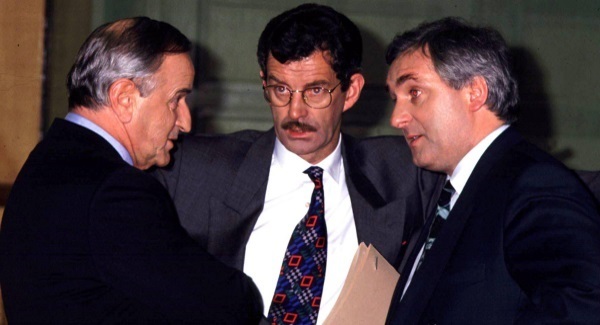
Bertie Ahern realised talks on forming a new government were not going well. 

An FF/FG deal document is next step on long road

He decided Fianna Fáil had to make a move to break the deadlock. The political situation was fraught, the results of the election were inconclusive and the parties were finding it hard to reach agreement. It was 1992, and Albert Reynolds, then Fianna Fáil leader, had been through a very difficult election. Fianna Fáil had lost nine seats and the party had returned to the Dáil with only 68 TDs — the lowest number for Fianna Fáil since 1954.

Though Albert Reynolds won more seats in the 1992 election than Micheál Martin has managed to win in the 2011 and 2016 general elections combined, Albert has been depicted as an electoral disaster.

After the 1992 election, Reynolds’s chances of returning to the taoiseach’s office seemed slim. Most commentators argued, given Fianna Fáil’s seat losses, that Reynolds had been decisively rejected by the electorate. Looking back on the scale of Reynolds’ defeat almost a quarter of a century ago, it is far less seismic than the scale of the seat loss Fine Gael is experiencing today. Enda Kenny’s party has lost almost three times as many seats as Albert Reynolds did in 1992.

The 1992 election was a political low point for Albert Reynolds. During the campaign, one journalist actually labelled him “the stumblebum taoiseach”. In a particularly poor interview, Reynolds had spoken of his desire to “dehumanise” the social welfare system and he also name-checked the leader of Fine Gael as “John Unionist”, without trying to be ironic.

Reynolds’s campaign gaffes are now largely forgotten, but Enda Kenny’s use of the word “whingers” in this campaign and his suggestion that ordinary people don’t understand “economic jargon” are likely to grate for a long time with many failed Fine Gael candidates.

With a little help from his friends, and because he got a lucky break, Albert Reynolds survived. So too may Mr Kenny.

When the 27th Dáil convened on December 14, 1992, TDs were unable to elect a taoiseach and the expected Fine Gael-Labour coalition failed to materialise. Fine Gael and Labour were more evenly matched in seat terms than ever before, but John Bruton was adamant there would be no rotating taoiseach — a concept that has again raised its improbable head in recent days. Bruton was also reluctant to accept Democratic Left into government and favoured instead a Fine Gael-Labour-Progressive Democrats arrangement. On the back of Labour’s then best-ever result, Dick Spring was in no mood to be pushed around.

The inability of Fine Gael and Labour to conclude a deal left a chink of light for Fianna Fáil. Bertie Ahern was quick to exploit this unexpected opportunity. On an instinct that the Fine Gael and Labour talks were not going well, Ahern and Martin Mansergh, a key party strategist, had produced a detailed policy discussion paper based on overlaps between the respective Fianna Fáil and Labour manifestos and the existing social partnership programme.

When this document was passed to Dick Spring, he was impressed by the strong synergies between the priorities of both parties. Labour opened negotiations with Fianna Fáil and ultimately, on January 12, 1993, Albert Reynolds, was re-elected taoiseach.

The lessons of this political saga won’t be lost on today’s politicians or backroom officials. It is very likely that right now, sitting under lock and key in the top drawer of at least one of the top policy wonks in Fine Gael or Fianna Fáil, there is a document which has begun the process of merging the manifestos of both parties into a single, coherent programme for government. The parties may not yet have commenced formal discussions or even off-the-record contacts, but the ground is already being prepared.

The never-coalesce-with-each-other mantras that we heard from Mr Kenny and Mr Martin during the election are already being deliberately diluted. Both leaders are now making calculated noises about everyone’s responsibility to form a government and about business being done in a new way. The shifting sands can also be detected from the debate about water charges being a potential block to a Fine Gael-Fianna Fáil government. This is a sure sign that the political ground is gradually but inexorably moving forward from a point where coalition was out of the question, to a new space where the political priorities of a Fine Gael-Fianna Fáil government can be explored.

The movement towards a Fianna Fáil and Fine Gael arrangement will be incrementally slow. Under its new rules, Fianna Fáil will have to get the approval of its membership at a special ard fheis before it can enter any such coalition. In the immediate afterglow of a successful election, where the party has more than doubled its seat numbers, Fianna Fáil activists might be tempted to reject overtures from their historic rivals in Fine Gael, especially because such an alliance would let Sinn Féin lead the opposition.

However, it is not where opinion stands now that is crucial, but the direction it may travel after the 32nd Dáil convenes for the first time next Thursday.

From next Thursday evening on, political discourse will increasingly be dominated by language that speaks eloquently of the need for stability; the need for the country to have a government; and the need to put the national interest above tribal party loyalties.

At some point thereafter, expect the document cataloguing the synergies between Fine Gael and Fianna Fáil to make an appearance from some bright party apparatchik’s drawer.

On the day the election was called, Enda Kenny told Joan Burton “this is not goodbye,” but a parting is now inevitable, especially if Fine Gael moves towards Fianna Fáil.

Dr Brian Murphy lectures in communications at the Dublin Institute of Technology.

More in this section

The Business Hub

Newsletter

News and analysis on business, money and jobs from Munster and beyond by our expert team of business writers.

Cookie Policy Privacy Policy Brand Safety FAQ Help Contact Us Terms and Conditions

© Examiner Echo Group Limited