Michael Clifford: Bringing in change just for the sake of it
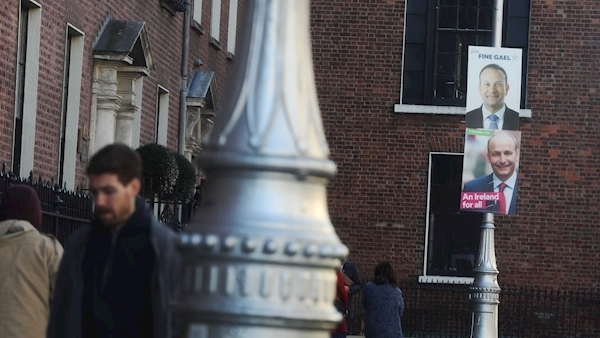
A little vignette demonstrates the difference between Fianna Fáil and Fine Gael, something that we are told is central to choices in this general election.
Last November, Michael Martin accused Fine Gael of having an “ideological” problem with social housing. The issue arose over a proposed development in Montenotte, an affluent suburb on the north side of Cork.
Two Fine Gael councillors were vocally opposed to a €17m social housing project earmarked for the area.
“Fine Gael has a problem with council housing,” Mr Martin told 96FM. “They are ideologically, and their individual disposition is, against it. We built massive housing schemes in the 1930s and 1950s when we had far less money than we have today.
“It’s the milieu from which some of them come – they don’t understand it, they don’t get it. I’m not going to label people but it seems to me it’s a class thing.” So that’s it. Fine Gael look down their noses at social housing. The portrayal of some of their front line politicians as “Posh boys” explains the difference between them and their opponents in Fianna Fáil.
Except…well, last Monday there was a plan for another social housing development in front of Cork City Council. This one concerned a project for 16 houses on the Skehard Road, in the affluent southside suburb of Blackrock.
The proposal was passed by 17 votes to 11. Among the dissenters were the eight Fianna Fáil members on the council, along with two Fine Gaelers.
Four others from the latter party voted in favour. Was this a class thing? Was it ideological? Or were the Soldiers of Destiny merely acting in their own best interests in this instance, just as the Blueshirts were when they objected to social housing last November.
The difference in terms of substance between the two parties is paper-thin. Do you believe that if Fine Gael had been in the driving seat rather than Bertie Ahern and crew during the illusory Celtic Tiger years that things would have been much different?
Do you believe that if Fianna Fáil were running the show for the last nine years society would have emerged better from the crash?
Tomorrow both parties draw their support from much the same pool, one that has shrunk from around 80% of the electorate in the 1990s to somewhere between 50% and 55%.
This section of society is the one which is benefiting to the greatest degree in the current booming economy. It is also the section most likely to vote and from which the most powerful vested interests are drawn.
We are told that the difference between the two parties in this election is that the incumbent wants to continue to run the country as it has been doing and Fianna Fáil represents change. Really?
If there is a change of government the faces at the cabinet table will be different. Micheál Martin may be better at projecting empathy than Leo Varadkar.
A new cabinet could throw up somebody who still eats his dinner in the middle of the day. But there will be no real change.
Take the two big issues of the election, housing and health. Micheál’s claims that Leo is more wedded to the market model might carry some weight if Mr Martin himself hadn’t been in a cabinet that bent over backwards to allow developers to run the economy.
The biggest challenge in housing is supply. Is there any real reason to believe that one or other of these two parties would be more efficient in getting houses built? Is there any reason to believe that Fianna Fáil would be more willing to exert executive pressure on the property market to tackle soaring rents?
Radical change, which many believe is required at a time of growing inequality, would demand confrontation with sections of the electorate on which the big parties heavily rely. That won’t happen.
Most people find the level of homelessness an affront. Yet neither of the big parties – nor most of the small ones – are willing to implement a functioning property tax, a basic instrument of equity. Who wants change in that area?
Health is the other big election issue. There is a blueprint for providing an efficient and fair health system. It’s called Sláintecare and was formulated and agreed by an all-party committee. Everybody loves Sláintecare because it is designed to make healthcare available equally to all.
The considerable funding required has not been forthcoming. Would Fianna Fáil be more driven to find the money to change health?
Do those who vote for both parties, and, who, for the greater part, have health insurance, want the disruption that would ensue in the short-term? Would either party have the stomach to take on vested interests in the service?
The smaller parties do want considerable change but maybe that’s why they are the smaller and not the bigger parties. Sinn Féin would be willing to disrupt the section of society that is benefiting most in the current environment. The party does appear to have a housing policy that would prioritise social housing.
But would that survive the kind of opposition to social housing that has been evident in better-off areas?
The Shinners have learned to tone down their stance on radical change. For instance, Pearse Doherty told Morning Ireland on RTÉ during the week that the party is in favour of a third rate of income tax for those earning more than €140,000.
Once upon a time, they proposed such an increase on salaries over €100,000.
Is their current policy in this area now mere window dressing?
Labour is in a similar space. And then we have the Greens, which is pushing for the biggest change of all. Engaging with climate change is going to require a reduction in standards of living, certainly in the short term. This is the kind of change that you don’t mention in a general election.
One interesting feature of the election will be how far the Greens are willing to go to ask voters to face up to the reality of what is occurring.
The campaign offers drama, excitement, personalities. Some of those vying for power will stumble and others will shine. There is a case to be made that switching horses for the sake of it is healthy for democracy. But let’s not pretend that any of this is really about change.
The problems that currently exist – and there are many – will continue to do so when a new government is sworn in. A personality in executive office here or there may make a difference, but otherwise it will be as you were.
That’s the bad news. When you consider the kind of change being wreaked around the world through the rise of right-wing populism, maybe it could be a lot worse.

CONNECT WITH US TODAY



Be the first to know the latest news and updates