Children’s hospital overrun: Key ministers on thin line between being characterised as fools or knaves
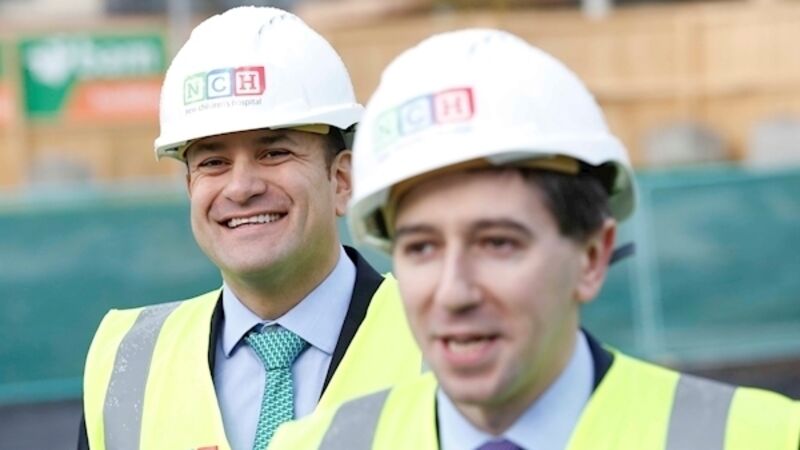
THE single issue arising for the Government from the nurses’ strike and the rolling debacle of the National Children’s Hospital is competence, writes
It’s the essential quality people look for in government. Fine Gael had it from 1995-1997. It lost it afterwards — spectacularly so in the 2002 general election. Compensating taxi drivers and Eircom shareholders, made Fianna Fáil’s promise of medical cards for over-70s look like fiscal prudence. In 2007 when voters dearly wished to be rid of Fianna Fáil, they balked in the final week of the campaign, because Enda Kenny couldn’t put the ball into the back of the net of an open goal.
It was only after Kenny’s mettle was truly tested in the internal party heave against him in 2010 that he became a taoiseach in waiting. The following March he was finally in office. In the four years between, an open goal had become the broad side of a barn; an unmissable object. It is true that unpopular or incompetent governments can buy their way back into office at an election. The problem for this one is that in Leo Varadkar’s ard fheis speech last November, he put his chips down on the table, and bet all on tax cuts. There is not a lot left to play with, and anyway, that game is called catch-up.
Staying ahead means the Government must keep intact its reputation for competence. The consequences of Brexit is one test. A special plea there will be that this was foisted on us. But the nurses and the National Children’s Hospital are another matter. They are homegrown, and there is no trace of Fianna Fáil in the ether this time. What Fine Gael now prides itself on — as Fianna Fáil once did — is that it can be trusted with the economy.
The economy is not an abstract subject. Its strength is means-tested through the filter of individual voters’ circumstances. Failure to understand that and measure it effectively was the reason for Fine Gael’s bloody nose at the last election, and Kenny’s subsequent departure. Varadkar is Taoiseach now for one reason only — which is to win seats back, and ensure his party is back in power.
The essential test for him is to balance the need for keeping enough people onside now, so that pressure on nurses builds up quicker than pressure on him. If nurses, as they claim, care about their patients he and his ministers must convincingly communicate care about all the people, not just nurses, and not just now. This strike is unquestionably going to get worse before it gets better. It is a test of nerve for the Government, and the Taoiseach particularly. Clearly, he is a man with many attributes, including some charisma, but he was mitching medical school the day they did bedside manners.
Fine Gael, contrary to talk of “holding the centre” beloved by Paschal Donohoe, governs on the largely correct premise that there is no housing or health crisis. There is a brouhaha about it all right. But the reality of crisis is limited to relatively small groups of people who are truly in dire straits and probably certainly beyond the pale for Fine Gael. Where health and housing become politically problematic is in two respects.
Firstly, it is the extent the party delivers for the aspirational class that is part of their natural bailiwick. The issue on housing isn’t homelessness, it is soaring rents and evaporating chances of a mortgage for young professionals who don’t have access to the bank of Mammy and Daddy. That is the pinch point politically. So forget about mass construction of social housing. Potential Fine Gael voters don’t aspire to that. This goes back all the way to the Land League. They represent people of property.
That’s precisely why present circumstances are potentially a deadly reputational threat for the Government and an actual political crisis as distinct from homelessness or people in pain on trolleys.
Secondly, the National Children’s Hospital, which has a long way to go as an issue, tells people that these guys aren’t so smart after all, and certainly not as smart as they think they are. That festering health issue makes it more difficult to outflank, and outrun, nurses. It is the synergy of the two issues, and the corrosive damage of both, that is the danger.
Giving in to nurses means abandonment of budgetary policy, such is the scale of the knock-on effect across the public sector. Coupled with the black hole opening up under the National Children’s Hospital, the effect of one alone is a major setback for investment and development in health. The two combined would mean us paying ever more, for an increasingly ineffective system. Existing health plans can then be binned with all the previous ones.
Damage limitation on the hospital issue must be executed in tandem with constriction of public support for nurses by a convincing articulation of genuine care that counters their hit and run on the public purse. All the while, Brexit looms. On the horizon, so do local and European elections on May 24.
In 2014, poor results for Fine Gael meant that after a different debacle in health, James Reilly lost his job as minister there soon afterwards. On Brexit, the course is fixed, and the bow of the boat is in the water. On health, it is unclear if there is capacity to do anything except pump water.
The plea by Paschal Donohoe that ministers should have known sooner about cost overruns at the National Children’s Hospital is an obvious truth and a deadly admission. Following on completely conflicting messages from the Taoiseach and Simon Harris about whether the PwC report could spear individuals with responsibility or not, two things are clear. Firstly a government, deeply invested at the centre in its political communications, fouled its own nest again. Secondly, the cast of personalities involved, and the theme of health, reprises the opening debacle of the CervicalCheck controversy. There was a rush out to the microphones, but a lot of circling back afterwards.
This is a government sitting on political capital, but surrounded by a series of interlinked issues that could squander it. This is the very first time that its ministers are completely alone between the crosshairs on a whole-of-government issue. The economic crash is effectively political history even if it is not yet entirely economic history.
There is the certainty of important elections on May 24, but complete uncertainty on electoral timelines after that. If the nurses win more than token gestures, the Government loses badly. They may still lose regardless, but that is another issue.
The overlay of the children’s hospital puts key ministers on the edge between being characterised as either fools or knaves. This is mission critical politically for Fine Gael in government. Charges of knavery can be overcome. But you never get over being classified as a public eejit.

CONNECT WITH US TODAY



Be the first to know the latest news and updates