A brutal drubbing that was conceived in Dublin
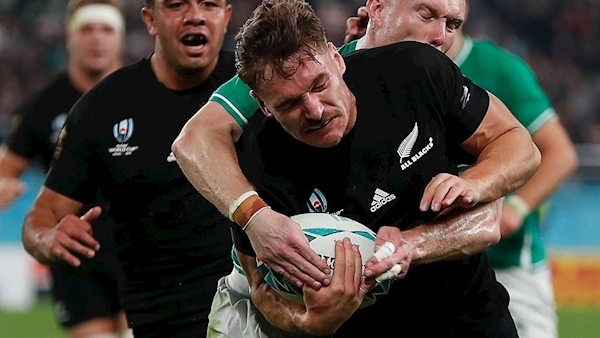
It’s unlikely to bring any comfort to Ireland that they brought the full wrath of the All Blacks upon themselves in Tokyo.
With the good old magic of hindsight, maybe Ireland shouldn’t have poked the bear as hard as they did last November.
Maybe winning in Dublin was a mistake — a wonderful little moment in time that allowed a second notch to be scratched in the bedpost of history as it were — but it also had an unexpected consequence of derailing Ireland’s other mission of winning a World Cup knockout game.
Obviously, losing to Japan was a major contributing factor to Ireland’s sad history of never making the World Cup semi-finals being preserved, but really, all roads to their failure in Tokyo lead back to Dublin 11 months ago and the effect that 16-9 victory had on the All Blacks.
The All Blacks aren’t great losers, never have been. It’s a curious business for them whenever they do lose and strangely they could forget 99 victories yet remember one loss in intricate detail.
They aren’t the sorts for tantrums and sulking when they lose, though. They brood for a few days and then, as happened last year, they typically begin a deep-dive forensic analysis of where things went wrong.
It’s not an emotional process. It’s conducted with a sort of Terminator-like focus that falls exclusively on themselves as they try to work out what it is they have to improve.
What they learned after losing in Dublin is that they needed a fairly major re-think about the way they were attacking. They are, after all, a team whose entire game is built on their ability to manipulate and ultimately break defences.
The All Blacks don’t often win 9-3. There are only rare occasions when they have dropped a goal to win a test and throughout this World Cup cycle they have averaged 5.5 tries and 39 points per game.
So to fail to score a try in Dublin last year and manage just three penalties was the sort of statistical anomaly that was always going to induce detailed introspection by the All Blacks.
But it wasn’t just the score that troubled them. There was this sense that Ireland had come to own them.
Everywhere the All Blacks tried to run that day, Ireland seemed to already be there, waiting and ready.
Poor old Beauden Barrett felt like the Irish were just about sharing his jersey and there were endless scenes of All Blacks being smashed by a green wall, which would then stand over them and hammer home whose turf they were on.
Something wasn’t right. A lot wasn’t right and the All Blacks knew they had to almost rip things up and start again after that loss.
Which they did. There was no idea rejected. No egos protected. No reputations to be worried about.
They looked and they looked and they worked and they worked to find a system that would be good enough to attack their way through a rush defence as relentless as Ireland’s.
Ireland had set the standard on defence, and the All Blacks had to respond by putting the bar even higher with their attack. They had shown what could be achieved by going all in on defence so the All Blacks felt their only response was to go all in on attack.
It required a few tough calls and brave decisions for the All Blacks to make the right response to the Ireland defeat.
The first was that they had to be brave enough to ask Barrett — World Player of the Year in 2016 and 2017 and shortlisted in 2018 — to vacate his beloved No 10 jersey and accept a new role at full back.
Whether any other team in the world would have been prepared to go down this road is hard to say — but the All Blacks did, and when the shift came in July this year, for the Rugby Championship test against South Africa, it went down like this according to coach Steve Hansen.
“I didn’t ask his opinion. I know he can play full back and he knows it too. I said ‘you’re playing full back’ and he said ‘no worries’. That’s about how it went.”
They also had to be brave enough to select Ardie Savea at blindside. Brave because it compromised their lineout, and brave because it effectively required captain Kieran Read to pack down at blindside on scrums and play much closer to the ruck to allow Savea to roam free.
The biggest name players had to be willing to make major shifts to achieve the goal, but they did without a moment of fuss.
Other big-name players such as Sonny Bill Williams, Rieko Ioane, and Ben Smith, had to be dropped to make way for the new breed of Anton Lienert-Brown, Jack Goodhue, Sevu Reece, and George Bridge.
Again, how many other teams would have been prepared to make those big calls? But the All Blacks did, because they were certain that injecting this new breed of fearless youngster was the only way they could build the attack game they would need to be successful in Japan.
And then, of course, they had to have the detail: the actual means to piece everything together to make sure they were playing into space and not being hammered by the defence.
So attack coach Ian Foster locked himself in a bunker and came up with the solutions. They would play further behind the gainline. They would work their blindside wing into the game more.
They would use Aaron Smith’s precision passing at first-five off lineouts and have Richie Mo’unga looping round — almost à la Jonny Sexton — to create an extra man.
We saw all this in Tokyo and a team that could barely make a linebreak in Dublin scored seven tries and bombed a couple more.
“Our attack has gone to a new level and he [Ian Foster] is coaching the best I’ve seen,” Hansen said after the 46-16 demolition of Ireland.It was a victory for the All Blacks achieved in Tokyo, but very much conceived in Dublin.
The All Blacks victory was achieved in Tokyo — but very much conceived in Dublin.

CONNECT WITH US TODAY



Be the first to know the latest news and updates