‘They’re a really special group. You’d bring your kids to watch them play’
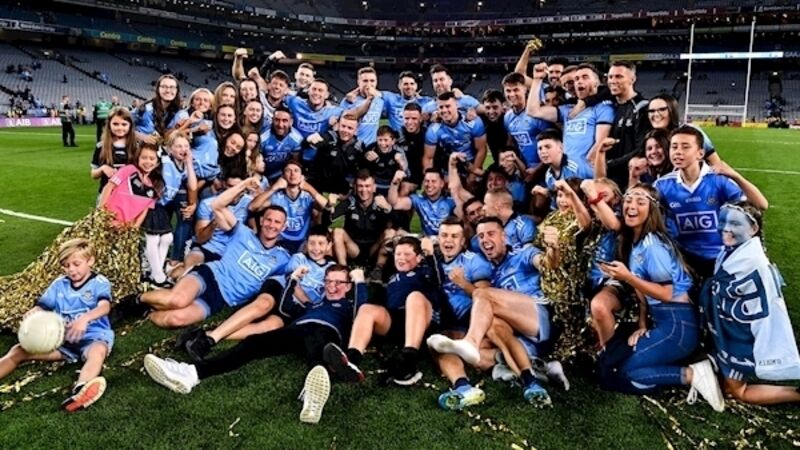
Appreciating the human condition has been at the very core of what has made this Dublin group as special as it is. In a frank interview, selector Declan Darcy, who has coached alongside Jim Gavin since 2003, gives an insight into how the panel’s bond has helped with grief, his five-in-a-row fears and the return of Diarmuid Connolly.

‘They’re a really special group. You’d bring your kids to watch them play’

Appreciating the human condition has been at the very core of what has made this Dublin group as special as it is. In a frank interview, selector Declan Darcy, who has coached alongside Jim Gavin since 2003, gives an insight into how the panel’s bond has helped with grief, his five-in-a-row fears and the return of Diarmuid Connolly.

Appreciating the human condition has been at the very core of what has made this Dublin group as special as it is. In a frank interview, selector Declan Darcy, who has coached alongside Jim Gavin since 2003, gives an insight into how the panel’s bond has helped with grief, his five-in-a-row fears, and the return of Diarmuid Connolly.


Question: Will the significance of this All-Ireland title take longer to sink in than the previous ones?

Declan Darcy: “There is a sense of occasion about this alright. The reaction of people afterwards solidified that. At the minute, it is a bit surreal. After the match, it definitely felt a bit more significant than any of the rest we achieved. At the same time, it is kind of surreal at the minute…”

Q: It felt different seeing Stephen Cluxton taking part in the celebrations and the team management (Gavin, Darcy, Jason Sherlock) going to Hill 16. We haven’t seen that before.

DD: “No, we would be very careful particularly after matches, how we would carry ourselves. Again, our context is all about the players but there was just something special that let people go a bit on Saturday.

"The supporters have been fantastic everywhere we go now, league matches, away matches and they deserve to be recognised. A lot of our families were in the crowd as well. Our clubs are really important to us because we could not function without them.

"I am in Clann na nGael and there is a whole clatter of people who support us. Everyone needs to be acknowledged on an occasion like that.”

Q: You mentioned before the drawn All-Ireland final that you found this season taxing. Did you feel the hand of history on Saturday?

DD: “Not particularly but the last day (drawn game), you wake up on an All-Ireland final morning and it just catches you and for some reason you can’t pull it back. It comes on top of you and it is a really special day. It kind of happened to me for the first one.

"I don’t know how a player would feel when you wake up that morning and then it hits him. It is quite difficult on the mind and I think a little bit of that happened to us on the first day.

In fairness to Kerry, they put it up to us as well. It was definitely a rollercoaster game, it wasn’t the usual form of a game and it produced certain scenarios we had not faced before.

Q: Did you have to speak to the panel about Diarmuid Connolly returning to the panel?

DD: “I think first and foremost the care of Diarmuid was really important for us. Things weren’t going really well for him probably outside of football and I think he needed football, he needed structure and whatever about whether he was to function within our group or not, to bring him back into the group was the right thing to do.

"He had soldiered long and hard for us and deserved that right to come back in. I think it was a really good thing for him. No matter whether we won an All-Ireland or not, I still think it would have been the right thing to do because we were looking after one of our own.

"He needs to be in our family because the lads are brilliant to look after him, and reach out to him, which is really, really important. It was very impressive to see it, when it operated, and how Diarmuid flourished in that environment, and that friendship being shared to him.

"Then the football side of it, he was in really good shape, and then the question for us was whether or not to play him given other guys were there all season.

It was difficult enough to balance that but he had produced good stuff in training so there was no indications as to why we wouldn’t play him.”

Q: If you had lost the drawn game, would you have been aware of a backlash about Diarmuid?

DD: “It was a big call because we were worried that it would crack the group, and obviously the connotations. If you were there, I am sure you would be thinking the same.

"We’d rather be looking at Diarmuid than not looking at him up in the stand. We were monitoring his fitness levels and they were very impressive, so all the indications were that he was in a really good position to go.

And again, even if we lost, I still think it was the right thing to do. He was one of our own and we were looking after one of our own. I think in the context of sport, the GAA is a really good powerful community within, right around the country at looking after their own.

Q: Did going for the five in a row have any influence in that decision to recall Diarmuid?

DD: “Not unduly. It wasn’t in our conversation all year. We were kind of in a state of mind to keep ahead of the pack because for us the pressure is getting beaten. Brian Fenton has never lost a match and for us, it was to keep that standard.

"Even when we go into league games, there is pressure to perform and to not get beaten, to keep driving on, to keep the Kerrys and the Mayos at arm’s reach. That’s really what it was. It was of no relevance to us that it was the chance of five in a row.”

Q: Does it feel like a weight has been lifted?

DD: “I haven’t reflected on it yet. It seems to be, you’d notice with the supporters and the way they responded to it at Croke Park, that there is now an acknowledgment to the team (in terms of recognition) that it took five years to get there.

"That these guys have probably now got what they should maybe have got after the three in a row. For some strange reason, there was a lot of other things thrown at this team, after the three in a row.

"Now it seems to be that people are going, ‘Yeah, I think these guys are good, they play really good football the last couple of years’. A lot of people are very proud of them. There is a sense of relief to get to the historic moment. No matter what happens from here on in, they’ll have that.”

Q: They’re getting their due recognition now?

DD: “And maybe the fact that Kerry, the competition, we were challenged in the final, made it a little bit different as well. Last year, people were kind of say we won it easy, but there was never any games that we won easily.

"The perception was there that we were so far ahead of everybody else. But it is unrealistic to think that.

"They were all saying, “Ah sure, Dublin is going to win”. But luckily the last two games have given everybody a bit of football back and that competitiveness and rivalry and last-minute stuff (proves Dublin resilence).

"We all nearly had heart attacks in the last five minutes of the last (drawn) game. Sometimes when you win like that, it makes it even nicer and special.”

Q: Do you have any inkling this may be the last game for Jim in charge of Dublin?

DD: “No, all I will say is that man has put in - and I know I am probably right beside him - but the work and preparation he puts in his phenomenal. I couldn’t put into words the drive and determination of him.

"You don’t get these things unless you work hard, that is the bottom line. You can have a certain amount of talent, but if you’re not putting in the hard yards, it’s not going to happen for you. In fairness to Jim, he leads that work ethic, he’s phenomenal.

"He just works, works, works and he’s very diligent. I think it has taken a lot out of him, so whether he has the energy to pursue it, I don’t know. There wasn’t any discussions among ourselves about the future. I think the whole context for us as a coaching group is ‘can we give something to this team, or can we add something to this team’.

"These players deserve the very best and people that have the full energy to drive on. That’s what they demand, and if you are getting a little tired maybe it’s time to go, but at the minute, there’s no conversations like that.”

Q: What about you?

DD: “I don’t know, I have an awful lot of stuff to balance in life. I have the U12 boys and two girls teams at U16 in Clann na Gael and I’m the U16 Dublin girls manager. It’s very hard, as I have a business to run.

"I love the GAA. I love the kids, they bring me right back down to earth; especially after days like (Saturday). This life balance piece, the lads are brilliant at.

"There’s a connection in the group that’s very powerful and the friendships are very strong, and that’s kind of underestimated a little bit as well. They are a very strong group.”

Q: You’ll give yourselves a few weeks to reflect?

DD: “Absolutely. That last two weeks was really tough for us as a management group because things didn’t go the way we would have liked.

"We took a chance on the first game and it didn’t pan out the way we wanted. When everything doesn’t come off, fingers are pointed and we point it at ourselves anyway. It was tough.”

Q: What chances did you take?

DD: “We didn’t play the sweeper in the first game, which is a bit of a risk against Kerry. Then the mismatch… well, I didn’t think it was a mismatch but (David) Clifford just duped Jonny (Cooper) a little bit for the frees and Jonny was a little bit over-emotive.

You have to say was it the right decision to put Jonny Cooper on Clifford. But we got an opportunity to put it right and we worked really hard in the last two weeks to make sure we covered every eventuality this time.

Q: Jonny was emotional after the game on Saturday?

A: “It was very powerful. Obviously, I have a big connection to the defenders particularly – and particularly Jonny Cooper. I have watched him since he was 15 and we have had him right throughout that journey.

"He’s very close to me, I know him inside out and it was very tough on him in the drawn game. It would have been tougher on him to lose when it was on his head really, so it was a really, really great moment for him on Saturday.

"He’s such a leader in the group. You would question whether he puts more than Stephen (Cluxton) into the group, so that’s why it meant so much to him. It was really important for one of our key players to get that moment as opposed to the negative moment in the first game.”

Q: Have Jim and yourself ever reflected on the journey you’ve made as coaches since 2003 when you were over the Dublin U21s with Tommy Lyons?

DD: “I have often said the day you look behind you is the day you get caught and it’s a dangerous place, because where you’re trying to go and achieve you need to keep looking forward. The minute you look back and reflect you get a bit soft and you start saying, ‘Oh, we did really well’.

"If you do look back, yes there are lots of great days and great moments but I’m not sure that now is the right time for that reflection.

Hopefully, there will be a day when we can have a quiet pint and reflect, because it has been a wonderful journey and we have had great days.

"I lost my sister (Sinéad) in 2011, which was a very tough time for me. I just found that very difficult to deal with but this group and the GAA again looked after me. Stephen that day kicked a point and they brought me back to the hotel and the night-club (the night of the final v Kerry) and they brought me into their group.

"I got a connection with them and I felt a loyalty. When I had it tough and was having bad days, that team gave me good days and that is a really important thing for me.

"There are lots of things for us to look back on as a group and there have been different challenges for different players but for myself and Jim… I remember the conversation Tommy Lyons had with us in South Africa (in 2002) and I knew it (being told they were dropped from the panel) was coming but I didn’t know that (being asked to be U21 coaches) was coming. It was a nice conversation on reflection.

"Tommy Lyons saw something in us that we could give something to Dublin and I think he was right in some ways.

“Some mightn’t agree with him but we haven’t done too bad. It’s been a good journey.”

Q: Tommy asked you both to be on the U21 management team?

DD: “Yeah, we were about to be put on the (scrapheap)… I wouldn’t have been into retiring anyway - if I wasn’t picked, I wasn’t picked. But we were on the team holiday and we thought the conversation would be ‘you’re gone’ but it was ‘you’re gone but I want you to think about this’.

"It was like a box to the gut (first) but then a slap to the head. We were going anyway saying, ‘What’s he after doing to us?’”

Q: Even if the group didn’t win an All-Ireland, the experience of being involved in it is what it’s all about for you?

DD: “There’s a lot of stories within the group. A lot of hard stories. Philly McMahon’s (father passing away last year) was tough for everyone. Sometimes people get caught up with this thing of winning, but what I have seen is the friendship and the bond.

"I know people will say, ‘He’s only saying that’, but go back to the Diarmuid Connolly thing. The group is like a family and they look out for each other. Even my own father (Frank), before the semi-final, he went in for an ordinary hernia operation and all of a sudden things didn’t go well for him.

"He was in intensive care and things weren’t looking good for him. He got pneumonia. But the lads went into the hospital and sent videos and did a placard with “Best of luck Frank, hope you get better”. They’re little things that say why you want to be part of this group. It’s not so much about football.

"They’re a really good group and they care an awful lot about what they do and who they represent. When you get little tonics like that, and it’s happened to others, I know the Smalls (John and Paddy) are going through a difficult time at the minute, their dad is not well.

"There are some really tough stories but the ‘family’ of themselves are looking after each other. How they operate and keep an eye on each other is very impressive.”

Q: So Dublin are the greatest team of all time now.

DD: “I’d never look at it that way. That’s for someone else to say. We go out every day to play and do the best with this group and for this county.

"That’s the mantra that we set and it’s going to get this group to wherever they want to get to. It’s the key driver of the team every time they play… Every time we pull on a Dublin jersey we’re going to play to represent the county.

Every time we play, all the players, once they put that jersey on they have a responsibility to perform. And we’ve done that. I think we’ll keep them in that head-space.

"And in time to come they can look back and maybe people will say they’re great, I don’t know.

"There’ll always be a debate about this team versus other teams. It’s been a good run alright. But I don’t like that word ‘great’. No, don’t like that word. They’re a really special group. You’d bring your kids to watch them play.

"That’s what really pleases me. When I coach the kids in Clann na Gael, I say, ‘Just look at Jack, look at Con’. That’s what you want, and that’s the beauty of it.”

More in this section

Cookie Policy Privacy Policy Brand Safety FAQ Help Contact Us Terms and Conditions

© Examiner Echo Group Limited