Are the 32 counties of Ireland represented on a chess board?
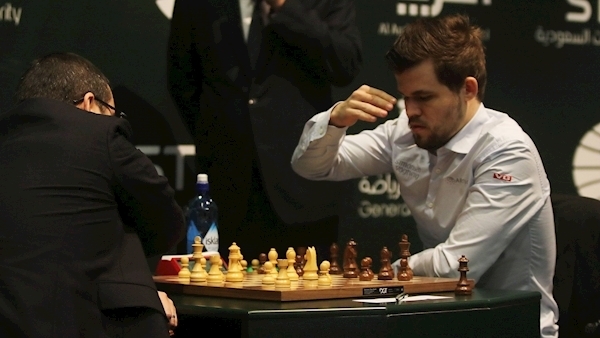
Two men are sitting at a table in an amphitheatre in the middle of London. Both are deep in thought, straining to understand what has happened, what will happen next, and what either can do about it.

Are the 32 counties of Ireland represented on a chess board?

Two men are sitting at a table in an amphitheatre in the middle of London. Both are deep in thought, straining to understand what has happened, what will happen next, and what either can do about it.

The television cameras capture their every breath — a mere shift of the body is enough to draw comment from analysts.

Every moment is being broadcast live on television in Norway, and on the internet across the world.

Magnus Carlsen is 27 years old and is the world champion. He is beloved in Norway, his country, where he is celebrated for his greatness.

His opponent, Fabiano Caruana, is one year younger. He’s an Italian-American and is considered the greatest player to come out of the USA since Bobby Fischer.

Both players have devoted their lives to chess — this match marks the apex of that devotion, as they play 12 head-to-heads over a couple of weeks, with almost no time for rest.

It is physically and psychologically gruelling, and — even if you don’t like, play, or even understand chess — this is a compelling drama. The world championship in chess has made men, and destroyed them.

But, for all that they are students of the game, it is fairly certain than neither Carlsen nor Caruana has the faintest clue that it was claimed for decades that the Irish invented chess.

In 1887, three years after he had founded the Gaelic Athletic Association, Michael Cusack established his own newspaper, The Celtic Times.

The newspaper was an extension of Cusack’s personality: it was brilliant, eclectic, learned, argumentative, and much more.

The focus of the newspaper was the GAA and its games, but Cusack also ranged across industry, social issues and, of course, what he considered ‘national culture’. Part of this imagined national culture was chess.

On July 16, 1887, in an editorial written by Cusack and in another article written by his business partner, A. Morrison Miller, the history of chess, and its Irishness, were set out in some detail.

Chess, wrote Miller, is the “king of intellectual games”, “it was invented in Ireland in 1430 BC
 and it is believed that the 32 pieces, which comprise the set, were made to represent the 32 counties [of Ireland].”

Cusack claimed that chess tournaments were once held annually across various Irish counties, until “the Anglo-Normans put an end to the tournaments, as well as almost everything else that was ennobling.”

Happily, they concluded, “the influence of chess 
 conquered in turn; and, today, we hold our annual tournaments and monster meetings, as our ancestors did of yore”.

In claiming chess for the Irish, Cusack drew on retellings of old stories, in which the mythological heroes of Ireland played chess in their resting hours and, in Cusack’s mind, did so to develop their intellects.

From Finn MacCumhaill to Oisín, the view was that the men of Ireland couldn’t be kept away from the chess board, unless it was to play hurling or engage in some extraordinary act of selfless heroism.

These were stories that were perfect for late 19th century Irish nationalists seeking to counteract the slurs of centuries of English writers who depicted them as barbaric savages and who continued to posture in the popular press that the Irish were a dirty, unsophisticated race.

For them, chess was a Godsend — this was, after all, the board game that was considered superior to all others, and which remains so today.

This image, of chess as inherently superior, is given withering treatment in The Oxford History of Board Games, by David Parlett, who caustically notes, “we will take as read the cultural equivalence of chess with Beethoven’s ‘Ninth’,” and ponders “why so many of its greatest exponents have been social misfits”.

But, still, the image survives and the apparent requirement of deep strategic intelligence, and its general connotations of grandeur, saw it embraced by writers such as WB Yeats (who wrote chess into his play Deirdre in 1907) and sportsmen such as Michael Cusack, who sought to see chess adopted by the GAA.

Indeed, Cusack saw chess as the natural ally of hurling; he wished to restore chess, alongside hurling, because he saw it as native: “We cannot hurl very well when night sets in, but we can then cultivate our minds, and we know of no game of skill better calculated to do this than the peaceably war-like game of chess.

It ought to be played because it is Irish and national, and especially because it was the principal instrument of intellectual culture among the most glorious people that ever lived in Ireland.

It is not clear to what extent Cusack — and others who floated on the high-tide of belief of the Irish invention of chess between the 1880s and the First World War — understood that the story was mere propaganda, or to what extent they considered it to be true.

Their claims rest in the numerous references to chess that appear in ancient Irish texts — the same texts which contain references to hurling.

In these old manuscripts, it is claimed not merely that the Irish played chess before the arrival of the English, but actually invented the game.

In time, the legend that chess was invented by the Irish faded (though not entirely, as the publication of the 2010 book, The Irish Invented Chess!, demonstrates).

Either way, it was agreed by all sides that the Irish were devoted to chess long before English boats made land in Ireland.

What is the truth of these claims?

The evolution of chess over many centuries renders definitive statements on the origins of the modern game somewhat speculative.

Historical varieties of chess possibly originated in India, spread into Persia, and were subsequently adopted in Arabia. The game subsequently spread to Europe and was certainly there by the 10th century AD.

Across the medieval world, chess became a central part of elite culture.

The spread of chess around the world more than a millennium ago was part of an exchange of culture that was not new.

Partly, this exchange was driven by conquest; as empires rose and fell, their political power may have been lost, but their cultural impact endured.

Partly, too, it was driven by trade and by travel. As commercial links between countries grew, so, too, did cultural exchange.

And then there was the church. Throughout the medieval period, churchmen railed against the many forms of gaming.

In particular, games of chance, involving dice, were considered to be particularly dangerous, not least because they usually involved a gamble of sorts, potentially leading to greed, violence, or destitution.

The social strata associated with chess created a dilemma for the church: how could one condemn a game so beloved of the wealthy and the powerful?

While there was some church opposition to the playing of chess, other churchmen were taken with a pastime that was considered prestigious and which was associated with nobility and high culture.

Monks and higher clerics indulged in chess and it is reasonable to speculate that some of these helped spread the game in Ireland.

It is one thing to dispose of the story that the Irish invented chess, it is another thing, however, to explain how this story of invention gained currency.

As Timothy Harding has explained, it appears that something rather straightforward happened.

When they were translating ancient Irish texts in the 19th century, scholars applied the name of ‘chess’ to all — or at least many — mentions of board games.

This meant many, many mentions. The precise nature of the board games played a millennium ago is lost to us, but gaming-pieces and bone dice survive from the Iron Age in Ireland.

Much later, a gaming-board carved out of yew-wood, dating from the tenth century, was discovered at Ballinderry, Co. Westmeath.

Again, there should be no surprise in any of this: playing all manner of games on a board has been a broad human activity time out of mind.

But in the peculiar case of Ireland, these games, and the stories around them, were shaped to create a history whereby the Irish invented chess.

It was a way of saying to the English: you may have an empire and power and money, but we have a history so deep and impressive, that we gave to the world the most prestigious of all board games.

And our genius — as revealed in the invention of chess — transcends the centuries and will endure when your empire withers on a stick.

They got part of that forecast correct, at least.

Meanwhile, in London, two men are still sitting at a table, still staring at a board, still moving pieces around that board, still oblivious to the story that every time they lift a chess piece, they hold an Irish county in their hands.

Paul Rouse is associate professor of history in University College Dublin and his book, The Hurlers, is now on sale.

More in this section

Sport

Newsletter

Latest news from the world of sport, along with the best in opinion from our outstanding team of sports writers. and reporters

Cookie Policy Privacy Policy Brand Safety FAQ Help Contact Us Terms and Conditions

© Examiner Echo Group Limited