Just as the US had its undocumented Irish, so now Ireland has its own ‘illegals’
26,000 migrants here ‘have no papers’ and they work for much less than the minimum wage, with no access to social welfare or health care. They are filling labour market gaps and so the Migrant Rights Centre of Ireland wants their status regularised. Joyce Fegan reports.

Just as the US had its undocumented Irish, so now Ireland has its own ‘illegals’

26,000 migrants here ‘have no papers’ and they work for much less than the minimum wage, with no access to social welfare or health care. They are filling labour market gaps and so the Migrant Rights Centre of Ireland wants their status regularised. Joyce Fegan reports.

They change your baby’s nappy. They help with your childrens’ homework. They care for your elderly parent.


They have no rights and live on much less than the minimum wage. Just as America has undocumented Irish, Ireland has its own undocumented migrants.

According to the Migrant Rights Centre of Ireland, there are between 20,000 and 26,000 undocumented migrants in Ireland. Some 89% of them have jobs, with 32% of them working in the food and accommodation sector, 29% in domestic work, and 13% in cleaning and maintenance jobs — 84% of these people have lived here for more than five years.

However, though some have PPS numbers and pay tax, they have no access to social welfare or healthcare.

Some of them came to Ireland on student visas, others had residency permits cancelled because of the breakdown of a marriage, and some came with nothing, but needed to earn a living and send money home.

“We try to draw the parallels between how the profile of the undocumented Ireland now is the exact same (as the undocumented Irish abroad). When we say ‘the exact’, what we mean is long-term, making a contribution, under the radar, getting on with life and work,” said Helen Lowry, deputy director of the MRCI.

The MRCI is connecting these undocumented migrants with the labour market shortages in Ireland, as a bridge towards a documented status. “There are a couple of other countries in Europe who have experienced migrants coming to fill labour market shortages and the two that would spring to mind are Italy and Spain. Throughout the 1990s and 2000s, they would have had people coming to fill specific labour market shortages.

“In both of those cases, they had introduced a series of regularisation schemes afterwards, for people who had come to fill those shortages, who were now living in the country long-term, so they could come forward and regularise their status,” said Neil Bruton, from the MRCI.

The Government did introduce a scheme for undocumented migrants who had entered Ireland as students, on the back of a court judgement. The scheme was opened for three months, from October 15, 2018, to January 20, 2019, to nationals from outside the European Economic Area (EEA) who were resident in Ireland and who had held a valid student permission during the period of January 1, 2005, to December 31, 2010.

However, the MRCI says this scheme did not deal with the largest cohort of Ireland’s undocumented migrants. “You have to welcome any steps that were taken with forward-thinking and planning. It will regularise people in the low thousands. But that is not the only cohort of undocumented people in Ireland.

“The scheme was high-specific and very restrictive. What we’d be looking for is more sensible measures that look at the current reality, so we recognise the reality of the situation we have here in Ireland today.”

The MRCI is working towards connecting Ireland’s long-term undocumented, who are working in areas like construction, care and hospitality, with work visas, as there are labour shortages. “Anecdotally, what we can see is that people are working in sectors that they’re now calling for non-EU migrants to come to Ireland (to work in).”

The Irish Examiner asked both the Department of Justice (DOJ) and the Department of Business, Enterprise, and Innovation (DBEI) for their response to undocumented migrants in Ireland.

A spokeswoman for the DBEI said the department had “no role” in relation to undocumented migrants.

A spokesman from the DoJ recommended that anyone who is living “illegally” in Ireland should bring themselves to the attention of the authorities. “Only when that happens can any examination of their case be undertaken by the State.”

The spokesman said the claim that “89% of undocumented people are working is a matter to be investigated by the relevant employment and taxation authorities”.

He added that “Ireland is an open and welcoming society,” where 120,000 people have been granted citizenship through naturalisation, since citizenship ceremonies were introduced, in 2011.

‘It was very tough leaving my country. My boy was only 1’

Irene came to Ireland in 2007, to earn money to cover her son’s medical costs in the Philippines.

She currently works four different jobs to support both herself here and her children at home, whose homework she does over video call.

“I’m 44 years old. I came here 12 years ago. I work as a full-time childminder, part-time carer, I’m selling properties and I’m a balloon artist. So I’m doing all those jobs to pay the rent and the bills and I’m sending money to the Philippines for my kids. So I work to cover all those expenses.

“Both of my kids are back in the Philippines. My daughter will graduate from university in May, she took fine arts and my son is only 13,” says Irene.

Her entire reason to come to Ireland was to earn more money to cover high medical fees at home. It was a “tough” choice, as her youngest child was only a baby at the time.

“It was a very tough decision leaving my country. The kids were very small, very young. My boy was only 1.

“I came to the decision because he had a congenital heart disease. I didn’t need to go abroad to work. I was a government employee.

“But what happened was, since my boy has this problem, of course I spent all my money on treatment. I got some support because I was a government employee, but it only covered half of the costs, and then they stopped helping because it was so expensive.

“I said to my sister who was working here in Ireland: ‘Can you please help me?’ I didn’t think I’d be long here, just to get a little bit of capital. It was hard to leave him. But I said to myself I had to be tough. I thought I’d only be here a year, but because of increasing needs, I had to stay,” she explains.

Being an undocumented person in Ireland, Irene worked long hours and below the minimum wage when she first arrived. Now she has a new employer who is very supportive.

“I changed then and it was a big improvement and my new employer was very supportive of my situation. They consider me as a ‘fundamental part’ of their family. That’s what she (my employer) is always saying to me: ‘She is a fundamental part of the family.’ They can go away without worrying. The kids are happy,” says Irene.

However, thoughts of her own children are always with her.

“It’s always on the back of your mind, you’re looking after the kids really well and I can’t do it for my own. We have seven hours difference and Ireland is behind, so I ring the kids in the morning to make sure they have all their homework done.

“Or they’ll take photos and send me their work, like essay corrections,” says Irene. “I’m also helping my daughter rephrasing her thesis and with her research.”

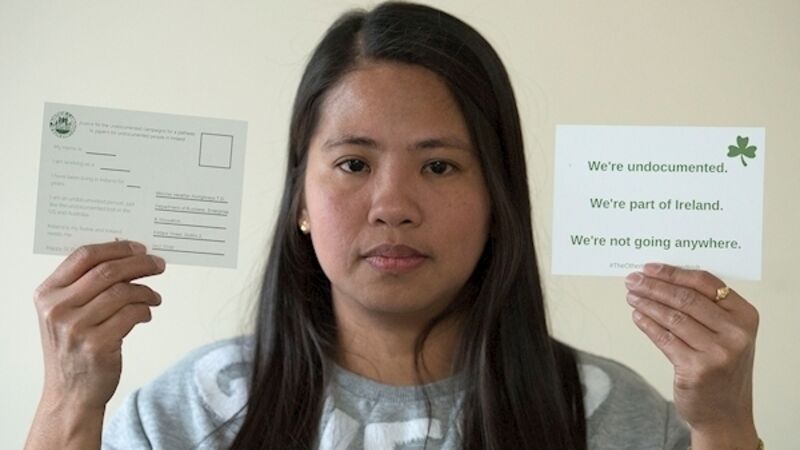
Something that has made her feel less alone is her work with the Justice for the Undocumented (JFU) campaign, through the Migrant Rights Centre of Ireland (MRCI).

“My first project was forming a human shamrock on Sandymount Strand,” Irene says.

“The following week we met the President. Seeing the work, I said: ‘Oh I want to get involved’ and learn our rights.

“I also want to help the people who aren’t aware that there is a campaign. So I help a lot in bringing members to the campaign, spreading the word.”

She points out that “the life of the undocumented migrants here in Ireland is exactly the same as the life of the undocumented Irish in the US.”

“We want the Government to recognise the reality that we are already here — we are working and we are contributing to the economy and we want to keep contributing by paying tax, but we are waiting for the Government to sort out our status so we can do that.

“We have our roots down here, we just want to continue with our lives,” says Irene.

‘When we had our second child, it was a very scary time’

Shyam, a chef who has been in Ireland for eight years, has sometimes worked for 60 to 72 hours a week on €6 an hour. Picture: Dave Meehan

Shyam has lived in Ireland for eight years, leaving one child in his home country in the hope of making a better life for his entire family.

At times, he has worked 72 hours a week earning just over €400, because of his undocumented status.

“I am from south east Asia. I’m living here eight years. I am working as a chef in a restaurant. I’ve always lived in Dublin and I’ve always worked in a restaurant. I have two kids, one in my country and one here. I left my youngest when she was 18 months, so she’s 10 now. I’ve changed job five times in these eight years,” says Shyam.

While he is undocumented, he did receive a PPS number several years ago, meaning he pays tax and now can earn the minimum wage.

“The PPS number has made work life easier. I get better work, I pay tax and employers give us a chance when you have a PPS number. Before I had the PPS number, I was working in a restaurant and they said they could give me a job but they couldn’t pay me the minimum wage. We were in trouble so I said: ‘Yes, no problem, I’ll take the €5 or €6 an hour,’ because we didn’t have any options, we had nowhere else to go.

“We had to look after our children and we had to look after family at home. I’d work 60 to 72 hours a week on €6 an hour. We just had one job in my house. That had to cover all expenses, there was no support if anything went wrong, nothing here, it was a very difficult situation,” explains Shyam.

His wife became pregnant with their second child, an experience he describes as “very scary” because of the lack of certainty.

“When we had our second child, it was a very scary time. We just got support from the MRCI (Migrant Rights Centre of Ireland) and our community as well, a very scary time. It was very hard for us, very, very hard.

“Renting can be hard, because we share a room and it can be hard because we have a child. Some people like it and some people don’t like it,” says the father-of-two.

Shyam said he was well aware of the disadvantages of arriving in Ireland as an undocumented migrant, but unable to claim asylum as he was only an “economic migrant” and not fleeing persecution, war, or discrimination, he felt he had no option but to leave his home country where jobs are scarce.

“In my country, the pay is low, there are no jobs, and coming here I could get a good job. And I can send €100 home, that’s 10,000 rupees. We had no options so we took the risk to come here. I had to work. I had to support my family.

“I couldn’t claim asylum because I didn’t have any problems, I was only an economic migrant,” he says.

“My daughter (in his home country) always asks: ‘Daddy, come soon’, but I can’t. If I go there and do the same work in my country, I’ll earn €100 a month.

“I can’t give my child as good of an education and support my family and myself as well. I can’t go back there even to see my family.

“If I had my papers, I could go back and meet my family and then come back here and work. I support my family at home all the time and their education, that’s why we are here,” he adds.

Shyam now considers Ireland his second home, and a stable country compared to his own.

His wish is that the Government would extend work permits to those who live here as undocumented, especially those working jobs where there are labour market shortages.

“We enjoy our life here, it’s a home, Ireland is our second home. We just want to be regularised. If I got the work permit, I can contribute to society. We are good workers. I have many job offers now, but if I get my papers I can get good money and earn €600 or €700 a week.

“If the Government was able to have a scheme for hospitality jobs it will be very beneficial for both parties,” he says.

‘They have a dream in their heart’

Accountant Mohammad has been awaiting a decision on his right to remain in Ireland since 2017. Picture: Dave Meehan

Mohammed works as an accountant in a large corporation. His residency visa was cancelled in 2017, after he informed immigration services that his marriage had ended. He has been living and studying in limbo ever since, unable to return home to care for his parents.

“My name is Mohammed and I am 31 years old, I’m living in Ireland since September 2006, so nearly 13 years now. I came here as a student. I did my bachelor’s degree and I’m doing my professional accounting exams right now,” he says.

Mohammed arrived in Ireland with his appropriate documents and made a life here, working 40 hours a week while doing his degree. He later married, but the relationship did not last.

“I was married in 2013, and my marriage didn’t work out. I let immigration know that my wife wasn’t living here anymore. Then they cancelled my residency visa and since then, almost two years now, they haven’t given me any final decision,” explains Mohammed.

He has lived in limbo since 2017, awaiting a decision on his right to remain in Ireland, while continuing to work and study. It means he has been unable to return home to his parents.

“My father had open heart surgery in 2012, and consequentially he is on medication. My mum had an accident and broke her leg. I am the eldest son, so sometimes I feel as the eldest son I am not helpful to my parents because when they need to go to the doctor they need to ask somebody else, a total outsider. My dad is still OK, but he is over 60. As the eldest son, I feel bad. I cannot be helpful to my parents, it’s so painful sometimes,” he explains.

He says his father asks continually about when he is coming home to visit.

He has undocumented friends who have lost family members and were unable to attend their funerals.

“One of my friends — his sister died, a few days ago, he couldn’t go, he couldn’t go to attend her funeral.

“One of my other friends is so unfortunate that he lost his mother and father both in a gap of two months last year. But he also could not go back home to see his parents for the last time.”

He wants the Irish Government to take the time to look at the cases of Ireland’s undocumented and see the contribution they make to society and the economy.

“If I was talking to Charlie Flanagan or the Taoiseach, I would say only one thing: ‘Please, please check our backgrounds. Check our backgrounds since we have moved to Ireland, what have we done? If you think, by using your honest judgement, that we have done something wrong, please don’t give us a residency permit.’

“But this is my 110% belief — everybody is clean. Every single person who is undocumented is very clean, their background is very clean. They have a dream in their heart but Government just need to make some space for that.

“Please allow us to stay in this beautiful country with pride, where we feel like home.”

‘We treat them as our own parent — that’s how we love’

Debra has been living here for 12 years. She has never met her seven grandchildren who live in the Philippines. Picture: Dave Meehan

Debra has seven grandchildren she has never met. Originally from the Philippines, she has lived in Ireland undocumented for more than a decade, working as a carer.

“I arrived here in Ireland through a tourist visa. I am living here 12 years and now I am 59. When I arrived here, I worked as a cleaner for six years. Then the family I worked for separated, so I got another job as a carer, for a doctor, and when he died, the family passed me to their relative where I work now,” explains Debra.

In her first role as a carer, she found herself in the fortunate position of receiving “sick pay” from her employer even though she was undocumented.

“The first time as a carer, they paid me by the hour and more than the minimum wage. They were very kind. If I got sick they would pay me the whole week — very kind. They were very good people. They saw what I did and how I cared for their husband.

“When that man died and I go to another person, to a lady who suffers from dementia. Having dementia is really, really tough. It’s hard work taking care of a person with dementia. The lady I look after, they pay me good pay, they are very kind,” says Debra.

Having left the Philippines 12 years ago to seek work and a better life here, she left her family behind.

“At home I have two daughters. They are married and have a job. They have children. I am a grandmother to seven grandchildren. I have never met them.

“I’m really used to it. I’m happy talking to them on the phone but it’s hard when they want me to go home. They keep asking me to go home, but I say I can’t,” she says.

She convinces the children by explaining that she will no longer be able to send clothes and sweets to the Philippines from Ireland if she returns.

“I tell them the reason is I can’t send them shoes, I can’t send them chocolate, and I can’t send them biscuits if I go home. But lonely? No. I am happy working here. My employer is very good and I live in an apartment with Filipino people. For 12 years, I consider Ireland my second home. I am happy working and living here,” she says.

Debra is part of the campaign group Justice for the Undocumented (JFU), which seeks to pave a pathway to papers for Ireland’s undocumented.

Before joining the JFU, Debra lived in a state of panic that she would be ejected from Ireland at any time.

“Before I joined this campaign I really, really had this experience of nearly jumping out the window of Dublin Bus, because I thought the ticket inspector was a Garda,” says Debra.

She believes if she could receive a work permit or visa for Ireland and become documented, she would be able to visit her family in the Philippines and then return to her life here.

“I think the Government have to look at what we do, what we contribute to the economy of Ireland, what help we extend to families, when we’re looking after their parents.

“The only thing I ask for is regularisation for the undocumented carers. I know they know what we contribute, what help we extend to the Irish family, what we do.

“We look after them heartily, lovingly, seriously. We treat them as our own parent, as our own grandparent, that’s how we love and that’s how we love the person we look after.”

x

More in this section

Cookie Policy Privacy Policy Brand Safety FAQ Help Contact Us Terms and Conditions

© Examiner Echo Group Limited