Against the odds: Three mums who breastfed their children despite the difficulties
Breastfeeding is not always straightforward. speaks to three mums who persevered despite encountering difficulties
It's National Breastfeeding Week and we’re being inundated with information about the benefits breastfeeding offers to mothers and babies.
In Ireland, only 15% of babies are exclusively breastfed for the first six months. This is despite 58% of mothers breastfeeding when they are discharged from hospital.
So what happens in the intervening months? Can more be done to support mothers who want to breastfeed their babies?
“More families are choosing to breastfeed but what we find is that when they realise it’s more challenging than they thought, they don’t know where to access the help and support they need,” says Sue Jameson, president of the Association of Lactation Consultants in Ireland.
She would like to see more pregnant women breastfeeding support groups.
“Cuidiú, La Leche League and Friends of Breastfeeding run free meetings throughout the country,” she says.
“At these meetings, women see breastfeeding in action and are able to ask questions. By finding out what’s involved before birth, they are in a better position to breastfeed once baby is born. They also know who to turn to if they have problems.
“With skilled and timely intervention, every breastfeeding problem should have a solution.”
We spoke to three mothers who found solutions to their particular problems.
A different approach
, 32, from Lucan in Dublin has two boys, Ethan, aged three, and Hugo, who is seven months.
Her experience of feeding both boys is completely different.
“My downfall with Ethan was that I didn’t give breastfeeding much thought,” she says. “My knowledge amounted to the hour we spent on it in antenatal class.”
Ethan had tongue tie when he was born, but neither Katie nor hospital staff realised it.
“I didn’t know it meant he couldn’t stay latched,” she says. “By the time I went home, I had cracked nipples and was in pain.”
That pain continued until she decided to stop breastfeeding when Ethan was a little over a month old.
Katie tried to do things differently with Hugo. By that time, she had a support network around her.
“I was the first of my friends to have a baby but by the time Hugo was born, I was surrounded by breastfeeding mothers,” she says.
I saw how most of them found solutions to their struggles.
She made sure she was more informed second time around, reading breastfeeding books and attending workshops before the birth. She also took a different approach post-birth.
“When Ethan was born, I wanted to go out and show him off,” she says. “With Hugo, I went to bed.”
She didn’t leave the hospital until she saw a lactation consultant and was given the details of the hospital’s breastfeeding clinic. This meant that when Hugo was also diagnosed with tongue tie, it got snipped immediately.
“I went to the breastfeeding clinic and by the end of week two, I knew something was wrong,” she says. “We found out Hugo’s tongue hadn’t been snipped enough, but luckily it was dealt with quickly again.”
By the third week, she felt things begin to change.
“I started to feel like I had a handle on things,” she says. “I’m happy to say we’ve had no complications since. Now I’m wondering how I’ll get him off the boob.”
Little fighter
, 35, from Portmarnock in Dublin always assumed she’d breastfeed her babies. She fed her eldest Leo, now five, for over a year, but Caleb, two, proved more complicated.
“The pregnancy was fine and so was the birth,” she says. “But when I was about to be discharged, a doctor noticed something wrong.
Within minutes, we were being told that Caleb needed a life-saving operation.
Aged six days old, he underwent surgery to remove a narrow section of his aorta.
Jan was devastated.
“I thought everything was ruined and that I’d never breastfeed my baby,” she says. The staff at Crumlin convinced her otherwise.
“They bought me a pump so I could start expressing,” she says. “They helped me learn how to use it and were there to support me through the entire process.”
That process was long and arduous, involving pumping every three hours for 24 hours a day.
However, it wasn’t long before Caleb was back on the ward and she was encouraged to start feeding him from the breast again.
“I didn’t think we could do it, but we did, and by the time Caleb came home when he was 12 days old, breastfeeding was fully established,” she says.
Caleb proved to be a little fighter and we continued until he was 18 months old.
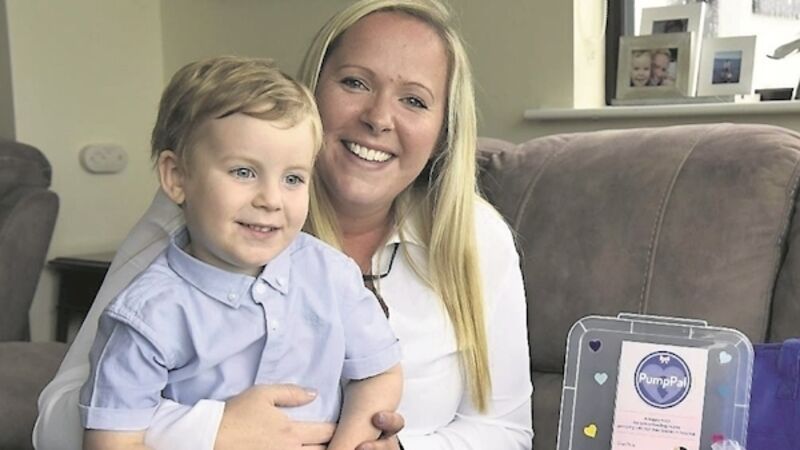
Prompted by her experience, Jan set up www.pumppal.org, a not-for-profit company that provides support kits to mothers who are breastfeeding sick babies in hospital.
“We know breastmilk is safer for premature babies than formula and mums in neonatal intensive care units can be under pressure to supply it,” she says.
“They need support, and this is my way of doing what I can to help.”
Low supply
, 35, is from Ballinteer in Dublin. She is also a first-time mum to seven-month-old Oscar.
She ran into problems in the middle of their first night together.
“I was up for hours feeding the baby, going from left boob to right boob and back again,” she says. “Eventually, I rang the bell and asked what I should do.”
The nurse suggested a top-up formula feed.
“The child was hungry, so I said yes,” says Denise. “I did the same the next night.”
What she didn’t know was by giving her baby formula, she was interfering with her body establishing its own milk supply.
“In the first few weeks, the baby lets the body know how much milk it needs, and the body responds by supplying it,” she says.
By feeding my baby formula, my body wasn’t getting signals from the baby.
She only realised this weeks later, when she sought the help of a lactation consultant.
“She told me I had low supply, but she also gave me practical advice about what I could do to improve it.”
That advice involved a combination of breastfeeding, pumping and formula feeding. It also involved following a diet to promote milk production.
“I spent an entire month doing everything I could to increase my supply,” says Denise.
Her efforts paid off.
“I’ve gone from one-third breastfeeding to breastfeeding more than half the time,” she says.
She recognises that there are advantages to combination feeding. “There’s more freedom for me,” she says. “I can go off and someone else can feed him.”
But she still wishes it was otherwise.
“My image of me as a mother was me breastfeeding and the expectation versus the reality were quite far apart,” she says.
I still get upset about it. But I accept that this is how I feed Oscar and that he’s happy.
“Breastfeeding doesn’t have to be all or nothing.”