Get up close and personal with intimate show
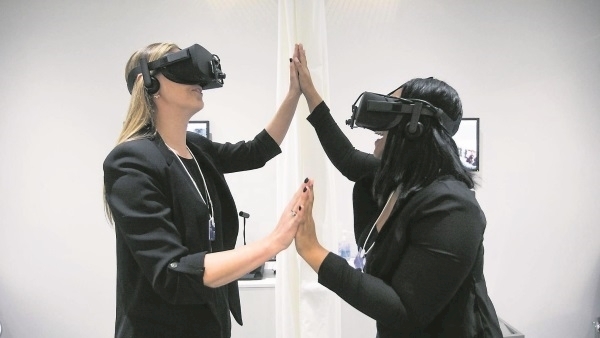
INTIMACY, a new show at Trinity’s Science Gallery, explores human connection, says
BEING intimate takes bravery. A revelation of the flesh, the soul, or the mind can leave us open to ridicule, and in a world where everything can be captured in an instant, but for ever more, being intimate can be fraught.
“Intimacy,” said the self-declared philosopher Alain de Botton, “is the capacity to be rather weird with someone, and finding that that’s ok with them”. He might have added that it’s ok at the time, but maybe not forever.
From October 19, INTIMACY, the latest exhibition at Trinity College Dublin’s Science Gallery, will examine the ‘science’ of human connection. It is the usual, brilliant exhibition mix of technology, neuroscience, art and research that the Science Gallery has made its own, since it opened ten years ago.
“The thing with intimacy is that people might have preconceived ideas of what it is, primarily romantic,” says Aisling Murray, exhibitions manager at Science Gallery Dublin. “It’s really about so much more. Ultimately, it’s about connection, but just because you’re connected, doesn’t mean it’s intimate, and just because you’re being intimate, doesn’t mean you’re connected. We’re exploring both sides of that.”
If you look at our target age group, of 15- to 25-year-olds, they are hyper-connected,” says Aisling. “They are more connected than any other generation, through technology, and yet you’re seeing higher rates of loneliness and anxiety.
British prime minister, Theresa May, has just announced the establishment of a minister for loneliness. British people are lonely. 200,000 elderly people had not had a conversation with a friend or relative in more than a month, at the time research was conducted.
To alleviate this scourge, lonely people are being encouraged to join Facebook groups and to organise meet-ups. While many see technology as a hindrance to real intimacy, could technology bring us together?
I think technology, in one sense, can get a bad rap,” says Aisling. “There’s a lot of bad press around it disrupting relationships, but there’s a lot of positives there, too, and we are trying to call that out in the exhibition.
The exhibition includes commercial products developed by scientists and researchers to aid us in our battle with the human condition. One of those is entitled ‘Pillow Talk’, a type of wristband that measures your heartbeat and replicates it underneath your pillow. As well as its obvious use in aiding long-distance relationships, the wristband is being trialled in hospitals, particularly where patients might be kept away from their loved-ones for a long time.
“So, that’s an example of how technology around intimacy could be incredibly useful,” says Aisling. “We know how important touch and intimacy is for premature babies, for example, and this is the kind of thing that could be developed in that sphere.
There are other, fascinating developments, like AI pets for people with dementia. There was a piece of research out earlier this year that showed that people who lived alone without a pet died younger — having something to care for, even if it’s a machine, brings us a sense of connection.
INTIMACY will examine the more controversial aspects of human connection.
“It feels quite timely, in terms of global conversations around consent,” says Aisling. “And I think we are well-placed to have a discussion around that.”
On show will be what the gallery are terming a speculative app, created by artists Lauren McCarthy and Kyle McDonald, which algorithmically determines how people make you feel, so you don’t have to. Using a smartwatch, it tracks and monitors your physical and emotional response to people around you, and takes action on your behalf, to “optimise your social life”.
Knowing how far you want that ‘optimisation’ to go, and communicating that, is explored in another exhibit, entitled ‘Please Touch’.
“This piece replicates the visual language of DO NOT TOUCH stickers,” says Aisling. “But when the visitor comes into the space, we ask ‘Do you want to be touched?’ If the answer is yes, then we ask: ‘Where do you want to be touched?’ ‘How do you want to be touched?’ and so it’s opening up, in a very playful way, a discussion about what your boundaries actually are and how open you are to having these discussions.”
Exhibits and artworks will fill both the upstairs and downstairs areas of the gallery, but another space will be opened up to what Aisling refers to as a ‘for play’ gallery (not foreplay), filled with ongoing workshops.
“This will allow us to create small, intimate moments and moments of connection with our visitors,” says Aisling.
“We want to encourage people to connect in the gallery space, maybe disconnect from technology, lock away your phones, and come and play a bit.
“Take the guard down, be a bit vulnerable, be present, and be open to connection.”
CONNECT WITH US TODAY



Be the first to know the latest news and updates









