The gig economy and its impact on workers explored in new movie from Paul Laverty
Celebrated screenwriter Paul Laverty tells about teaming up with Ken Loach again for a film about a man battling to survive as a van driver in the gig economy.
The gig economy — and its devastating impact on workers and families — is the subject matter of Ken Loach’s latest film, Sorry We Missed You.
The story of a delivery driver and his carer wife, on an uphill struggle with their family years after the financial crash, is a scathing account of how some companies reap all the benefits from their workforce, while giving little back.
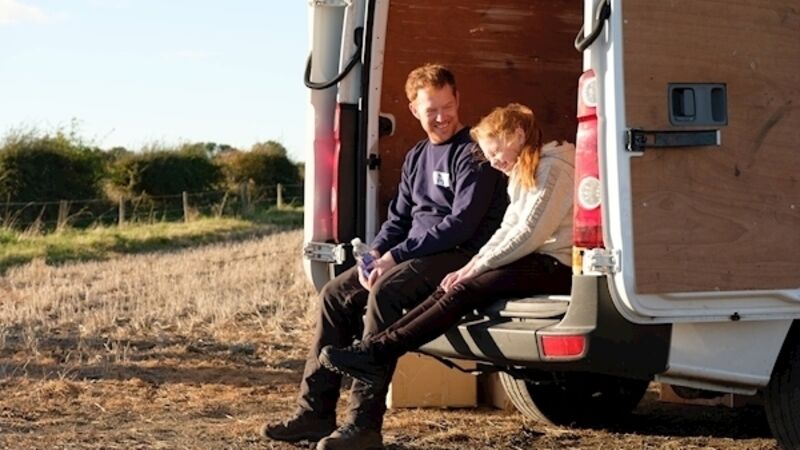
Ricky (Kris Hitchen) drives to tight deadlines for a courier company where he is paid by delivered item.
There is no sick or holiday pay — and if he can’t show up for work, he must find a replacement driver or face a stiff fine. For screenwriter and longtime Loach collaborator Paul Laverty, the idea was formed when they were working on their last film.
“We see it as a kind of companion piece to I, Daniel Blake,” he says.
“As we went around the food banks up and down the country, what we found really remarkable was the numbers of working poor. Three out of four children who are poor in the UK have got a working parent.
“So that whole contract is actually broken now, that you get a job and you could look after a family and have some sort of security.

“I think what is really very interesting, too, and this is what really got me about this story, is the language, because these are employees.
"Every moment of their life is controlled. But they’re presented it as if they’re the owner/driver/franchisee.
"It’s like this great big giant conjuring trick so that all the risk is transferred from the company onto the driver.”
TRUE STORIES
Loach and Laverty’s films, which also include The Wind that Shakes the Barley and Looking for Eric, are famously authentic and meticulously researched.
But the screenwriter initially found getting individual accounts a challenge — because stressed workers simply didn’t have time.
“This was actually much harder than even Daniel Blake, because people are knackered and they’re away, and they’re atomised and fragmented and they’re on the road. Through all your contacts you can find some people.
"I went to the depots and waited outside, went to the car parks and began to speak to people and persuaded some of them to take me out with them.
"The real secret was to go round with them, because you see someone’s face at the end of ten hours driving, see how tired they are.
“We went out to one depot, but word had got out somehow or another, and the company had said nobody was to speak to anyone. The last thing I want to do is jeopardise someone’s job. It’s their livelihood and their contract.”
IDEAL MOVIE MATCH
Born in Calcutta to a Scottish father and Irish mother, Laverty’s collaboration with Loach has spawned numerous award-winning films,including a win at Cannes for The Wind that Shakes the Barley.
Laverty was an unproven screenwriter when he first approached Loach about a project — but the veteran filmmaker sensed he had a story to tell.
“I was in Nicaragua, El Salvador and Guatemala for about three years. I worked for a human rights organisation.
"I came back from Nicaragua, and I wrote to him with an idea for Carla’s Song. I wanted to see if you have an imaginative story that could somehow incorporate some of the things that I witnessed.
In my naivety I was very determined, so I wrote to a lot of people, most of whom never responded. Hardly surprising really, given I was going to ask them to go out to a war zone with somebody who’d never written a screenplay before. Ken just rang me up one day, said if you’re ever in London come by for a cup of tea.
“I got a bus down to London, met him. And he was just curious. He wasn’t worried about whether I’d written things before. Instead of doing up a treatment [early draft], I actually just wrote the first half of Carla’s Song and it was like a drug.
“We’re really very close friends, way beyond cinema. Politically we’re joined at the hip with our interest in politics and film and life. And I suppose we do very different jobs. He directs, I write, but we meet in the middle as filmmakers and there’s no big egos and it’s enormous fun.”
WEST CORK BRIGADE
Telling the story of very different brothers during the War of Independence in The Wind that Shakes the Barley required historical expertise. Laverty and Loach turned to UCC-based historian Donal O’Drisceoil.
They also worked together on Jimmy’s Hall.
“He was an absolute gem, another brilliant collaborator who wears his learning very lightly. I mean, you’ve got to do the research yourself.
"You’ve got to try and delve into it. And I actually wrote the first draft of The Wind That Shakes the Barley before we managed to get in contact with Donal. But it is really important, especially something like that.

“There’s so much conflict. It was just really important for us because the Tories, you know, you saw the reaction when it won the Palme d’Or, they tried to undermine it.
"So to have someone like Donal beside you to check… he knew what we were about as well, beyond just the detail.
"He had a great sense of what we were trying to do with the story. I’d love to work with him again on something else.”
He has many fond memories of shooting in West Cork’s vivid landscape.
What was really an absolute key was just walking the land there, where the ambushes were, where key incidents took place.
"It was February, March, and it was fuckin’ wild. I thought: ‘Imagine being on the run’. And that’s where the penny clicked.”
FREEDOM AND LOVE
Laverty met his wife, Spanish filmmaker Icíar Bollaín on the set of Loach’s Land and Freedom. They have three children and havecollaborated on a number of filmsincluding Yuli, the story of Cuban dancer Carlos Acosta.
“Ken and Icíar are very close. They have a great solidarity, both being directors and all of that.
"And having to put up with me as well! They have very different histories, but their process is very similar. I never take working with either of them for granted. It’s been a great privilege to work with them both.”
LOACH’S LEGACY
Now 83, Loach hinted at retirement five years ago but has since made some of his most celebrated films.
Laverty is keeping an open mind on their future.
“I don’t make any plans really. Life is full of ambushes and surprises, just take it as it comes. He’s my friend first, so I want him to do what is best for him.
"He’s got a great family. I’m very close to them all. So if he wanted to spend a bit more time with them, I’d be the first to celebrate that. We’ll just take it step by step.”