From redefining pop to silver screen superstar: Lady Gaga is a star reborn
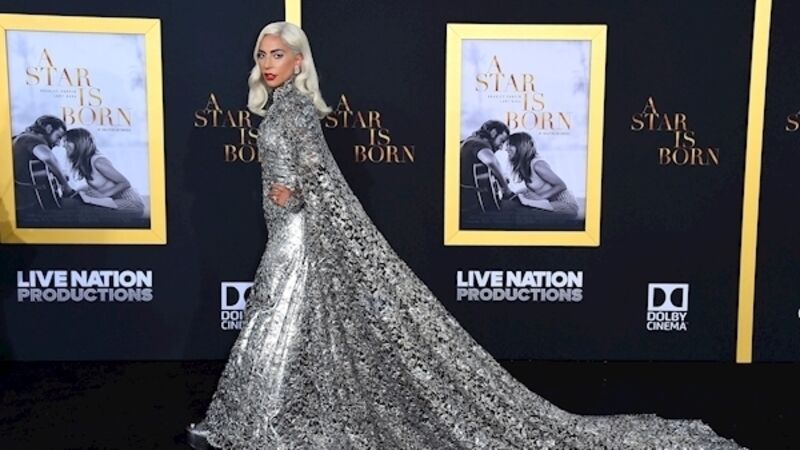
From redefining pop a decade ago to stealing the spotlight at film festivals this year, Lady Gaga, with her show-stopping role in A Star Is Born, is a force of nature, writes .
Lady Gaga did not so much arrive at the Venice Film Festival in August as she floated into it, a platinum Aphrodite borne on the waves, black stilettos skimming the sea foam. Which is to say, she took a water taxi.
An image of her zooming across the canal — perched precariously on the side of the lacquered motorboat in a little black dress, her legs elegantly entwined, her hair shaped into three victory rolls like a crown of croissants, holding a single red rose in one hand and blowing kisses with the other — immediately became a meme.
Of course, she couldn’t just walk up to the premiere of A Star Is Born, the first feature film in which she has a leading role, playing the titular supernova. In mere hours, several internet sleuths began to post pictures of Gaga on the boat along with photos of classic Hollywood stars, including Marilyn Monroe in a one-piece black bathing suit.
The next day, Gaga and Bradley Cooper, her director and co-star, arrived hand in hand to a screening; she was wearing a swingy white dress, the kind made for walking over subway grates. The wink was complete.
We could have seen this coming. Lady Gaga is our pop laureate of the grand entrance, our patron saint of operatic ingress. She has never, in a decade of global fame, been content to simply appear in a room; she has to plummet into it, shimmying down a cable like a diamond-encrusted spider.
Or she hobbles in, a fembot on fake crutches, a high-fashion Tiny Tim. Gaga once described herself as “a show with no intermission”, but it might be more accurate to view her career as a glorious series of overtures; her curtain is always rising. This is why her water ride in Venice elicited such collective delight in the form of vigorous retweeting. She may now be a serious actress, but she hasn’t lost her sense of play.
When I met Lady Gaga on a hazy afternoon a few days after her Venice tour, at her house so high up in the Hollywood Hills that I broke through the fog line before I reached it, she was still in full Marilyn mode.
Having seen A Star Is Born the day before, in which Gaga gives a notably stripped down, unbleached performance, I was slightly jarred as I watched her shuffle through her house in a full face and spike heels.
In the film, her character, Ally, starts off makeup-free, a frustrated waitress with mud-puddle hair (Gaga’s natural hue) who long ago abandoned her songwriting dreams and has settled for crooning live covers one night a week at a drag bar, the only woman on the bill.
One night, Bradley Cooper, as the shambling, alcoholic rock star Jackson Maine, stumbles into the bar looking for a nightcap and instead discovers a muse — he is bewitched by her performance of ‘La Vie en Rose’ in an Edith Piaf costume complete with thin eyebrows fashioned from electrical tape.
Later that night, Jackson asks Ally why she doesn’t pursue a music career. She tells him that she tried, she really did. She just couldn’t find any industry types who could get past her face. They loved the way she sounded, hated the way she looked. Hearing this, Jackson reaches out with a single finger and traces the contours of her nose.
While this is on its own an erotic gesture, it is Ally’s reaction that makes the scene: She just breathes as he gently outlines the organ she feels worst about. It’s an arresting moment, in which she seems both receptive and completely assured.
Now, as we toured her house, Gaga was as opaque as Ally is transparent. She spoke carefully, in a breathy tone, as if she were in an active séance with an old movie star whose press agent advised her to remain enigmatic and demure.
We made our way to a small alcove with whitewashed walls and 20ft ceilings, which looked like the storage room of an art museum — an echo chamber, she explained.
I asked about the acoustics, in part because it seemed the polite thing to do, but in part because I was trying to open any conversational tap I could find. Whether she was feeling legitimately shy or was simply method-acting as a restrained ingénue, she had yet to speak at full volume.
Suddenly, she broke into song. A cappella, unprompted, voce forte, her arms flung out to full wingspan, her head tossed back to bare her throat. She was singing the chorus of ‘Shallow’, the song she co-wrote for A Star Is Born that has become the de facto theme song for the movie, sung at the moment when Ally reluctantly steps onto an arena stage for the first time to sing with Jackson.
Gaga plays this moment with incredible restraint; it’s hard to imagine her not wanting to storm a stage, but she really sells it. Ally has been down for so long that she hesitates, not fully believing that this is her shot. But then something shifts. She straightens her shoulders, struts out to the microphone, and sends her voice soaring over the crowd.
In the echo chamber, the words of the song ricocheted, shaking the room: “I’m off the deep end! Watch as I dive in! I’ll never meet the ground!” When Gaga sings, her whole body vibrates.
She clenches her fists, squeezes her eyes shut. After she finished belting, Gaga looked beatific, almost giddy, having answered my banal question with undeniable certainty. The acoustics in here, we agreed, were very good.
A Star Is Born has never really been a film about an unknown actress shooting across the screen like a rare comet. Instead, from the very beginning, it has always been a film about an already superfamous woman shooting a movie. That’s the real reason the franchise works: It comes with a built-in insurance policy.
In 1937, when Janet Gaynor stepped into the role of the farm girl Esther Blodgett in the first version, she was making a comeback, but she had been a box-office titan of the silent era, the first woman to ever win an Academy Award for acting. Judy Garland, who tackled Esther in 1954, was a household name at 17, no longer a vaudevillian striver but a minted studio girl, kept on a steady infusion of amphetamines and barbiturates and praise. In 1976, Barbra Streisand was already an Oscar winner.
This is why the lead role is so alluring to divas who want to explore the boundaries of their fame and what they had to endure to lasso it. These actresses, in drag as younger versions of themselves, get to wrestle with their flaws and air out their darkest fears. But we don’t fear for them, not really, because we know how the story turns out.
Gaga’s innate New York City toughness brings a different flavour to the role than her predecessors. Where Janet Gaynor plays the starlet as pure and cornfed, Garland plays her as a plucky troubadour in pert ribbon bow ties and Streisand plays her as a wise-cracking prima donna in colourful ponchos, Gaga’s Ally is more world-weary and knowing.
When Cooper offered Gaga the role, he told her that “this is what it would be like if you were 31 and had never made it”, and she readily embodies the ferocious hunger of the would-be famous. She’s no innocent when she walks onstage to sing. She knows exactly what to do, and exactly what this will mean for her career. She’s ready to go.
It is difficult to pinpoint exactly when Lady Gaga, the international superstar, was born. Past a certain level of fame, the origin stories of pop artists begin to tilt into the mythological.
“I have a nerve inside of me to do this,” said Gaga, sitting on a swivel chair in her basement studio, when I asked what drives her. She kept her legs crossed at the ankles and her spine rod-straight, with her shell-pink nails gingerly intertwined in her lap, as if she were practising to meet Queen Elizabeth.
And I have no idea where it comes from, except that it might come from God. No one knows.
What she does know is that at some point, she felt free: To drop her birth name (Stefani Joanne Angelina Germanotta), to turn herself into an event, to keep shedding old skins.
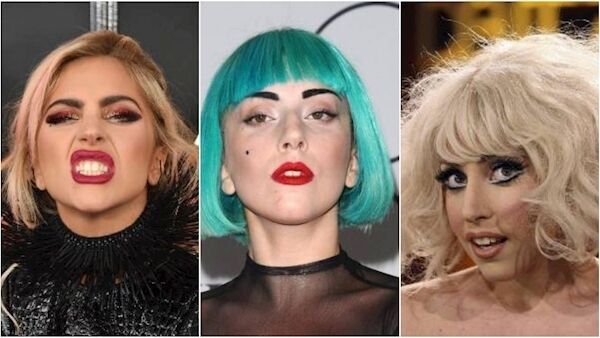
Lady Gaga’s early career was a study in this invitational freedom: Look how free I am, look how free you could be. This is what she was selling, at 21, with her platinum oversize hairbows and gigantic sunglasses and skyscraper shoulder pads.
This is the realisation that led her,
after growing up on the Upper West Side, attending a private Catholic girls’ school, and studying piano minuets, to move downtown in 2004, first to study theatre arts at NYU (she dropped out during her second year) and then to sing in grungy bars on the Lower East Side while she sent her demos to record labels.
She read Andy Warhol’s books and realised that what most people want, when they dream of fame, is not necessarily wealth or power but limitlessness: The ability to change. What if she began with the character, and the character was the physical embodiment of flux? What if she never wore the same outfit twice, or gave an interview out of costume, or claimed to be a paragon of creative authenticity?
Gaga’s initial obsession with masquerade predicted the double lives we all live now, our simultaneous existences as living, breathing people and disembodied avatars.
But instead of seeing those identities as segmented — the real person, the facade — she put forth the concept that it’s possible, and ultimately adaptive, in a fractured world to try to free yourself from old boundaries. You can be an insider and an outsider at the same time, a human and an alien. Her whole project was a Technicolor dream ballet, a gauzy hallucination. And it sold records (over 27m, worldwide) and won awards (six Grammys).
Gaga has, over the last decade, arguably moved the entire pop apparatus towards forceful weirdness. Her influence is everywhere — she opened the doors for more female hitmakers to be cheekily bizarre (Miley Cyrus grinding on a wrecking ball, Katy Perry with her sniper-rifle bra filled with whipped cream, Sia living under her wig, even St Vincent’s indie Fritz Lang affect) — but as a result, Gaga’s early maximalism began to feel less vital to the cultural conversation.
In 2011, Adele’s 21 cemented a new austerity in pop; all she had to do to sell 11m records was stand in one place and sing plaintively about heartbreak. So Gaga swerved again, and again, and again. She made a jazz record with Tony Bennett. She made a crunchier, heavy-metallish album called Artpop that mostly failed to connect with the public, at least on the large Gagagian scale she was used to (it sold fewer than a million copies).
When she turned 30, she released a more minimalist fifth record called Joanne, after an aunt who died young of complications from lupus. She promoted the album in ripped T-shirts and a plain, pink felt hat. She toured dive bars before the arenas. She also released the Netflix documentary Gaga: Five Foot Two, a vérité glimpse into her daily life as she prepped for the 2017 Super Bowl, produced and promoted Joanne, and spoke openly about the debilitating pain caused by her fibromyalgia (something she had been dealing with privately for years).
The documentary presents Gaga with a striking lack of vanity. She appears on camera with dirty hair and a bare face. This is Gaga the Vulnerable, Gaga the Sensitive Soul.
She has not given up on the power of an audacious live show (this winter, she will put on a pyrotechnic Las Vegas residency called Enigma), but in making A Star Is Born, she is entering into a softer conversation with the public — about talent, about ambition, about her own trajectory.
Ally is the most human of all of Gaga’s creations, and offering her to us — her fear, her loyalty, her shattered heart after tragedy — is a different kind of gamble than stepping out in front of millions dressed like a holographic Muppet. She is, in essence, making exploratory autofiction on a grand scale, even as she is playing yet another character.
If she was going to be a movie star, she couldn’t just step into a role, or a film, that no one had ever heard of — she wanted to waltz into a lineage.
When she was younger, she told me, she used to watch The Wizard of Oz, over and over, convinced that Judy Garland was the greatest entertainer alive. “Judy, I just think she’s tremendous,” she told me. “There’s a vulnerability behind her eyes, the way she speaks, she has big features. I just always wanted to be like her. It’s as simple as that.” And now she is standing on the very same stage.
Earlier in the afternoon, Gaga showed me a room that was empty save for a gigantic photograph of her own face, at least 15ft across, in a gilded frame. “It was a gift from Bradley,” she said. “It’s the last frame of the movie. Do you know the scene?”
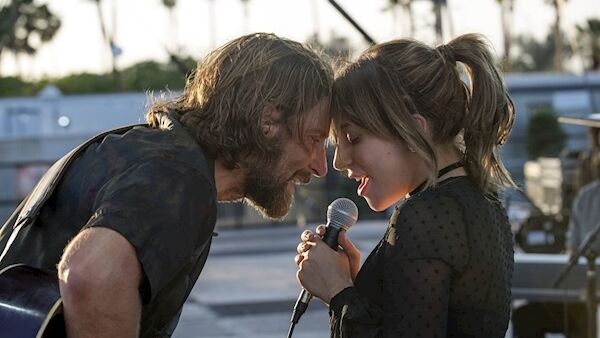
I did know it. It is the moment when Ally is standing on the stage of the Shrine Auditorium — where Garland shot her final scene — in an ice blue evening gown, singing a homage to her late husband. She starts out timid and drained of expression, explaining to the audience that she is going to sing the last song that Jackson wrote for her, and that maybe with their support, she can get through it. But as the ballad goes on, her voice swells and becomes an avalanche. It’s a bravura performance in extreme close-up, a sort of symphonic summoning of every woman who has played the part.
When she finishes, a single elephant tear rolls down her face. Magically, the moment somehow avoids bathos — the tear feels truly earned. After watching her perform this scene, I felt elated by what Gaga managed to do, not just for her character but for herself. You desperately want to know what her future holds after the curtain falls.
I asked Gaga later what we can expect from her next phase. Of course, there’s Vegas and a new record on the way, and she’s reading piles of scripts. But she really didn’t want to discuss any of that. Instead, she just smiled enigmatically.
“Oh,” she sighed. “I’m just shape-shifting again.”


CONNECT WITH US TODAY



Be the first to know the latest news and updates