Changing their feathers: Male lead Swan Lake went from controversial to iconic
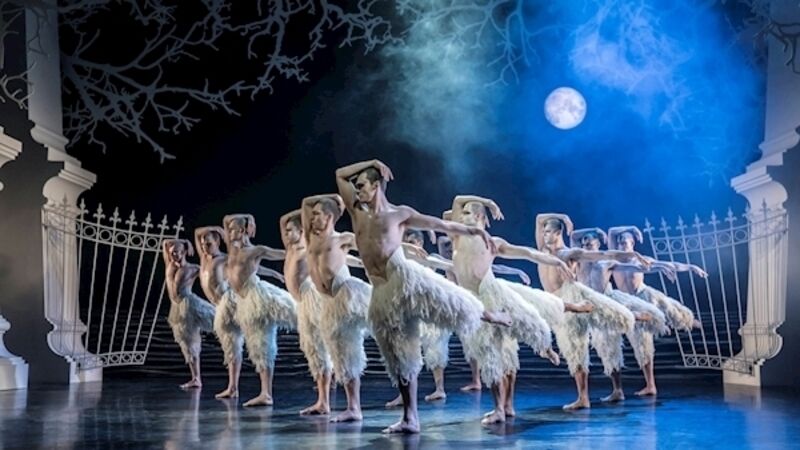
Matthew Bourne’s once-controversial retelling of Swan Lake with a male focus has become an iconic production, writes
TWENTY-FOUR years ago, a radical young contemporary dance theatre company flipped Swan Lake on its head with their modern take on the classic Tchaikovsky ballet.
Choreographer Matthew Bourne made headlines in the mid-1990s by reimagining the elegant female swans beloved by traditional ballet audiences worldwide as an all-male corps of dancers, danced with equal parts sensuous grace and masculine, feral menace.
Bourne is fond of recalling the hullabaloo that surrounded the production by fledgling company Adventures In Motion Pictures in its early days: walk-outs, little girls crying that they had been brought to “the wrong ballet,” and column inches devoted to labelling it the “gay Swan Lake” or an “all-male Swan Lake”.
But years have passed and what was once a risqué outlier is now a modern classic, with a broad appeal to audiences beyond fans of dance.
It’s a tale with the potential to be overwhelmingly dark: a psychosexual allegory in which a closeted and suicidal Prince is saved from the tedious pageantry of his life by the bestial glory of a bevvy of cobs headed up by the object of his affections, the magnetic lead Swan, only to be driven mad.
But Bourne’s crowd-pleasing cultural references to British royals, to film, even to advertising, bring levity and popular entertainment value to his dark materials. It’s the longest running ballet on London’s West End, it featured in the moving closing scene of the film Billy Elliot, and has been the recipient of numerous international dance awards.
But Matthew Bourne is not one to rest on his laurels. Bringing an updated, 21st century version of his hit production on the road with New Adventures, the company he founded in the Noughties, the director and choreographer’s work is never done; Swan Lake is, he says, an endless work in progress.
“Most directors hover in the back of the theatre, or disappear and come in for the closing night party,” he says. “I’m an unusual director because I love being part of the audience, particularly in a new venue. I get a sense of how it’s working. It’s not a finished thing; there are always things to do in nurturing young artists.”
With dancers in the new production including Liam Mower, one of the original Billy Elliot dancers, as The Prince, and Royal Ballet dancer Matthew Ball as the lead swan, the latest outing of Bourne’s modern classic has proved as big a hit as ever in the UK and is winging its white-feathered way to Dublin next week.
SLIGHT REVISION
Although retaining the same narrative as the original, as well as the distinctive vision of set and costume designer Lez Brotherston, Bourne says details throughout the whole production have been revised and updated.
“When you think back twenty-something years, you’re a different person, so it’s nice to ask, ‘why did I do that, why was that in it?’” he says. “You can direct the performances differently. For me, this feels like the grown-up Swan Lake. I’ve taken out a lot of the silly things.”
Plenty has changed since Swan Lake first took the dance world by storm in 1995; Bourne says that over time, the politically charged nature of the original production has been tempered by changing attitudes towards gay relationships.
“When it was first staged, some of the more militant gay groups saw it as another gay tragedy,” he says. “They said, ‘why not make it positive?’ There were the pressures of selling a show and being asked to play down that aspect of it as well. It was very controversial in some ways, taking this supposedly untouchable classic and reworking it. Now of course, it’s been embraced by the public. It was a ‘bring the kids’ Christmas treat at Sadler’s Wells.”
Is it possible that his original tale, which hinges on the Prince’s fear of revealing his true nature, could have dated in the 21st century? “You could say that happily, that side of it has dated,” he says. “But one of the few types of people left who really can’t be themselves is someone who born into a royal family. If Prince Harry was gay, it would be interesting to see if it was acceptable now. There’s still a lot of pressure there.”
Ultimately Bourne, whose new production of Romeo and Juliet is also due to debut in 2019, believes the power of dance is that it’s open to interpretation, and that Swan Lake retains its appeal as a result.
“The reason it’s still a powerful and positive piece is it’s about simple things,” he says. “It’s about love, the need to be held and embraced, and to accept who you are. It’s still a powerful message that moves people.”
For a ballet famous for its male cast members — the lead Swan and Stranger roles, which mirror the dual roles of the White Swan, Odette and the Black Swan, Odile in the original Swan Lake were originally played by dance star Adam Cooper – the female roles in Bourne’s production are satisfyingly deep and flawed.
QUEEN MOTHER

The character of The Girlfriend, played in the latest production by Royal Ballet School trained Katrina Lyndon, is an endearing, tottering socialite whose physical pratfalls and social gaffes generate the warmest audience responses.
But it’s the Queen, mother to the Prince and possibly the oedipal source of all his angst, who is one of the greatest forces to be reckoned with in Swan Lake, playing a crucial role in the audience’s understanding of the Prince’s unhappiness and need for love.
“It really annoys me when the media say it’s an ‘all-male Swan Lake,’ Bourne says. “It’s not. Sometimes I tweet pictures of the female dancers and say, ‘these are the women in the ‘all-male’ Swan Lake.”
One of these women is Nicole Kabera, a full-time senior dancer with New Adventures. Now filling the shoes of The Queen, Kabera danced a minor role in Swan Lake as the Italian Princess when she joined the company eight years ago, so she’s lived with the legacy of Bourne’s Swan Lake for a long time.
“I’m really enjoying playing The Queen,” Kabera says. “There’s a depth to her and a type of warmth that may not be visible on the stage, but she’s very fun to play.”
The elegant Queen is certainly not a character that’s easy to warm to, with her rejection of her son’s emotional needs in favour of the worship of her subjects. But alongside her glacial rejection of her son lies her contradictory narcissistic tendencies to accept the advances of young and handsome strangers.
“Matthew made us watch a BBC documentary about Princess Margaret and that’s what inspires the wilder side she has when she’s flirting and letting herself go with younger men,” Kabera says.
Working with Bourne on such an iconic production is, immensely rewarding for senior dancers as well as recent arrivals. “He’s always finding new and exciting ways to keep the production fresh,” she says. “He allows you to have your own creative intelligence into the characters.”
“Watching the younger dancers who are coming to this for the first time, and watching how excited they are by being involved in it, reminds you of what an important production it really is.”
CONNECT WITH US TODAY



Be the first to know the latest news and updates