Galloping off to war: War Horse
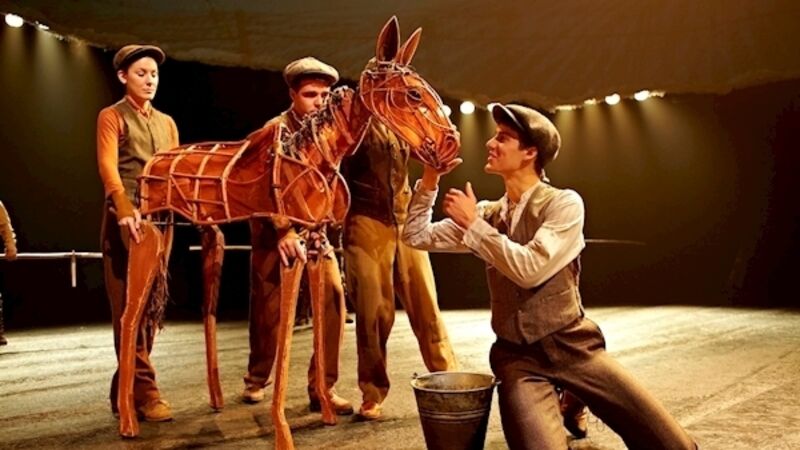
Amazing life-sized puppets are at the heart of a superb stage adaptation of Michael Morpurgo’s ‘War Horse’ novel, writes .

A horse and a boy go to war. That’s the premise of Michael Morpurgo’s 1982 children’s bestseller War Horse. Against the backdrop of the First World War and the killing fields of Flanders, Morpurgo wrought an intensely moving meditation on friendship, loyalty, our place in this world and the ways in which fate can grab us by the scruff and shake us violently.
That same sensibility — universal and visceral, profound and poetic — is conveyed by the 2007 stage adaptation by Nick Stafford, which has run constantly around the world and now returns to Dublin’s BGE Theatre. War Horse, from Britain’s National Theatre, is a gripping reimagining of the novel, elevated by incredible life-size horse puppets created by South Africa’s Handspring Puppet Company.
“We convince you very, very strongly that this is a living, breathing, thinking, feeling horse,” says Gareth Aled, puppetry director of the touring Ireland and UK production.
The quality of the work and the detail are astonishing.
Each of the horses — including main protagonist ‘Joey’ — are cane and aluminium configurations operated by up to three puppeteers. Before a matinee performance in Stoke recently, I was somewhat sceptical of Aled’s assertion that by the end the puppeteers, who are fully visible throughout, would dwindle into the background. Yet this proved absolutely the case. After only a few minutes, the horses become characters in their own right — seemingly as alive as the actors with whom they shared the stage.
“We operate with some key principles of puppetry,” explains Aled. “The first is focus — we ask the puppeteer to focus on the puppet. If a puppeteer is holding a puppet but looking away we as humans start to see the person on stage and not the puppet. The second thing is that all our puppets ‘breathe’.
“That rhythm of the breath suggests it is alive. The final thing is something called ‘fixed point weighted muscularity’. Our horse puppets don’t weigh the same as real horses. But through the way we manipulate the puppets, whether it’s walking or trotting or galloping, we convince you there is great muscle and weight. When really it’s just cane and bungee [cord]. We can strongly suggest life. You the audience forget the puppeteers exist.”

World War I is an oft trod subject —especially in the UK where the conflict has become entwined in the national story and to this day tinges its relationship with Europe. With the 100th anniversary of the end of the conflict just passed and Britain in ongoing paroxysms over Brexit, the contemporary resonances are obvious, says production director Charlie Kenber.
“It has all those layers to it,” he says. “It is really unusual for a play to run as long as it has. Usually it’s musicals that do that. War Horse shies away from big crowd pleasing moments. But it has a bit of everything. You have these mass battle sequences that are astounding aesthetically.”
IMAGE OF WAR
As well as a chance meeting with a war veteran, Morpurgo was inspired to write the novel after coming across a painting of a soldier riding a horse into battle. “It was a very frightening and alarming painting, not the sort you’d want to hang on a wall. It showed horses during the First World War charging into barbed wire fences. It haunted me,” he says.
He expanded on the image to create the story of a young farmhand, Albert Narracott, separated from his beloved steed, Joey, as the animal is requisitioned for the First World War.
But when Albert too joins the conflict their fates become once again entwined in ways sure to tug at the heartstrings. In between, there are calvary charges, death and devastation on a mass scale and a reminder that kindness, to humans and animals, was not exclusive to the Allies. It’s a nerve-flensing, incredibly moving, parable. By final curtain in Stoke a fair chunk of the room were discreetly dabbing their eyes.
For the author, telling the story of a horse — one among the hundreds of thousands to see “service” on the frontline — was a way to interrogate attitudes towards WWI whilst side-stepping cliches about life in the trenches or going over the top into the Kaiser’s guns.
“War Horse,” he would write of the stage adaptation. “Is not simply a show or a play about a war, a horse and a boy. It is an anthem for peace and reflects, I think, a universal longing for a world without war.”
“It avoids things we’ve heard a lot about regarding the war,” agrees Kenber. “You see it through the ‘side view’. Amongst the huge numbers of people dying, all these horses [being killed] is forgotten. They didn’t sign up, they didn’t volunteer. They had no choice in the matter.”
HARD HITTING
Morpurgo is said to have mixed feelings about Steven Spielberg’s schmaltzy 2011 movie adaptation. The film has undoubtedly raised awareness of the play.
Yet those who take their seats expecting a retelling of the Spielberg saccharine-fest are often surprised by the sheer gut-level punch of Stafford’s take (parents are advised to use their judgement as to whether to bring young children — there is a great deal of death, of both man and horse).
“It’s loud, it’s not comfortable,” says actress Jo Castleton, who plays Albert’s long-suffering mother in the new production. “That’s important. You think, ‘wow that’s what it must have been like’. A lot of people have come because they’ve seen the movie.
And you have that wonderful magical moment of, ‘wow — this can be done on the stage.’ Once you’ve seen these extraordinary puppets, it’s more moving really isn’t it?
As Morpurgo has stated, the message of War Horse is that, regardless of the flag the men fought under, they were united in their hopes and dreams. “You see in the good in British and German sides,” says Castleton.
“You see the German story as well, which is so tragic and devastating. The horses bring out the good in all these different people. You really observe the war through their [the horses’s eyes]. It’s very powerful.”