The 2016 Huracán LP 610-4 Spyder is the Lamborghini of your dreams
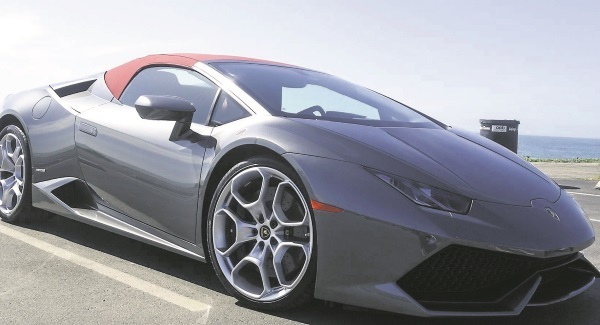
As when you take a high-performing sports car, remove the top, and find a way to achieve the same aggression, stiffness, and wind efficiency in the new version. It’s a lot more complicated than just lopping off the roof. Physics and aerodynamics are complicated devils.
The engineers at Lamborghini have found a way to tame them, though, with the 2016 Lamborghini Huracán LP 610-4 Spyder. This is the drop-top version of the excellent coupe we saw last year; rather than making the car heavy or burdensome around corners, a common problem of convertibles, the alteration comes only as an improvement.
I drove the Huracán Spyder in Los Angeles traffic, through West Hollywood and Santa Monica, in the Malibu hills, and along the twisty Pacific Coast Highway. It is the most intense modern production car I’ve ever driven, equalled only by its siblings (Aventadors and Gallardos) and by a few halcyon afternoons spent piloting a Bugatti or two. That’s rare air.
From the moment you get behind the wheel, your senses go into overdrive. Everything is heightened, super-sharp in focus, as when you walk alone through a dark alley. One errant sound, one blush of wind on your cheek, and you whip to action like an assassin ready to fight.
If you were, and you did, the Huracán Spyder would prove an apt weapon. It even looks like a weapon, a fighter jet whose edges along a taut body might as well have been carved by the wind itself.
The Spyder has a short nose, dipped forward and down, set with deeply- slanted headlamps that hold triangular LED lights. Turn the lights on and the car becomes an animal growling at you from the shadows.
The blackened front grill enhances the predator effect. Four big wheels, on 20-inch blade-style rims, are pushed all the way out to the corners of the car; a transparent engine bonnet is optional — and preferred, in order to better show off the car.
If you want, you can choose among a handful of colours on your ceramic brake calipers (red looks nice) and a smattering of carbon fibre accents to augment the hybrid aluminium/carbon frame. The outer skin of the Huracán consists of lightweight aluminium and composite too.
Most convertibles typically weigh more than their coupe counterparts, but at 1.54 tonnes versus a 90kg-lighter coupe, this one stays on the lighter side.
The real potency of this fighter comes from what’s under the hood. The Huracán Spyder has the same V10 602-horsepower engine as the hardtop version, with the same all-wheel drive on a seven-speed dual-clutch transmission. You can choose among three drive modes, plus launch control; use the paddle shifters, if you don’t like automatic, in changing gears. Sadly, there is no manual option.
Top speed here is 323 kph — exactly the same as with the coupe — with a 0-100kph sprint time of 3.4 seconds. (The coupe does it in 3.2 seconds.) Lamborghini is particularly proud of these statistics, along with the fact that both cars share virtually the same drag coefficient for wind resistance. It’s quite the engineering feat.
I drove it a lot. And I have no complaints. None.
Sure, driving over potholes is a drag. Slowing down sufficiently to handle them without damaging the rims, bumper, or chassis tested my patience to the extreme, and the lift-kit that raises the car nearly two inches only goes so far.
But once you get out to the road, once you make that final corner and see a stretch of road open before you, you’re golden. The car is perfect.
The steering might as well be linked directly to your brain in its precision. Braking is instantaneous. There’s no rolling around corners, no lumbering up hills trying to gather speed, no hesitation when you press the gas. You could put this car through the most gruelling track day possible and never get the sense that it was ever really straining.
Then you come back to earth.
You know how you’re actually safest flying fast and high in a jet rather than during takeoff and landing? Driving slow and idling in traffic is comparable for the Huracán Spyder. I’ve already mentioned the excruciatingly low clearance. There’s also the lack of visibility (I pretty much gave up even attempting to look behind me — not a good thing) and a dearth of head space. The tiny, grainy, rear-view camera doesn’t proffer much consolation.
Looking forward wasn’t good either: The bar across the top of the windshield aligned perfectly with my line of vision, prohibiting me from seeing any light-changes whatsoever at intersections.
This is my pet peeve with convertibles and, boy, did it flare. I had to crouch and hunch my back in order to see traffic lights. It kind of ruins your street cred. With the top up, my head nearly touched the ceiling.
There is a cup holder, if you buy one. There is relatively little seat adjustment and no USB plug. If you want cruise control, it costs extra. I don’t have to tell you I deactivated the start/stop function as soon as I could.
That, plus the automatic cylinder deactivation, will get you 17 miles per gallon in the city, which is a better rating than I expected. I mean, this is a Lamborghini. At a certain point with this calibre of car, it doesn’t pay to care.
I love the dashboard, though. It looks like a pilot’s cockpit, complete with the essential toggle switches (windows, climate) separated by metal bars and devoid of other knob nonsense.
The steering wheel is flattened at the bottom and fits ergonomically in the hand. And everyone loves the fact that the start button for the car hides under a red cage that you must flip up in order to access. It takes a split-second longer than normal to use the thing, but the novelty goes far.
There’s no extra interior space — not even a ledge. And while it can get loud with the top down, the car is silent with the top engaged — it takes only 18 seconds to raise, at speeds up to 49 kph.
Loud rag-top flapping is as far from the Huracán as launch control is to a Model T. Choose the fabric in red, brown, or black.
I should note that Lamborghini has offered some interesting accessories for your journey: A rim kit, a rechargeable flashlight, and a matching briefcase and luggage set will serve you well.
The briefcase might just fit in the tiny boot, though nothing else will. (Prices for those vary according to the dealer.) There’s also an extensive customisation programme, of which Lambo tells me nearly all new owners avail themselves.
It stands to reason. This car demonstrates the best of Italian engineering, technology, performance, and style. It will become extremely collectable, given 30 years or so. If you are lucky enough to own one, you might as well make it yours.







