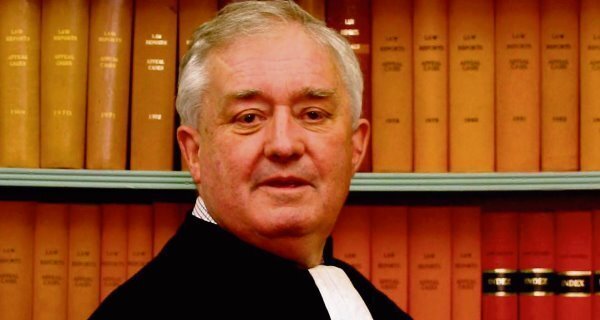
Adrian Hardiman believed profoundly in the democracy of political process
There is a lot of furrowed browed tut-tutting about the rise of an unhouse-trained ‘nihilist’ left, writes Gerard Howlin

Adrian Hardiman believed profoundly in the democracy of political process

THE finest accomplishment of the late Mr Justice Adrian Hardiman was the tally of 854 votes he secured as a defeated candidate in the local elections of 1985.

There is a coincidence in the timing of his passing and political events now. Having stood in the Dún Laoghaire ward of Dún Laoghaire-Rathdown County Council for Fianna Fáil he had an enduring, but not un-sceptical respect, for the democratic mandate. It is spurious to attribute views to people you did not know but his considered judgments in the Supreme Court upheld the prerogative of the elected legislature over the pretensions of an unelected judiciary and unelectable chattering class.


I was on the edge of company years ago, when the Progressive Democrats were founded and the late Adrian Hardiman was present. He was quite the star — socially and politically — and only 35 at the time. One of those at university who make a mark that is never forgotten; no matter how old or addled they all become afterwards. But for Hardiman, there was no old age. He went down like a shooting star; burning bright at the end.

Whatever the personal views of the private man may have been, and I did not know him, as a judge of the Supreme Court he enacted a strong, continuous respect for the prerogative of the legislature. A political activist first in Fianna Fáil and then the Progressive Democrats, it appears he believed profoundly in the political process, mediated at the ballot box, as the fulcrum for debate and decision in a democratic society.

Many don’t. They are lukewarm, having an acquired fey indifference and snobbery of a would-be elite or worse the self-aggrandisement of those who innately believe they know best. For them, the raucous mess of the hustings can only to be looked out at from the comfort of a Foxford rug spread on the ditch.

Some of our current anti-political mood derives from glaring failure within politics itself. More of it comes from the lack of functionality of essentially 19th-century structures of state in the 21st century. However, more of it is the rotten fruit of the indolence of the most educated, privileged generation in Irish history. In refusing to take up the responsibilities of citizenship; in delegating to an undefined “them”; and using disparagement as projection away from the responsibility innate in their own citizenship, a vicious cycle of disempowerment is born.

Tomorrow as Hardiman is buried, the 32nd Dáil will meet and elect a ceann comhairle for the first time by secret ballot. That itself will be a small step forward in strengthening the legislature: Too long easy prey to both judiciary and executive. The secret ballot is a corner-stone of democracy. Its application in the legislature, where accountability must be paramount, requires reaching a high threshold to justify. That threshold is the requirement of TDs, much like citizens, to be free from the influence of those they are beholden too. The election of a ceann comhairle, the cornerstone of a functioning legislature still to be put in place by the unanswerable, independent mandate of the Dáil, is such a threshold. It is not a panacea, but it is a correct step.

Looking back at old coverage of a very young Hardiman in the bear pit of debate on the Eighth Amendment, his theme was the overweening, inappropriate interference of the Church in private morality. That is a well-rehearsed, true story. What is less appreciated is how the Church of yore and to some extent still, was only the preeminent example of corporatism then but has since been overtaken by the State and latterly by global corporations. There is a requirement for perennial vigilance against all who would know best and consequently distain to account.

The gigantism of Church, state, and corporation are different dialects in the same language. Its most effective, insidious, ally is indifference. Some indifference is the artifice of distain; more is an authentic but futile reality of despair. Among what passes for an establishment in Ireland, and the very word is risible, there is a lot of furrowed browed tut-tutting about the rise of an unhouse-trained “nihilist” left. This fear is most acute among the physically older, politically tired left who having pioneered the politics of protest in their youth, went on to give it up for a life of smug self-satisfaction — and that tells a lot. In 1985 when Hardiman was defeated in Dún Laoghaire, Eamon Gilmore was first elected to the same county council for the Workers Party. The sow did eat her own farrow. And so it goes on and on.

There is little to fear from participation from Sinn Féin, Anti-Austerity Alliance, People Before Profit, or the rest of a so-called hard left. Indeed there is much to be reassured about. There is no criticism I could make of any of them that they would not gladly make more vehemently of each other. But the point is and, it is the respect they must be accorded, they do participate and they are strongly motivated. The only nihilism I truly fear is indifference or cynicism. That is fundamentally corrosive and worryingly more prevalent than ever.

A great concern now is that after tomorrow’s failure to elect a taoiseach, enormous pressure will be felt by Fine Gael and Fianna Fáil to form a government, any government, for the sake of stability. It presupposes firstly that we have a crisis of some sort, when demonstrably, we have none. Secondly it forgets almost instantly the lessons of the crash which was that our unfit systems were the primary contributory cause. Most of those systems are intact and still unaccountable.

In a state that has surpassed the Church in its reach and influence the inculcated self-belief of one has passed seamlessly to the other. Any question is a perceived attack. The state unchained is not the natural friend of the citizen. It is a predator. It is a necessary means to deliver functions we cannot deliver alone but, it always come at a price.

As a judge of the Supreme Court, Adrian Hardiman understood the incessant, creeping reach of the State. It is endemic in every large organisation and many small ones. Whether they are Church, state or corporation, makes little difference. Our liberty depends on individuals being free and ready to pay for that freedom with continuing vigilance. Vigilance can only be achieved effectively by participation.

Ultimately the death and burial of all public figures is an intensely private moment. Adrian Hardiman the public man, however, did not aggrandise his judicial office at the expense of public liberty or the prerogative of the elected Oireachtas. Not every judge can say the same. He stood on the hustings before he sat on the bench. He went door to door to ask for the confidence and consideration of his fellow citizens.

Which of us has received the vote of 854 electors to represent them? Very few indeed!

x

More in this section

Revoiced

Newsletter

Sign up to the best reads of the week from irishexaminer.com selected just for you.

Cookie Policy Privacy Policy Brand Safety FAQ Help Contact Us Terms and Conditions

© Examiner Echo Group Limited