Why is Micheál Martin so afraid of getting into bed with Enda Kenny?
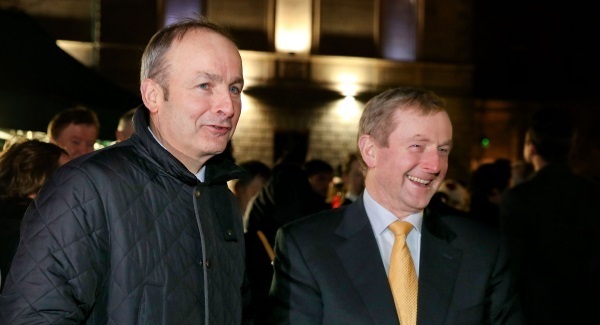

Just hours into the 32nd Dáil, late on Thursday evening in the chamber, something remarkable happened.
Amid some antics — described by Brendan Howlin as “bullying” — by members of Sinn Féin and the Anti-Austerity Alliance, an unprecedented act of co-operation between Fine Gael and Fianna Fáil took place.
As Sinn Féin and Paul Murphy TD attempted to put a motion to abolish water charges on the order paper, several Fine Gael ministers including Frances Fitzgerald and Simon Harris sprang into action. While the vote was called and the microphones went silent, they crossed the floor to confer with members of the old enemy, Fianna Fáil, about what was happening.
It was not in either party’s interest to allow Sinn Féin and Murphy succeed and they agreed with each other to stop it. So with the help of the Labour Party, the two parties united and saw off the attempted stunt.
The significance of the impromptu deal was quickly apparent with one Fine Gael spin doctor feeling the need to text: “FF voting with FG already. On Water”.
Politics is often described as the art of the possible, but Thursday’s events were a case of what was necessary, even if that meant Fine Gael and Fianna Fáil working together.
So, if they could do it in this one instance, what is the major stumbling block to the notion of a grand coalition between the two parties? Just why is Micheál Martin so afraid of power?

On Thursday, Martin went the furthest he has gone in terms of ruling out a deal with Fine Gael, saying his party have no mandate to put them into power. The Irish people did not vote for Fianna Fáil and Fine Gael to go into government together, Martin said outside Leinster House.
Surrounded by his expanded Dáil party members, Martin said the mandate given to him was to change the Government: “We didn’t get a mandate to go into government with Fine Gael and we certainly didn’t get a mandate to put Fine Gael back into government.”
Martin restated his position that Dáil reform must take place before negotiations begin on the formation of a new government: “Our objective in terms of the present situation is that the people voted for change.”
Martin’s comments came after we reported last Tuesday that Kenny and Fine Gael were about to reach out and “make an offer” to him in a bid to form a Coalition.
We reported that Fine Gael was and still is willing to give away half the Cabinet and also look to a rotating taoiseach arrangement in a bid to retain power.
Our story was followed up by a remarkably similar piece on the front page of the Irish Times 24 hours later, which sent the rumour mill into overdrive.
Martin’s visceral rejection of the overtures from Fine Gael was driven by a similarly visceral outcry from the Fianna Fáil grassroots who are not prepared to countenance a deal of any kind.
Is the opposition to a deal with Fine Gael to do with lingering Civil War type hatreds and mistrusts? Probably, but there is another reason.

Martin, the man who has brought Fianna Fáil back from the dead in 2011 has to walk a tightrope as regards where to position his party. A major reason why a deal with Fine Gael is off the table for now is Sinn Féin.
Martin and his party have Sinn Féin breathing down their necks and the events of Thursday evening in the Dáil was a tangible example of that. By joining with Fine Gael, Martin would be granting the status of lead party of opposition to Sinn Fein.
Such fear of “the Shinners” is widespread within Fianna Fáil and is largely overplayed, but presents Martin with a real dilemma.
He knows he runs the risk of losing as many as five of his TDs should a deal with Fine Gael go ahead, and there are others like Éamon Ó Cúiv and John McGuinness who have openly expressed a willingness to sharing power with Sinn Féin.
So with the Grand Coalition idea ruled out for now, talk has returned to the subject of a minority Government.
Around the Dáil on Thursday and yesterday, Fine Gael TDs conceded their preferred option of a coalition deal with Fianna Fáil is now not possible.
But almost all made it clear they have no interest of being “held hostage” to a minority government.
Speaking to me, Fine Gael ministers have said they would seek rock solid assurances from Martin for any minority government arrangement to work.
Fianna Fáil sources said they are open to supporting a minority government in a situation were “votes can be lost except on a budget or vote of confidence before a government could fall”.

The source said it would effectively be a halfway house between a minority government, as has previously been known, and a full-blown coalition.
“A minority plus Government,” was how one minister described it.
But equally, a growing sense among backbench Fine Gaelers that they would be better going into Opposition and propping up Fianna Fáil.
“They would be in office, but we would have the power. We would dictate budgets, policies and they would take the flack for it,” said one TD.
But, to my mind, a minority Government of either kind, is too unwieldy and unworkable and too open to be pulled down by the deep mistrust between the two parties.
Last night, it was becoming clear that Kenny and Fine Gael are now once again prepared to look beyond Fianna Fáil and re-double their efforts to court Independent support.
References to the 1948-1951 inter-party Government resurfaced yesterday with the hope of adding to Kenny’s level of support in the Dáil.
With the support of Michael Lowry now promised, the gap between Kenny and Martin stands at eight and Fine Gael sources feel this widening gap is too big for Micheál to close.
Kenny, who appeared jaded and under pressure in the Dáil corridors yesterday, travels to the US on Monday but has decided to curtail his trip to ensure he is back in Dublin on Wednesday to oversee the talks. He is fighting for his political life and is not willing to go down without a fight.
Martin may be in a position of strength at the moment, but his outright refusal to deal with Kenny may come back to haunt him.
The electorate will not thank him or Kenny should a second election be needed. And certainly, fearing Sinn Féin is most certainly not a good enough reason to force the people to the polls again.
CONNECT WITH US TODAY



Be the first to know the latest news and updates