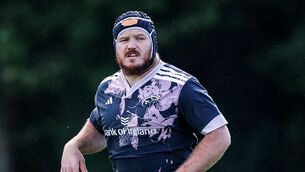
The curious case of ‘All Black No. 686’ who went to ground
There have been 1,108 of them since Dave Gallaher, from Ramelton on Lough Swilly in Donegal, kicked the whole thing off as skipper of the pioneering untouchables of 1905.
More than 400 have come and gone since Keith Murdoch disappeared halfway through the British and Irish tour of 1972-3.
Even now, almost 40 years after one of the murkier episodes in New Zealand’s rugby history, he is still the only touring All Black who never came home.
Nobody will ever know for sure how much pressure, if any, the British and Irish establishment as the Four Home Unions put the New Zealanders under to make an example of the brooding prop with the Zapata moustache.
The Kiwi management took the drastic action after a security guard accused Murdoch of assaulting him at the Angel Hotel in Cardiff where the tourists had been in celebratory mood after beating Wales 19-16.
They did so, ironically, thanks to Murdoch’s first Test try. He would never get the chance to score another.
The draconian punishment and the player’s subsequent disappearance into the Australian outback has left some of his old team-mates nursing regrets which have not withered with the passage of time. Four decades on, nobody feels that more than Tane Norton, hooker in the 1972 team and one of those heading for the reunion in a place called Oamaru, Richie McCaw’s hometown on the east cost of the South Island in the province of North Otago.
Norton, All Black captain when the Lions lost here 3-1 in 1977 and a past president of the New Zealand RFU, wishes it could all have been done very differently. Given his time again, as he admitted yesterday, the players would have stood behind Murdoch and given tour manager Ernie Todd a simple ultimatum: “If he goes home, we all go with him.”
A former tomato farmer whose Christchurch bar business has been hit by the city’s earthquake, Norton said: “You regret some things during your life and this is definitely one of them. It was a very sad moment, the saddest memory for most of those who were on that tour.”
Norton and the rest of the players were sitting aboard a coach outside the hotel ready for the trip from Cardiff to their next match, in Birmingham.
“It all happened very quickly,” he said. “Keith came to the steps of the bus, went back to his room and then was gone. I can’t remember exactly what he said but he didn’t tell anyone he was going home. We think it could have been handled a lot better. Ernie Todd was our manager and we didn’t realise at the time how ill he was. If he hadn’t been, the whole thing might never have happened. The last thing I remember was that Keith seemed to indicate that they wouldn’t see him again in New Zealand.”
True to his word, Murdoch hopped off the plane at Darwin on its last refuelling stop before crossing the Tasman. Since then he has turned himself into the most reclusive All Black in history.
The more the Murdoch mystery endures, the less the likelihood of his ever telling his side of the story.
New Zealand’s foremost rugby journalist, the late Terry (TP) McLean, summoned all his nous and tenacity to track Murdoch down to a quarry in the vast hinterland of Western Australia during the 80s.
TP found his man driving a gigantic earth-excavator and brandishing an almost equally gigantic monkey-wrench.
The conversion is reputed to have gone something like this: TP: “Hello, Keith. Long time no see.”
Murdoch: “McLean, you’ve got 60 seconds to get your a*** out of here.”
End of interview.
Norton and his contemporaries are not the only ones regretting their last sighting of the man on that wintry Monday morning in downtown Cardiff. Peter Bush, the most celebrated of all rugby photographers, talked his way onto the Qantas plane out of Heathrow a few minutes after Murdoch boarded his flight to oblivion.
His chief regret is not buying himself a return ticket for the first leg of the journey, to Frankfurt. Bush, still going strong at 80, has been waiting half his life to deliver a ‘huge packet of pictures’ to Murdoch.
“I got on pretty well with Keith back in those great old days and there’d be plenty to tell you he got a raw deal,” Bush said. “I’m pretty sure that if I see him, he’d say: ‘You’d better have a drink seeing as you’ve come this far.’ Then again, he might just tell me to get on my bike.”
Over the years, every attempt to contact Murdoch has fallen on deaf ears, every invitation to official dinners returned unopened. “Some of the boys have tried to contact him over the years,” Norton said. “I’ve tried myself but Keith is one of those guys who wants to be by himself.”
Murdoch’s profile has only been disturbed once, 10 years ago when police cleared him of involvement in the death of an Aboriginal youth whose body was discovered in a disused gold mine in the Northern Territory. He went straight back to ground and has remained there since.
Murdoch turned 68 earlier this month, not that it would have occurred to anyone from the establishment to wish him many happy returns had they known. When the beer is flowing and old stories are retold of the 72/3 tour in Oamaru this weekend, it can be assumed that Murdoch will not make a surprise appearance.
“It would be fantastic if he did,” Norton said, wistfully. “Maybe one day. You never know…”

CONNECT WITH US TODAY



Be the first to know the latest news and updates