The final word on Paul Galvin
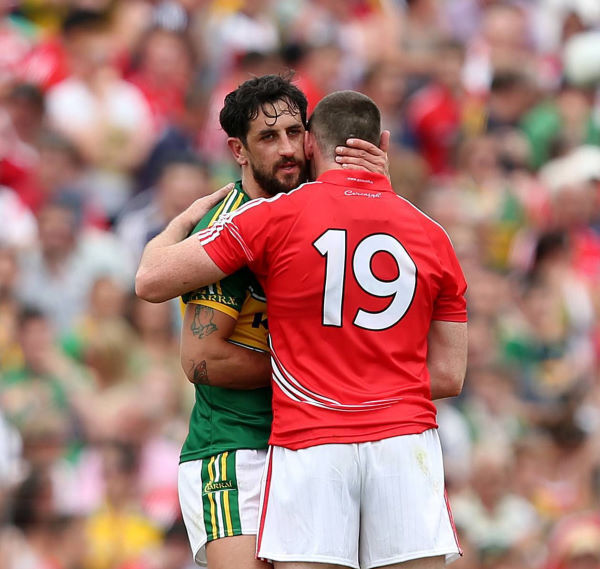
Wordplay. Words and play. The nouns and fields that define Paul Galvin. The truculence. The stubbornness. The competitiveness. The grit. The defiance. In his words. His vocabulary.
Meeting Paul Galvin again after years without words was always going to be interesting. This wasn’t a first date like the one with Louise when she asked what he liked reading.
A vocabulary, he said.
She laughed.
And laughed some more before realising he was serious. He felt uncool for a moment before Question Time started. What does this word mean? What about that one? Noun or synonym? Should this be so competitive.....? “I wanted to be a writer. It’s part of the incentive for the book. In school, I thought about journalism.
I have a fascination with words.”
This is Paul Galvin. Just different. Different in one important way to the Paul Galvin you thought you knew half a dozen years ago. Back then emotion mastered him, moulded him. On the field.
Frequently off it. But with Enda McNulty’s help, he went in search of an emotion by-pass. On the pitch at least. He’d learn to ask questions first, not later. Think, not combust.
“Words help me make sense of life, situations and people. I only discovered it towards the end of the book. Words have been very important in my life. Being able to rationalise things and events.
“A lot of confusion and problems in people’s lives comes from not having the right word for a problem or a person. If you don’t have the right word, you’re failing to communicate properly with that person.”
Take your choice from the words that characterise the Paul Galvin you think you know. They come in multiples. He is a palate of colours and moods. Most don’t look beneath the hood though. He likes that because he wants that. Galvin likes elusiveness. But there are thoughts and events in his autobiography that colour in the outline.
These aren’t just on Penny Lane, where he tried to grow up, on the edge of a forest between Lixnaw and Causeway. They are on New Year’s night in the Bahamas in 2010, where life is good, the cocktails are flowing and Galvin has climbed on a bar stool only to get a dreadful crack on the back of the head. His Kerry team-mates, All-Ireland champions for the 36th time, are buckled over laughing.
“Someone had thrown a bottle at me,” assumes Galvin in his autobiography. Tommy Walsh looks guilty. “Who the f**k threw that?”. Walsh points to the fan on the ceiling. “It nearly lobotomised me,” he writes.
Galvin has taken on Cork men and Aussies, Tyrone and Kilmoyley. But getting him some payback on the ceiling fan with rotor blades for arms was going to be difficult. But it didn’t stop him plotting.
“I had a bit of a vengeful side in me, for sure. I’d have broken that thing off the wall if I could, the fan. Had I my way, I’d have found the switch, turned it off, and yanked it out of the wall. F**ked it on the ground and left.”
There was that cliff jump in Negril. In Jamaica. A 40 foot drop. When you went through the water, you kept going south. And south. Seamus Scanlon did it. Kieran Donaghy too. Galvin had no shorts with him, and he couldn’t swim. He could remedy the first, not the second. He could neither remedy it or accept it. He went back to the hotel but the cliff jump grated like a stone in his sandals for the day. He had to go back. He had to jump. He had options but defeat wasn’t one. Donaghy knew what he was thinking. “I’ll go down first and wait for you in the water,” he offered.
It summed up playing for Kerry in a heartbeat. Sacrifice. Brotherhood. “Star has a very paternal side to him,” Galvin says. “People see him laughing and joking, but there’s another side.”
There is another side to Galvin’s defiance, and it caused him plenty of bother in his ten-year ride with Kerry. It made him a zealot, a blinkered sonofabitch to play against. Once Stephen Stack from Listowel asked what drove him. Paul thought a bit about that, back to a time when he was 14 and they sneered at him going to Kerry hurling trials. You coming along to make up the numbers? “F**k you old boy, I’ll show you.”
Proving people wrong. Not shirking from the challenge. Whatever the challenge. Along the way, there were casualties and relationship breakdowns. He knows that now. He knows he’s not in a position to be telling everyone damn you and plague on you too because one has to take account of oneself too.
“I did things because of me.”
But the book hasn’t been written for cathartic reasons. It’s for context. Closing chapters. Dealing with glory and ghosts.
“Yes there is a creative or artistic element, but primarily the reason for the book is putting context on events in my life. That was the driver. I think I’ve done that in a fair way. While I was never the guy — and I’d make this point strongly — going out looking to cause bother, I always went out to win games. I needed to be one of the best players on that field. If I wasn’t man of the match, I’d be asking myself why.
“It was not in my psyche to go out and try and get a guy sent off or come up behind a guy and give him a box. Never. I’m talking about starting trouble. I was never shy if a fella came at me. I didn’t hold back. But I never went out looking for trouble, or instigate bother. I might have hopped off a few guys along the way but that was the name of the game. I never went out with a premeditated plan to do something like that. I could never understand a fella following you around the field, trying to stop you.”
Like Noel O’Leary, with whom the enmity doesn’t remain, like it might with others. However when Galvin characterises their relationship as more panto than rivalry, he’s not really laughing.
“It was embarrassing at times. The audience loved it. I tried to box clever and get out of there.
“I wondered whether his manager saw him as the footballer he was or as an instrument to use against me when we played?
“Maybe my previous left me vulnerable to that attention. I got the feeling that if both of us got sent off, it was mission accomplished as far as Cork were concerned.
“It was almost a case of ‘Galvin’s playing, sure we’ll throw in Noel and let them at it’ like we were two dummies who knew no better than to fight. I have no respect for that. I wanted to play football.
“I got the sense that they were willing to take the hit with losing Noel if it meant I was off the field too.
“Cork played like they didn’t care about each other at times and it struck me that their manager didn’t seem to care too much about Noel O’Leary at times also.”
This and others he’s addressed in the book, but some days he won’t dignify.
“I didn’t do it (the book) to settle scores. If I’d a proper gripe with a fella, I’d have it out with him. I’d pick up the phone or confront him face to face. I don’t feel books are for settling scores, but each to their own.
“Some scores weren’t worth settling. That club final incident against Cookstown in Croke Park? That was ugly, I didn’t want me or my family reading that in 20 years time, about some fella running up behind and spitting on you. Anyway I addressed it how I wanted to at the time. Not a very nice experience and I don’t want to be reading about it down the line.”
His annus horribilus was not Paddy Russell and the six-month suspension in 2008 — the year of the lost Kerry captaincy — but 2010, the season he found his best form, the year of his greatest display in green and gold — at Páirc Uí Chaoimh. Two incidents with the same player, Eoin Cadogan, soured him that year, and he finished it embroiled in a bizarre furore over a thrown duster in a classroom at St Brendan’s College in Killarney.
“That year was a nightmare, more damaging to me than 2008, to my football reputation, and to my career. It did me a lot of harm to get suspended twice in the one year, particularly that (League game in February) Páirc Uí Rinn thing. That was wrong. It was too much. I had to shut up, there was nothing I could say. The whole year was damaging for my career.
“I’m being balanced in this book, there is an accumulation of things I did with my temperament and personality. I was combustible, emotional. Then one day I said, ‘emotion gives you away as a person’. Emotion allows people to get such a handle on you. They think they have you. You sell yourself, you give yourself away. You allow people to label you. And you get to the point where you say, ‘I’m going to address things’.”
It’s 13 years since that evening in The Bailey when the Cork boys landed. That Paul Galvin was full of dreams and ambition and a bit of madness. Though Kerry wouldn’t call for another two years, he was getting ready. The Cork players were just supping after a League game, but their presence got him all riled again. They were there in front of him. His trigger. In the dead of night, he’d wake up and get out of bed on the floor to do his operated shoulder rehabilitation. This night nothing would do but upstairs to the toilet in The Bailey for a brisk 100 press-ups.
“People would have used that word (madness) about me a bit and at times, maybe I was. It was a competitive madness. In games, I changed. I would change in the dressing room, my mindset would completely change. I would see it, this is a battle, a war I could not allow myself to be dominated. That’s what it was. Small things used annoy me — if my man touched the ball, I would get cross, that would annoy me. Is that madness? Well, the Kerry teams I played with, there was a lot of mad men there so.
“When I zone into something, it’s all I can think about. When I did this book, I did it quite quickly, because when I focus on something it takes over. Louise couldn’t talk to me. I was shaping it in my head, the writing part of it wasn’t hard at all for me.
“Jeez I look back at that night now in The Bailey, and think ‘that’s not really normal’.”
‘Cork had some great players but they were also predictable’
Cork played a significant part in Galvin’s football and his education but years with UCC or teaching in Coláiste Chríost Rí didn’t spare him from sledging that at times bordered on sinister.
“Cork and Kerry are two very different football cultures. There are Kerry footballers that would never make it in Cork, they would fall by the wayside. And vice versa. I think they weren’t used to a Kerry footballer playing the way I did, I wasn’t a stylist, I went in and upset people. I was aggressive, I played a certain way and I had my run-ins. Rival counties will pick out a fella — Darragh and Tomás got a bit of it, I got a bit more.
“Cork had some great players and were hard to handle physically. But they were also predictable.
Jack was clever, he had ideas, Cork seemed to have one idea. And this dummy teams lark...”
He sat too close to the burning embers of Kerry’s football hegemony in 2003, on the sideline in Croke Park as Tyrone swallowed Kerry whole. It was a seminal moment, vividly described in the book. It was also the beginning of his green and gold tour of duty for Galvin.
“It was like looking at a battlefield. There was bodies everywhere and they were all our fellas on the ground. It did feel like a war. But I found it exciting, I was energised by it. That was my reference point in 2004, and when Jack O’Connor was explaining ‘this is the game now’, I was like ‘I know Jack, I was on the sideline looking at it’.
“It’s funny, that day against Tyrone was like anything goes. But then when I come in and it’s anything goes, it’s a big problem for everybody. Sometimes, even now, I can’t understand the raps I got. Throwing the bottles against Armagh in 2006, that was not a clever thing to do. Sometimes you can’t come out looking to blame other people. But there are other times — that Páirc Uí Rinn game and the suspension, that was just wrong, all wrong.
“I don’t know what to say about that other than it was a decision reached through guesswork more than anything. I did no more than defend myself and I certainly never hit anyone, which I was suspended for. It was the perfect storm for Cork on the back of the ‘09 final and Tadhg’s book. I was nicely caught. I wondered for a while after what was said by the other party in those disciplinary hearings. Then I started to look ahead. I took it on the chin and waited until June to beat them.”
A league game in Tralee against Armagh in his first full season had Kieran McGeeney looking quizzically at Darragh Ó Sé between the pucks, wondering who this young punk thought he was.
“I hopped off him a few times alright, but to my mind McGeeney was a player, I enjoyed the McGeeneys, the Ciaran Whelans, big operators around the middle of the field and I wanted to make life hard for them, I enjoyed that. It challenged me. It was like ‘who’s the big guy here now?’ I’d make sure he knew I was around, and I don’t mean that it a sinister way at all. I wanted to be one of the big boys and if you wanted to be a big boy, you had to take on the big boys.”
This was Paul Galvin back then. No All-Irelands but lots of attitude and ambition. And emotion.
“I started with my body language always, I made myself big and aggressive at the start of my career. I would get to my spot first and go straight at him and straight through him. If he gets the ball, be all over him to such an extent that it would make him not want the ball any more. It was very emotional stuff that was driven by a massive pride in Kerry football. Playing with these warriors — that’s a good word for them — with Darragh here in the dressing room, Seamus Moynihan there, Tomás behind you, Gooch over there. I was just bursting with pride that I was taking the field with these lads. I would have done anything for them.
“I was like ‘there’s no way anybody’s beating these lads if I can do anything about it’. I played on that for a long time in my career, but you can only get so far with that stuff. You only get a certain type of performance on that — it’s physical and it’s aggressive, but it’s blind as well. They are the days you get in trouble, you get distracted.”
That’s why he admires Gooch. And Darragh Ó Sé.
And Zinedine Zidane.
“Gooch is cold as ice. Darragh is calculating in terms of losing his rag. If he does, he has a reason.
But I used always look at Zidane in his best days. He had a streak in him too but at times his displays were almost spiritual, he looked serene to me. It was like no one else was on the field and that appealed to me. That’s a much better way to be.
“Gooch that day of the (2007) All-Ireland final. That time is burned into my head. 1.50pm, less than two hours to the biggest day of our lives and he’s fast asleep in the hotel bed. When I woke him, he had a stretch. He has that coolness. It’s cold.”
If 2009 was the zenith — perhaps because it delivered an All-Ireland and he was named footballer of the year — Galvin thinks his form was better in 2010 and 2012, when Kerry never got beyond the quarter-finals. But the latter did include a qualifier day heavy with emotion and littered with baggage in Killarney against Mickey Harte’s Tyrone. To this day, Galvin thinks he cost Kerry the 2008 title through his suspension that season.
“I blamed myself for not being available. The emotion still came through the odd time. Mickey was grieving still over Michaela and the trial that followed. I did a tv interview I probably shouldn’t have.”
Louise Duffy has had a balming effect. She’s mellowed him since the day they met in Castlebar three years ago.
“She’s great fun,” he says of his fiancee from Mayo.
“I like being around people who make me laugh. That’s why I hung around the Ó Sé’s so much, especially before games. I’d be stuck to them, laughing my ass off.
“They’re totally irreverent, and I love that quality in people. Massive courage. Tadhg (Kennelly) was the same. Irreverent, huge heart, huge courage, that suited me.
“I love being around big characters, fellas with a bit of devilment. And the opposite type of person has a draining effect on me. I get uncomfortable around quiet types that are nervous. On the weekend of games I love being around exuberance, laughing.
“Taking momentum away from the opposition is the key to a great player, and that was Darragh.
He could do that quite a bit. He had an aura about him. Rarely have I been inspired on the field but he inspired me. There was an energy off him. Gooch could win a game but he needed Darragh to influence it first. Bolder than a brass band were the Ó Sés.”
Declan O’Sullivan was the one Galvin felt was a kindred spirit. Bold, defiant, proud.
“He’d act when it was really needed, he’d get bold. When it was looking bad, he’d get cross. If it was gone south altogether, he’d get even more cross. There was no end to him then when he got like that. Pure pride and temper. He’d often turn it around but even when he couldn’t, he’d let fellas know.”
Paul Galvin’s life is in Dublin now, though so long as he can lace boots, he’ll play with Finuge and hurl with Lixnaw. Football’s down the field now. Prior to September’s All-Ireland final against Donegal, he’d seen ten minutes of Kerry this past summer.
He doesn’t appear to be missing it. Then as we part at Heuston Station, he brings up Eamonn Fitzmaurice’s personal letters to the Kerry players the night before the final last September.
“There was a bit of a pang there when I read that,” he half-smiles. “I would have liked to get one of those.”
The words. It’s all about the words.

CONNECT WITH US TODAY



Be the first to know the latest news and updates