A taste of paradise in the Maldives, where the ocean is electric blue, the sand sugary white
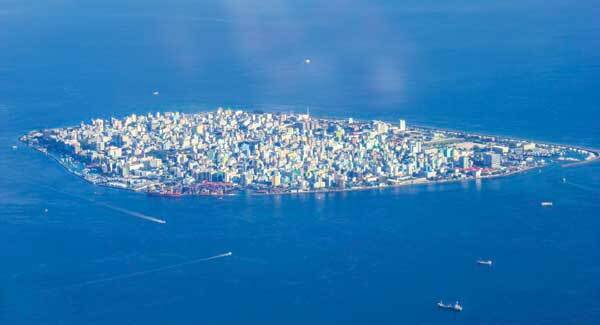
The natural beauty of the Maldives could make a believer out of the staunchest atheist.
From the day-glow wrasses which feed off the debris on parrot fish, to these vibrant parrot fish waste products which form the sugary sand, to the sand and exotic coral reef which provide food and shelter to sea life: the ecosystem is so beautiful and so balanced that even Richard Dawkins might wonder if there’s larger forces at work.
Lucky for us, nature’s helping hand has extended to the tourist - well, the tourist with a sizable budget - as the tiny islands that form the Maldives are so resort-sized that 120 of them have set up shop, claiming a coral reef island each.
These resorts range from three-star affairs to ultra-extravagant getaways for the over-rich, though most are four or five star hotels, and high-end ones at that.
For while the star system varies in different countries, the competition in the Maldives and its base expense caused by importing goods to its isolated location means that the standard is elevated considerably.
Good news for those shelling out the high prices.

But, as those who’ve ever picked a bad resort and stuck with the same dire food for seven days can attest to, it’s important to choose wisely.
To gauge the differences between what’s on offer, I divided my recent trip between resorts.
Like a pub crawl, but with paradise islands instead of busy bars.
After arriving into Male Airport, an island off the coast of the capital that houses only the airport itself, it’s a short domestic plane ride and speedboat away from Six Senses Laamu.
This is when my first preconception is debunked: no island is so isolated that there’s nothing but horizon as far as the eye can see. Even here, plopped in the middle of the Indian Ocean, the atoll formation produces a number of visible islands in the ring. But that doesn’t stop it from feeling like paradise on Earth.
The ocean is electric blue, the sand, sugary white.
My shoes were whipped off as soon as I set foot on the island – where we’re going, we don’t need shoes.
Accommodation is an overwater villa. It was a walk away but aided by the bicycles they loan to all guests (or tricycles if like me you missed the bit in your childhood where you learned how to ride a bike).
I had perused the pictures on the website before, but still my jaw dropped as I entered. The design was fabulous, even down to the glass-bottomed bath which allowed you to see stingrays float by as you bathed.

As it’s completely isolated, with a deck that takes you straight into the marine life-filled sea, it’s an obvious choice for couples; contrary to popular belief, most guests aren’t honeymooners but couples enjoying a well-earned break.
Being a Six Senses hotel, the spa was its piece de resistence.
Making the most of its idyllic location, there were no treatment rooms – instead, there were treatment pods made of vine, and open to the elements enough that I watched the postcard view of rolling turquoise waves as I indulged in a much-needed massage.
The hotel had nice details too, from their beachside cinema with perfect sound, to playing classical music to the water served to guests. I didn’t leave the island so much as float away.
I thought I’d found perfection, but Coco Bodu Hithi, an hour by speedboat away from Male Airport, made me reassess.
Immediately the differences present themselves: while Six Senses was a manicured island of paths leading to various parts of the complex, Coco Bodu Hithi retains a jungle feel, with trees lurching over you and huge villas obscured by thick vegetation, making them a honeymoon hideaway for land lovers.
For water babies, however, there’s a large selection of spacious water villas, which lead directly out to their luminous blue waters - so clear that the only thing stopping you from seeing right to the bottom at any point is the gentle waves.
The marine life is phenomenal everywhere in the Maldives, but perhaps aided by a snorkel with the marine biologist who pointed out the breadth of life and activity in its waters, more of it came to my attention than ever: the delicate yet dangerous coral reef, the American football-sized clam, a huge sea turtle by the name of Yang Bao, who upon seeing us, nonchalantly lifted himself off the sea floor and swum up for air alongside us, not a bother on him.

While at this point, rain stopped play – hardly traumatic as it allowed me to enjoy the villa - what struck me most about Coco Bodu Hithi was it was as peaceful as a resort could ever be.
Despite the good occupancy rate, you’d barely pass by fellow travellers on the way to the restaurants or gym.
And no voice, even in the bar, was above a functional level. It was blissful for anyone who gets caught up the white noise of everyday life.
So while Six Senses could be surmised by the word ‘indulgent’, file Coco Bodu Hithi under ‘tranquil’.
I expected the opposite from Kurumba, officially the oldest resort at 44 and the one nearest resort to the airport, being only 10 minutes away by speedboat.
I suspected it would be a bustling, noisy resort of blow-ins (relatively speaking of course - it was still a five-star in the Maldives).
It was certainly busier than the others: occupancy was at 80 per cent when I stayed out of season, and yes, I could see planes land on the airport, but it somehow reassured me that I was in my own cocoon of rest and relaxation (“look at those poor people on the plane, impatient to be on the beach like I am now”).
This also meant that when I felt like when I felt like plugging in, there were opportunities to mingle: special events like the manager’s cocktail reception and nightly entertainment encouraged this, and the staff were as much fun on duty as they were when off-duty and in the bar.
Of course on the evenings I felt like being anti-social, I dined at one of their quieter restaurants, like the sea-facing modern European, Thlia, for example, then retreated to my expansive villa, complete with its own pool.
So in the space of just three luxury resorts, differences in the styles of resorts are apparent.
But let’s not overstate this either; the biggest draw of any Maldivian island resort is the Finding Nemo ocean full of activity.
And the friendliness of the staff everywhere is beyond words.
It feels like natural hospitality rather than bend-over-backwards service.
So when it comes to picking a resort on the Maldives, as unique as the resorts are, the phrase ‘you can’t go wrong’ springs to mind.
Amen to that.
One-stop flights with Emirates, British Airways or Eithad Airways from Ireland to Male begin at €445
Shilpa was a guest of Coco Bodu Hithi, Six Senses and Kurumba. For information about Coco Bodu Hithi, North Malé Atoll, visit www.cocoboduhithi.com or email reservations@cocoboduhithi.com
Lagoon Water Villas available at Six Senses Laamu from $808 USD (€745) per villa, per night, on a B&B basis. For more information, visit www.sixsenses.com
Kuoni offers seven nights in Kurumba in a deluxe room, including British Airways/Sri Lankan flights from £1,521 (€2,045) per person, based on two sharing. To book, visit www.kuoni.co.uk
If it’s a good quality resort, watersports and indulgent spas will be the main activities. There’s likely to be excursions, for example a fishing expedition or lunch on a deserted island
The Maldives is prohibitively expensive, so just concentrate on bringing back lovely memories.
As you’re stranded on an island, your only choices are the hotel restaurants. But fear ye not — the standard is comparable with high-end eateries at home
- For more information about the Maldives, see visitmaldives.com

CONNECT WITH US TODAY



Be the first to know the latest news and updates