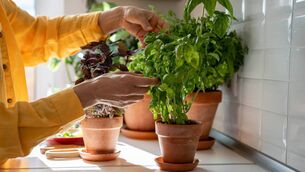
To feed or not to feed our flowering plants?

It’s the time of year that we need to keep feeding our flowering plants to extend their display.
Getting the best out of hanging baskets, window boxes and patio planters means feeding with a good liquid feed. Perennials too and roses will all benefit from dead heading and some fertilising.
Or will they? Is it all just a myth? A marketing ploy to keep us gardener’s buying plant feeds and fertilisers. Do they actually make any difference and if so which one should we use? Good gardening advice has always been that we should feed the soil and not the plant. The logic being, obviously, that if the soil has everything that the plant needs to thrive, then you shouldn’t have to add specific feeds.
For years gardeners like myself have been using and recommending high potassium feeds such as tomato food and sulphate of potash to encourage flowering but there is much debate at the moment as to whether potassium actually has any discernible effect on promoting flowers.To understand what plants need, it is important to have a grasp of the different nutrients and what each provide to plants.
Nitrogen is necessary for leaf production and green colour, phosphorous is important in root development and potassium regulates water and nutrient movement in plants and also has an effect on fruit production. Magnesium and iron are necessary for green leaf colour. When you look at a plant fertiliser you will see the NPK analysis on the packaging, this will tell you the ratio of nitrogen to phosphorous to potassium.
The Royal Horticultural Society (RHS) advises using potassium, but there have been many studies and trials undertaken that show potassium has no effect on flowering and its all just a myth.
It is certainly true to say that nutrients don’t promote flowers — hormones do and potassium is not a hormone so it cannot promote flowers. However, if a plant is suffering from a potassium deficiency then this will lead to stunted growth and this may limit flowering because the plant cells can’t divide to allow the growth.
There is no doubt that a potassium deficiency will reduce the quality of flowering and thus a potassium feed will improve the quality of the blooms, but there is little or no evidence to suggest that it will increase the number of flowers.
Why then have gardeners for generations used and still use, high potassium feeds to encourage flowering? Perhaps it’s because potassium is essential for the development of over 50 soil enzymes so the argument isn’t as clear cut.
There is still much in the world of nature and under the soil that we do not understand. So let me stay on the garden fence on this one, maybe the benefits of potassium as a plant food have been overstated or maybe nature still has much to tell us.
Let me tell you something about my friends the earthworms. They work like mini processors, ploughing through the soil, aerating and improving its texture. Up they come to the soil surface and munch away on pieces of leaf mould and other garden debris, regurgitating it as worm cast. Earthworms have been used in trials for sewage treatment plants and in this waste there are traces of heavy metals. When a worm feeds on the waste, there is no trace of heavy metals in its cast. There are traces of these same metals in the worm but when that worm dies he is devoured by another worm and there are no traces of these metals in the new worm. The more I work in the garden and the more I learn, the more I am aware of how much I have still to learn and how much I will never know.
I am a great believer in the logic of feeding the soil as opposed to the plant and I would encourage all gardener’s to invest in a wormery or worm composting bin.
The main feeding that my soil gets is what my worm bin produces in both worm casts and also the liquid ‘worm tea’ that is produced.
Both the casts and the liquid are extremely high in nutrient value but also, and more importantl,y they are probiotic which means that by adding them to the soil they will stimulate the beneficial bacteria and micro organisms already present. A wake up call to the soil if you like.
Worm tea is widely available in a locally produced product called Liquid Gold so even if you don’t fancy setting up the worm processing unit, help is still at hand.
Keep an eye out now for tell tale signs of vine weevil damage. Leave s of susceptible plants will be eaten from the outside in with tell tale signs. If you can remember the old weekly bus tickets that we used to get long ago — each day the conductor would punch a piece from the side. Well, that’s what a leaf looks like once the vine weevils have attacked — a well used weekly bus ticket.
It’s the adult beetle that causes this damge but the damage done by the larvae is more insidious and much more harmful.They will feed on the roots of host plants and their attack results in weakened growth and a plant loose in the soil.Because they are unseen, the damage is done before it is spotted.
Go online to supernemos.ie and read about this Irish-developed product and apply it to your garden now to eradicate this cursed pest.


CONNECT WITH US TODAY



Be the first to know the latest news and updates