Eyrie
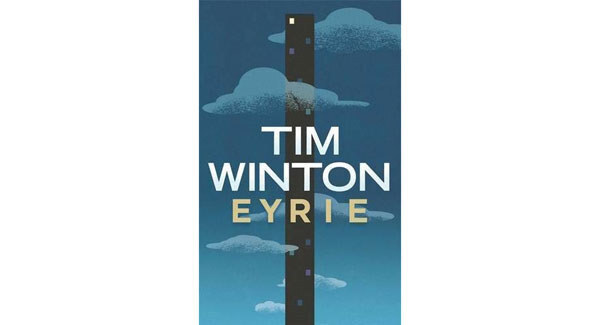
TIM WINTON’S ninth novel, Eyrie, opens with a hangover. Tom Keely wakes in his high rise apartment in Fremantle, and waits for the real pain to kick in. He can’t remember the previous night, and one leg is still intoxicated. He’s hiding from the world, and this reclusive state is new to him.
After a chance encounter in the lift, Keely becomes embroiled with Gemma, who as a child was once rescued by his parents, and her grandson, the sensitive Kai. Reluctantly drawn in to help the pair, he soon realises they bring trouble.
And if this synopsis sounds gloomy, Winton’s magic touch ensures that Eyrie is anything but. He reveals the past gradually, unpeeling it, layer by layer. It’s a book to savour; to read slowly in order to lap up the language. It’s tender, with both tension and heart.
I expect Winton to shrug off my praise. Twice Booker shortlisted, he has won the Miles Franklin Award four times, but he seems genuinely pleased.
“It always surprises me when people connect with my books, and get it,” he says, on a visit to Dublin. “I’m writing from somewhere strange to the rest of the world with this Western Australian vernacular, and I felt that this novel might not travel as well.”
The inspiration for Eyrie came when he was writing his last novel, Breath, which came out in 2008.
“The house was a bit crowded at the time, and even a bloke needs a room of his own. This little flat became available. Vertical environments are really porous. There I was, writing my book about the seventies on the South Coast and these boys frightening the hell out of themselves riding these big waves, while I’m in this space absorbing the atmosphere.
“Sounds move upwards in a cheap building. If someone is having a jolly moment, they could be two floors away but you feel like they’re in your bathroom. That’s what it was like. There was a great mix of the prosperous having a nice place in the city, to those downsizing, those renting, and the working poor in welfare flats. The book came from that chowder of humans.”
At the start of the novel, Winton knew as little about Keely’s background as the reader. Some have said that he based Keely on himself, and there are similarities. Both come from working- class backgrounds and later joined the bourgeoisie. Both worked as environmentalists, though in Winton’s case, it’s as a volunteer.
Unlike Keely, though, Winton remains happily married. The couple have three adult children and two small grandchildren whom he adores. A self-confessed workaholic, who is still consumed with his ecological campaigning, he does share his hero’s love of music.
Keely attends a concert when his mother, anxious for his welfare, hands him a ticket. The description of the young soloist performing Vaughan William’s Oboe Concerto was, to me, the most vivid scene in the book.
“I have a story about that,” says Winton. “I got a letter a month or so ago from an oboist who had read my book. She said, ‘I came to a scene and I got goose-bumps.’ She said, ‘it feels familiar.’ Essentially, she was saying, ‘I was in Perth five years ago and I was playing. I was reading the book, thinking, this can’t be me, this can’t be. But other members of the orchestra were reading the book too, and they said, It is you, it is.’” He laughs with delight.
“That was a lovely thing to happen,” he says. “I had gone to that gig and been swept away by her performance. I took almost everything from that experience of sublime music. It was the only part of the book that got close to journalism in terms of me faithfully reproducing a scene. Everything else was made up.”
All Winton’s novels start with a place.
“I take either a landscape, a cityscape, streetscape, or a building, as in this one and Cloudstreet, and that sets the agenda. The economy and ecology of the place determines the characters.”
His worries about his country surface in Eyrie, too.
“I am concerned about the dark side of prosperity,” he says. “We’ve come out of the mining boom in Australia, but all that means is we’ve gone back to being rich instead of strikingly rich. The curious thing about sudden prosperity is that when a bucket of money falls into our lap, within 10 minutes you feel like you have earned it [when] you were just standing in the way of good fortune. “There is a kind of moral blindness that comes with prosperity where you very quickly don’t notice those who are falling by the wayside. In retrospect, that was a great preoccupation with the book.”
He worries, too, that the new government is planning on peeling back on the progressive things that happened in the seventies, like free university education; something that changed everything for Winton’s family.
“My parents really did want us to have everything they didn’t have. They had a strong moral stance. My brother is a school chaplain and musician, and my sister is the youngest, and longest-serving director general of education.
“In contrast, my Dad got home from school one day and his mum said, ‘that is your last day at school. You start work on Monday.’ She had got him an apprenticeship as a cabinet maker. He said, ‘What’s that?’ He went, and cried on the bench every day for two weeks.” In creating Kai, Winton was projecting his worry about Australia’s children.
“We don’t have a culture now; we have an economy. I was trying to figure out Rachel Carson’s thinking in Silent Spring. She has this notion that you can gauge the health of a nation by how well the children are doing.
“Kai is like the canary in the mine. It’s terrible that in a prosperous country like Australia, we are damaging our children. But we are, whether through the narcissism of the wealthy, who don’t properly notice their children, or by the underclass of people in a state of disorder and addiction whose children are massively damaged and traumatised.”
In the book it becomes, almost, Keely’s mission to save Kai; but ultimately it is Kai who redeems Keely by giving him back his self-worth.
“The child was an agent of grace,” says Winton.
Addiction in all its forms seem to preoccupy Winton. Has he an addictive personality? “I have a compulsion to work,” he says. “But that’s non- destructive.” He adores surfing, but says that, unlike the experience of some of his friends, that sport has never put his relationships in jeopardy. “Though If I spend a few days out of the water I’m not the same person. I might come home after surfing sore and tired, but I’ll be happy.”
Recently, Winton moved from Fremantle to the country. He spends his summers on the Midwest Cast and his winters on the North coast. He once lived in Ireland.
“I had a travel scholarship in 1988,” he says. “I spent six months in a gate-lodge of a castle on the border of Tipperary and Offaly. I went on to Paris and then the Greek Islands. I wrote Cloud the book that put the children through school and saved our bacon.”
He talks again of his surprise, and delight, that his books do so well round the globe. I comment on his lack of ego, and he says he can’t stand books written from entitlement.
“It’s all, ‘of course I’m important.’ It’s amazing how much literature in our era is writers talking to themselves and their professional peers.” He shrugs, laughing. “Kill me now,” he says.

CONNECT WITH US TODAY



Be the first to know the latest news and updates









