Dolly The Sheep may have pushed stem cell research forward 20 years
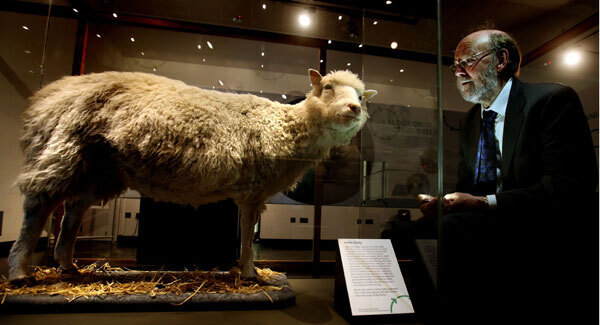
Speaking on the eve of Dolly’s 20th anniversary, Professor Ian Wilmut said widespread use of stem cell treatments was still likely to be “decades away”.
Controversially, he added he did not believe there should be a ‘red line’ ban on ethical grounds to modifying inherited DNA in human eggs and sperm.
It was his personal view that such “germ line” research either to defeat disease or provide broadly approved “enhancements” could be justified.
Dolly, who was born at the Roslin Institute in Edinburgh, on July 5, 1996, was the first mammal cloned from an adult cell.
Mr Wilmut said he had never hidden the fact that Dolly’s creation was largely a stroke of luck. She was the only surviving lamb from 277 cloning attempts.
The pioneering technique involved transferring the nucleus of an adult cell into an unfertilised egg cell whose own nucleus had been removed.
An electric shock stimulated the hybrid cell to begin dividing and generate an embryo which was then implanted into the womb of a surrogate mother.
The result was a newborn animal that was a genetic copy of the original cell donor.
Dolly died on February 14, 2003. She had suffered from arthritis and a virus-induced lung disease, and is thought to have aged prematurely due to being cloned from a sheep that was six years old.
Despite sensational speculation about human cloning at the time of her birth, Dolly’s most important legacy was a massive boost to stem cell research.
The same
technique used to create Dolly was adopted by other scientists to generate “induced pluripotent stem cells” (iPS cells) from adult human skin cells.
Such cells have the potential to transform into any kind of tissue in the body, raising the possibility of ethically-approved stem cell therapies tailored to suit individual patients.
Mr Wilmut said: “The odds are that somebody would have come upon iPS cells through a different route, but that process, which is key to a lot of things, would have been delayed by an unknown number of years. It might have taken 20 years.”
He acknowledged that he and others in his field had been over-enthusiastic and optimistic about developing radical stem cell treatments.
In reality, the obstacles to overcome were so great that it might still be decades before stem cell therapies become routine.
Questioned by journalists at a special Dolly briefing in London, he was asked if patients should not get their hopes up. He replied: “I’m afraid so — it must be terrible.”
He had a controversially liberal view of modifying human DNA, even inherited “germ line” DNA in eggs and sperm.
“I think as a principle there shouldn’t be a simple red line that says ‘no we don’t’. The question is what’s the benefit, what’s the risk of mishap, and does the one thing justify the other?
“If there’s a procedure that would enable you to either correct a disease or enhance somebody in some way, and approved within a broad context, then I would be in favour of it.”
Anyone tempted to have their beloved pet cloned should think again, according to the scientist who created Dolly the Sheep.
Even a genetically identical dog or cat would probably be disappointingly different from its original counterpart, claims Professor Ian Wilmut.
“Before they start they should recognise that it won’t be the same,” he said.
“I have a dog. If we had a clone which had been brought up under different circumstances, its personality would be different, apart from anything else.”
Cloning could not be guaranteed to produce a carbon copy even in terms of appearance, he added.
His dog was a “tri-coloured” Cavalier King Charles spaniel which was “white, brown and gingery”.
“If she was cloned almost certainly that coat pattern will be different, even if it was a genetically identical twin, because it all depends on movement of cells during foetal development,” said Sir Ian.
“In appearance and certainly personality it’s very likely to be different.”
On a superficial level, a new animal bought from a pet shop was probably going to be as good a match for a lost companion as a clone, the professor added.
Wilmut led the team that created Dolly, the first mammal to be cloned from an adult cell in July 1996.
He thought scientists would have to be “very careful” not to overstep the mark and go down the route of altering human characteristics such as physical appearance or intelligence.“I can’t imagine a time when that would be an appropriate thing to do.”


CONNECT WITH US TODAY



Be the first to know the latest news and updates