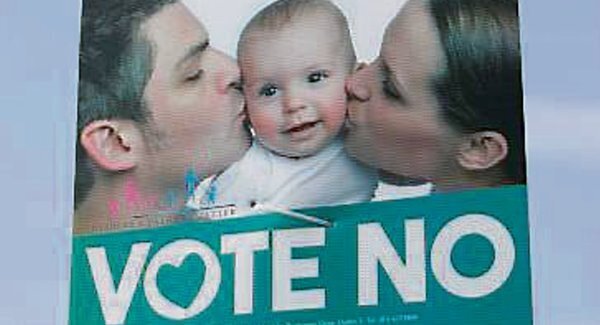
It’s perfectly logical to vote ‘no’ in the same sex marriage referendum
In the gay community I note that there are prominent speakers on both sides. I don’t detect unanimity on the issue.
The government parties are unanimous on ‘yes’. How authentic is this under a virtual oligarchy or government by a few, ie, the leaders and deputy leaders of Fine Gael and Labour, backed by a strict whip system which brooks no opposition?
‘Yes’ is the choice of the media. Hostility to the speakers for the ‘no’ side is obvious. When there are opposing panels on TV or radio, some presenters often align themselves on the ‘yes’ side. Speakers for ‘no’ can be subjected to frequent interruptions. A ‘yes’ speaker would seldom be challenged. After debates, a ‘no’ speaker can be the target of unpleasant attention, mainly personal abuse. Logical, reasoned counter-arguments would be a more convincing response. I would deduce from this that the abusers have no answers to the ‘no’ case.
The churches generally say ‘no’.
The Catholic Church states that “marriage is between a man and woman united in the sexual act which can bring a child into existence. No other relationship can do this. It is the essence of marriage. No other relationship can be called ‘marriage’. To refer to ‘same-sex marriage’ is clearly self-contradictory. To say that one is equal to the other is a misunderstanding of the essential meaning of marriage.”
From this, I can see that no believing Catholic can, in good faith and conscience, vote ‘yes’.
The other Christian churches seem to support marriage in its essence. A leading Ulster Protestant said on radio recently that marriage was between a man and a woman; he added that he did not think that he should be called a homophobic bigot because he held this view.
I note too, from the publication “Same-Sex Marriage Referendum. A Cross-Denominational Response” that many Protestant churchmen propose to vote “no”
The polls may indicate a 70% ‘yes’, but the ballot is the only true poll.
My own view? I note the the word ‘equality’ being used by the ‘yes’ lobby in a way which contradicts its essential meaning since it is obvious that no same-sex relationship can be truthfully said to be equal to the union of a man and a woman united in marriage, with the possible conception of a child resulting from such a relationship. Anything else does not make sense.
For me, therefore, it is common sense to vote ‘no’.

CONNECT WITH US TODAY



Be the first to know the latest news and updates