First Day of Dáil - The theory was sound. Pity about the reality


WE HAVE seen the future, and it bears near perfect resemblance to the past. Yesterday was the first sitting of the 32nd Dáil.
Thirteen days after an election that saw some serious changes, the new assembly gathered, and, give or take a few details, resumed where the last one had left off.
A new complement of TDs took their place in the House, amid the colour and emotion that informs such occasions. The gender imbalance of the Dáil was not as bad as it had been before the election.
There was a secret ballot for the election of the ceann comhairle, but beyond that, it was as you were — despite suggestions that a new way of doing politics was on the way.
Once Seán Ó Fearghaíl was elected as chair and then took his place, the election of a new taoiseach saw all the bad old ways come to the fore.
For more than 90 minutes, a succession of speakers — most from Sinn Féin and the Independent benches — rose and effectively refought the election.
Instead of looking to the future, they all wallowed in the past, berating the policies that sunk and refloated the economy to its current, precarious condition.
Ó Fearghaíl was even moved to intervene. “We are getting to a point where some of the very valid points are being repeated,” he said.
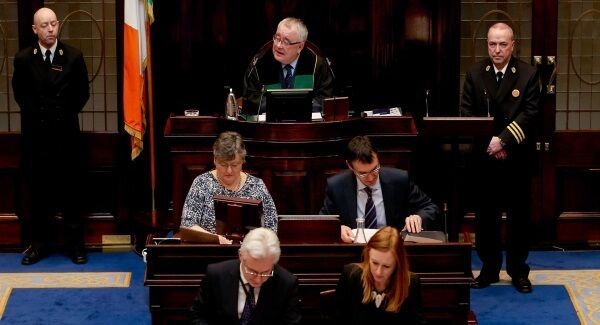
Following that, all parties went through the charade of voting for four different taoisigh, all of whom had no hope of winning. Having convened two weeks after the election, the whole day was largely wasted, apart from the election of a new chairman.
Outside Leinster House, more than 200 protesters had gathered to loudly decry what is apparently the most important issue in the country — whether or not we pay directly for the use of water. For anybody who had hoped that a new day was dawning on politics, yesterday was little short of depressing.
This is not the first time in recent decades that a taoiseach was not elected on the first day of a new Dáil. In 1989 and 1992 it took some weeks to form a coalition.
This time, however, the business of coming together is far more complicated as there is no large single entity or any combination other than Fianna Fáil and Fine Gael that would have a majority. (Fianna Fáil and Sinn Féin, along with fewer than a dozen Independents could do the job, but this option has largely been ignored in politics and the media.)
The most notable feature of yesterday’s gathering was the physical manifestation of the shift in power that occurred in the election. It was all there in the seating arrangements when the Dail opened at 10.35am.
Fianna Fáil and Sinn Féin are no longer bunched together, dwarfed by the parties of government. The ranks of the Soldiers of Destiny have swelled to more than twice the size of the last Dáil. The Shinners, for their part, have commandeered the larger benches occupied heretofore by Labour, whose numbers have sunk to seven.
Sinn Féin is the most gender-balanced party at the moment, but they had an impatient look about them. It’s as if its TDs can’t wait for the big two to get together so they can occupy the main opposition benches and get stuck into accelerated growth. The national interest, as far as they are concerned, is the burden of the two bigger parties.
Such is Labour’s significance in the current Dáil that its TDs were pushed to the end of the seated section of which they had occupied a whole before yesterday.
They sat looking like survivors from a great massacre, a sense of glum defeat hung over them. Leading its complement in the front row were Joan Burton and Alan Kelly, side by side, displaying the body language of a divorced couple who have agreed to retain some civility for the sake of the kids.
The seating for the Independents and smaller parties illustrate both their growth and the disparate elements among them. At one end, Mick Wallace and Clare Daly were perched above the Fianna Fáilers, while halfway across the chamber, down at ground level, Shane Ross and Finian McGrath fronted the new Independent Alliance.
Perhaps ominously, the fledgling Anti Austerity Alliance/People Before Profit partnership was sundered by seating. The three AAA deputies sat to the left of Sinn Féin, their three colleagues in the BPB to the right. Was this a portent for the split to come? By the time the House reconvened after lunch, the alliance was all in a row.
The first business of the day hailed a new way of doing things, but through an old prism. This was the first Dáil to elect its ceann comhairle by secret ballot, as per a late, late reform implemented in the dying days of the previous Dáil.
It was supposed to represent one of a number of changes to rebalance power between the executive and the parliament. That’s the theory.

In practice, the secret ballot shows these things are not completed in one go. There were five candidates; two from Fine Gael and one each from Fianna Fáil and Sinn Féin, as well as Independent TD Maureen O’Sullivan.
One interpretation of the election is that precious little has changed. O’Sullivan was the favourite, but she shares a three-seat constituency with Fine Gael’s top man, Paschal Donohoe. As the ceann comhairle is automatically re-elected, this would put Donohoe under serious pressure.
Ó Fearghaíl was a popular choice with the Fine Gael leadership. One Fianna Fáiler less to worry about in the expected “difficult” negotiations ahead.
None of which is to take from Ó Fearghaíl ’s suitability for the post, but the notion that his election heralds a brand new day for parliamentary democracy should be met with caution.
Meanwhile, outside the seat of power the anger that has been to the fore over the last seven years had yet another outing.
“No way, we won’t pay,” they chanted.
Despite the start of a drift towards stalemate, it would appear the main political parties are of a similar mind. They could well, inside their own party bubbles, be lashing into a similar chant of “No way, we won’t play.”
They’re going to have to get the finger out pretty soon. The people have spoken and it is getting on for the time when those whom they have elected decide how exactly the country is to be run.
CONNECT WITH US TODAY



Be the first to know the latest news and updates