Seanad reform could see Enda Kenny forward with a visionary agenda
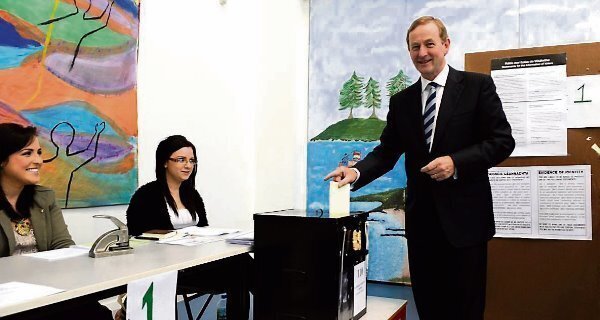

But come the day, cometh the man. The full frontal assault when it came, had more than the whiff of self-entitlement about it. Kenny of course had been leery of it all, long time before it happened.
Correctly paranoid about the sound of rustling in the long grass, Kenny was very concerned to demonstrate his leadership credentials. A bold act of decisiveness would be just the thing to clear the air. The Fine Gael annual dinner in 2009 would be just the place, to upset the apple tart and put his adversaries on edge.
The Fine Gael front bench were not consulted or forewarned. But that was the point. Not all on convivial or intimate terms, it was more about teaching them manners than showing them courtesy. In Napoleonic mode, Enda announced the abolition of the upper house in his speech. Then it was petit fours and dancing till dawn.
In the event, the great sweep of the leader’s scythe just above the knees of the body politic did not have its intended effect. It looked more like a stroke that smacked of desperation than a policy that demonstrated leadership — a point not lost on his internal critics. So onward they came, months afterwards. But they didn’t get their man. He might not be the brainiest of them all, but he is the most determined. And, he is no fool either. No, this is a man who will hold your head under the water until the bubbles stop coming up. That’s real leadership: laying down your friends for your life.
The Seanad was collateral damage. It was a minor inconvenience that, only months before he announced it, was surplus to requirements, Kenny had opined at the MacGill Summer School on how it should be reformed. No matter. The wheels were coming off the economy. The government of the day was the most unpopular ever. Abolishing an entire House of the Oireachtas, could only be a vote-getter, so into the Fine Gael manifesto it went. Then Fine Gael thundered into government with the largest majority in the history of the State. So enough said, it must be a winning proposition. Sure, didn’t they just vote for it? And then fatally it made it into the Programme for Government and became a promise that would be kept. Odd the promises that are kept, and the ones that aren’t.

Four years after that Fine Gael dinner, and two-and-a-half years into government the proposition was put to the electorate in a referendum. In October 2013, 39.2% of the electorate turned out. 51.7% of those voted against abolition, and 48.3% for. It was a losing margin of 3.4%. Hardly a ringing endorsement of anything, but enough to poleaxe the proposition.
A body that was almost universally ignored, and largely thought of as little use, was saved not by itself, but by the sense of overweening pretension of a government becoming unpopular, and which had certainly lost the popular touch. The Seanad was a talking shop to be sure, but it was a place where other voices occasionally raised issues that mattered. In contrast, debate in the Dáil was stultified and regimented. Ministers in sergeant-major mode were not effective campaigners in their own interest.
In contrast Democracy Matters — a very broad coalition of people who believed the upper house could and should be reformed — played a blinder. Senators Fergal Quinn and Katherine Zappone published a bill showing how within the current constitutional framework of vocational panels, the Seanad could be opened up to universal suffrage. The Quinn-Zappone bill got short shrift at the time, but it is a corner stone of the report of the group led by former Senator Maurice Manning, set up by the Taoiseach, that reported to him on Monday.
“Sometimes in politics you get a wallop” was Kenny’s verdict after the humiliation of losing the Seanad abolition referendum. That wallop, late in 2013 was only the start of it. Throughout 2014, an annus horribilis for the Government, blows — mainly self-inflicted — rained down. Opinion poll numbers sank, and a once mighty pomp looked very lank. But now it is spring again. Lessons have been learnt, we are told. The economy is slowly but surely recovering. And, as if on cue, a thought-through plan to not only reform, but transform the Seanad arrives on the taoiseach’s desk. It is strange how, circumstances dictate context.
The irony is that back in 2009 abolishing the Seanad was supposed to be the master stroke that would put the necessary smacht back into his leadership. In 2015, radical reform of the Seanad, along the lines proposed by the working-group he established, could be the means to put reform back on his Government’s agenda.
It would enable him to face into 2016 with a visionary agenda. It would embrace the people of the whole island who could vote in a Seanad election. And it would embrace the Irish abroad, who would likewise be enfranchised.
Critically, and this was the wisdom of the original Quinn-Zaponne approach, it does not require a constitutional referendum. It is within the Government’s power to action.
It is an action, if Kenny were to embrace it, that would be transformative for his otherwise discredited credentials for political reform. He has said he plans first to consult the opposition leaders. I presume he will be mindful that the prospect of a leader of Fine Gael extending the franchise to the people of Northern Ireland, or as many of them as want to avail of it, will be deeply discomfiting to the pseudo-republican pretensions of Sinn Féin. Fianna Fáil has already lost its once venerable claim to be the embodiment of the political nation.
This sort of 2016 — 21st century nation-building stuff, the effective implementation of which will coincide with the election after next in about 2021, in the State’s one hundredth year, is transformative. More important than the banality of substance it changes the self-vision of how we see ourselves as nation. It is in that re-imagining of ourselves, that real change is ultimately founded on.
Otto von Bismark remarked that “laws are like sausages — it is better not to see them being made”. We could dwell on the unappetising process of how we came to make the sausage that is the Report of the Working Group on Seanad Reform, or we can just tuck in. Paradoxically the political football of reform has landed at Enda Kenny’s foot at just the right time, and in front of an open goal. It would be the re-making of him — again.
He might not be the brainiest of them all, but he is the most determined. And, he is no fool either

CONNECT WITH US TODAY



Be the first to know the latest news and updates