The only way is up for a dynamic Sinn Féin with women at its helm
Well schooled in publicity, the party knows how to maximise its exposure for its own self-advancement.
The events surrounding the death this week of Martin McGuinness were no different.
His passing marked a seismic moment in the Northern republican movement and was a truly international event.
The world’s press rushed to tell the story of the former IRA commander who became a statesman, only to die with his desire for a united Ireland unfulfilled.
In every interview, leading Sinn Féin figures stuck rigidly to a formula of words which ensured their mantra was ventilated from Belfast to Boston to Brisbane and elsewhere.
Condolences were offered to the family, they spoke of Martin’s quest for a united Ireland. A kick at the Brits usually featured at some point and so on and so on.
But in the days after his death, it was remarkable just how far Sinn Féin was willing to go to exploit his passing for publicity.
Images from major vigils held on the night of his passing showed big “Vótáil Sinn Féin” posters on hastily-erected platforms.
At his funeral, party president Gerry Adams gave the graveside oration to his “comrade” with whom he worked for 45 years.
Even the podium he stood at in the consecrated ground of the city cemetery in Derry was adorned with two Sinn Féin logos.
It was too much, but they clearly feel you can never pass up an opportunity.
But, in terms of where Sinn Féin goes now, it was clear how those in charge see it going.
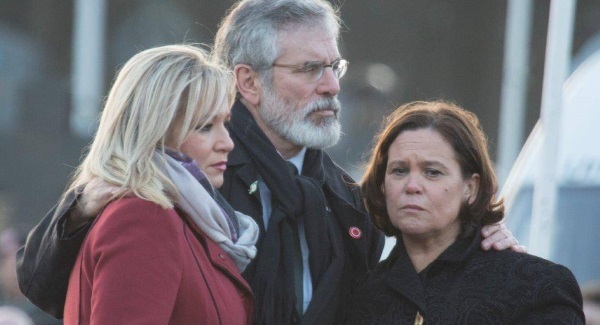
Positioned beside Adams in the graveyard, in the full glare of the national and international media, as well as thousands of the party’s own supporters, stood Michelle O’Neill and Mary Lou McDonald.
The sight of both women carrying a coffin, as McGuinness and Adams had done so often during the troubles, was notable.
It would be charitable to Sinn Féin to think the party did not plan every inch of the day, but we know that is not how it operates.
So, instead, we know the party was sending out a strong message that it intends to be led by two women north and south, whenever Adams feels the time is right to exit the stage.
It was the party making clear that it will change its leader on its terms and no one else’s.
We now also know that we can forget the idea of Pearse Doherty as a leader. Forget anyone else. It will be Mary Lou McDonald.
With O’Neill already in situ as the party’s leader in the North, the clear anointing of McDonald as the heir apparent in the strongest possible terms is hugely significant.
Under O’Neill, Sinn Féin romped home to its most successful Assembly elections since the institution was founded, returning with 27 seats, just one shy of the Democratic Unionist Party (DUP).
Talks are progressing in a bid to re-establish the power-sharing administration which McGuinness collapsed through his resignation in January in his last substantive act before his death.
Sinn Féin has been adamant that Arlene Foster must step aside to allow the inquiry into the so-called Cash for Ash scandal to be investigated.

But Foster’s attendance at McGuinness’ funeral, which was greeted by warm applause and her significant handshake with O’Neill in the church, suggests a way forward is possible.
The passing of McGuinness will inevitably hasten the queries for Adams to clarify his intentions. We have heard much of the party’s 10-year transition plan, but the death of McGuinness has clearly put paid to that.
Adams, aged 68, has in truth brought his movement as far as he can electorally, in the South anyway.
In the 20 years since Caoimhghín Ó Caoláin became the first Sinn Féin TD to be elected to Dáil Éireann since 1957 and the first Sinn Féin TD to take his seat at Dáil Éireann in Leinster House, the party has come in from the margins to the mainstream.
But come polling day it has consistently failed to deliver on positive ratings in the run-up to general elections.
Take the 2016 election: The party had been polling at levels up to 20% but returned with less than 14% of the vote. Yet, now with 23 seats in the Dáil, it is a seemingly permanent fixture in the seats formerly occupied by the Labour Party.
One of the main stumbling blocks to Sinn Féin progressing to date has been a reluctance on behalf of many to trust the party with the economy.
Also, while many may like its stances on social issues and its arch populist approach to pretty much everything, the ghosts of the Troubles are embodied in the symbol that is Gerry Adams.
With him out of the picture, Sinn Féin has the potential to be a very different animal. And with Mary Lou McDonald at the helm, it would seem the only way is up. Sinn Féin looks young, dynamic, inclusive, and incredibly well-organised.
Several of the party’s first-time TDs have already made a mark on the political landscape.
For example, even in the shark-infested waters of Cork South Central, alongside the big beasts of Micheál Martin, Michael McGrath, and Simon Coveney, the highly impressive Donnchadh Ó Laoghaire has made an impact since his election and looks assured to keep ex-TD Jerry Buttimer at bay.
It is also significant that McDonald recently announced the end to the party’s ridiculous stance that stated it would only consider Government if it were the majority party.
That strategy clearly backfired on Sinn Féin last year and the party was legitimately criticised for walking off the pitch when others were scrambling to try and form a Government.
The prospect of Sinn Féin being in Government under McDonald is not as threatening a prospect as it is under Adams. Recent polls have reflected an increased support for Sinn Féin at the expense of the main parties, with Labour showing no sign of a recovery from the trough it finds itself in.
One poll, in the Sunday Times two weeks ago, showed Sinn Féin as the second-most popular party.
SINN FÉIN’S new willingness to consider government, even as a junior party, is a game- changer in the electoral landscape.
Were the party to remain out of the fold, the next election is likely to throw up pretty similar Dáil numbers, meaning another unstable minority government.
But what is now in play is a Fianna Fáil-Sinn Féin coalition, as both parties would be aiming to get near the 40-seat mark.
There is also a growing belief that a stint in government, with all the rough and tumble that goes with that, will blunt the edges off the Sinn Féin arch populist attack.
Ultimately, the passing of Martin McGuinness was a very tangible closing of one chapter in the narrative of Sinn Féin.
It is now looking to the next chapter, which will determine whether it is a party to be truly taken seriously or simply the noisy neighbour who continues to talk a good game and nothing else.


CONNECT WITH US TODAY



Be the first to know the latest news and updates