It is now up to the free press to call out Donald Trump on his lies
IN Trump’s first week, we learned that the emperor has no clothes. And it took almost no time for it to become apparent.
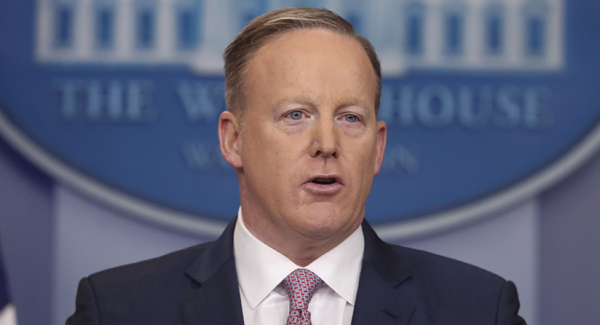
Looking like a child in his father’s coat, White House press secretary Sean Spicer took to the podium the day after the inauguration to excoriate journalists for accurately reporting the size of the crowd at President Donald Trump’s inauguration.
He spouted easily rebuked assertions, including saying it was the first time floor coverings were used to protect the Mall’s grass (it wasn’t) and that magnetometers kept people away (there weren’t any).
The next morning, Trump surrogate Kellyanne Conway appeared on NBC’s “Meet the Press,” saying Spicer was giving “alternative facts”. This was not the debut of lies as facts from Trump, but their codification; a statement that this administration expects reporters to blindly accept the new president’s warped view of reality.
Watch entire clip! No defense 4 press lies about MLK Jr. bust; actual facts about women in poverty, w/ no health care, failing schools https://t.co/5lfkM6j2IO
— Kellyanne Conway (@KellyannePolls) January 23, 2017
“The media should be embarrassed and humiliated and keep its mouth shut and just listen for a while,” chief White House strategist Stephen Bannon told The New York Times.
But why go through the effort of lying about easily disprovable things? To legitimise false ideas and use them to drive policy. In his first official meeting with members of the US Congress, Trump said he lost the popular vote after millions of people voted illegally.
It was a statement so false on its face that the Times ran the headline, “Trump Repeats Lie About Popular Vote in Meeting With Lawmakers.” The next day, Spicer defended Trump’s statement by mischaracterising studies. By Wednesday, Trump announced he would launch an investigation into the nonexistent voter fraud.
There you have it: Government resources will now be spent looking for something that does not exist. And after the dust settles with no trace of fraud found, the push will be that it’s time to pass laws to make sure election results are never doubted again. Laws that, like voter ID laws, will disproportionately affect voters who tend to support Democrats.
And the lies have become increasingly difficult to debunk among his supporters. Not because of their subtlety, but because Trump has worked for months to cement the idea of the press as worthy of derision and nothing else. At his rallies, journalists were a prop – penned in the back, a cage built to catch the hatred of the crowd. It didn’t stop after the inauguration. Spicer’s summoning of the press corps for a drubbing was just the start.
Step away from your type writer and google "live stream" - it's really cool, the kids love it https://t.co/QNJhb9CwKd
— Sean Spicer (@seanspicer) January 25, 2017
Since then, Bannon has called the press “the opposition party”. Conway told NBC journalist Chuck Todd that: “Your job is not to call things ridiculous that are said by our press secretary and our president.”
Republican Rep. Lamar Smith urged people to not listen to the media, saying “Better to get your news directly from the president. In fact, it might be the only way to get the unvarnished truth.”
Another challenge in fending off the lies is that, for decades, politicians and journalists have been caught in a game of polite fiction. Politicians might lie, but the lies always had the edge of truth to them, causing journalists to go along with it to avoid appearing biased.
When lies started coming from the Trump campaign, news outlets were (and continue to be) slow to be confrontational. Toronto Star reporter Daniel Dale reviewed 140 front pages after Trump misstated inaugural crowd sizes in a speech to the CIA. Only one paper directly said he told falsehoods in its headline. Others simply framed it as Trump criticising the media.
So what, aside from calling out lies, can the press do? They can recognise what little value White House press briefings now provide. CNN chose not to air Spicer’s first conference live, with the network’s Brian Stelter tweeting that: “The decision was to monitor the statement and then report on it.”
FYI, CNN made a conscious choice not to show the @PressSec statement live. The decision was to monitor the statement & then report on it.
— Brian Stelter (@brianstelter) January 21, 2017
Later CNN’s report was released, with the headline “White House press secretary attacks media for accurately reporting inauguration crowds.” Monitoring was the right call — reporting on the conference after the fact kept the network from participating in its own public flogging. Jay Rosen at Press Think has an even more radical approach: Send interns to cover the White House, and put experienced journalists to work at the edges of the administration. “Recognise that the real story is elsewhere, and most likely hidden. That’s why the experienced reporters need to be taken out of the White House, and put on other assignments.”
Lastly, journalists must become comfortable with being seen as biased. When Trump and his surrogates spout obvious lies designed to become truths, the idea that both sides are participating in a conversation in good faith must be abandoned. Lies must be called out, interviews cut short, press conferences should not be aired. Those who already believe the lie will cry foul, but by then our job is not to convert them. It is to keep toxic ideas from spreading and gaining legitimacy through discourse.
A quote commonly attributed to George Orwell, but of uncertain origin, says, “In a time of universal deceit, telling the truth is a revolutionary act.” Journalists, welcome to the resistance.
CONNECT WITH US TODAY



Be the first to know the latest news and updates