Economy of waste is no longer viable. Is it time for The Circular Economy?
ALTHOUGH consumers may be familiar with the environmentally-aware concept of “reduce, reuse, recycle” in a effort to use less of the planet’s finite resources, a similar concept is gaining traction throughout Europe that could be the basis of a €3bn per annum industry employing 174,000 people by 2020 across the continent.
The Circular Economy is one which according to the Ellen MacArthur Foundation “aims to keep products, components and materials at their highest utility and value at all times.” Whether this be computers, white goods like fridges and washing machines, or even mobile phones.
An economy built on the principles of “take, make, and waste” is no longer viable. Unless current trends are reversed, resource supply disruptions coupled with rising and increasingly volatile prices will in the next two decades translate into trillion-euro losses for companies and countries where growth remains tied to the use of scarce natural resources.
One area which most consumers use but never see is the large-scale computer businesses of data centres, the hub of cloud computing and online ecommerce.
Businesses operating in this sphere need to upgrade their equipment every two to three years to maximise their efficiencies and thereby need to “dispose” of thousands of tonnes of hardware when upgrading their banks of data servers.
Core technology in the equipment may be outdated because it is three years old and in keeping with Mooore’s Law — where performance doubles and prices half every two years. But there is value in the rest of it, the cabinets, the power distribution unit, the fans, and all the other components.
One Irish company operating in the circular economy is Wisetek. “We were there before the concept of the circular economy took off,” says Mike Higgins, chief sales and marketing officer at Wisetek. The company provide managed services offering for the processing of used IT equipment from data centres and major IT manufacturers.
The Cork-based company started operations in 2007 at the time of changes to the WEEE (waste electrical and electronic equipment) regulations in Europe.
“The legislation stated basically that the amount of equipment by weight that manufacturers put on the European market in any one year, they must take back a certain percentage. In 2007, that was brought up to 35% and most manufacturers saw this as a cost burden,” says Mike Higgins.
The founder of Wisetek was a former employee of computer giant EMC, Sean Sheehan worked at managing the returns for that company and saw the value in the materials coming back; understanding the value of putting the ‘used’ equipment through a really formal lean manufacturing process: Take the system apart exactly the way it was put together.
“We operate like a reverse manufacturing process: Instead of seeing all the components coming in and being tested and put together to form a finished system cabinet, here it’s like seeing the video backwards,” says Mike Higgins.
“We start with the system cabinet and go all the way back to the components and we work at that component level.”
Wisetek was very innovative at what it was doing from the beginning and estimate that its recovery rate is probably the highest in the industry.
“The facilities we have in Cork means we are the biggest at what we do in Europe. We also have facilties in Asia (Thailand) and in the USA,” says Higgins.
Wisetek operates out of the largest freeport in Thailand, they collect equipment from all over Australasia and disassemble it there. It is not allowed to ship any material to a non-OECD country like Thailand for instance, so all of the required material that is good is shipped to its Cork facility, all of the rest is shipped to other OECD countries for refining or re-marketing.
It also operates to a standard known as the “Responsible Recycling Standard” and is strictly and independently audited as to how stringent its recycling controls are all the way downstream and all the way back to refinement, so nothing ever goes down the unscrupulous or environmentally harmful route.
“We operate at the component level; the items that will have a serial number on it for instance,” says Higgins.
“When we see a system coming out [of a facility] we don’t see a system, we see a whole cabinet full of components. When that lands in our facility, we scan every component, it’s the level that we work at, then it goes through a precise dismantling process.
“The component then can go one of three streams from there: Our clients might require them for inventory, mostly for spares, or some components can be re-manufactured into new systems. Some may not be required by our clients but Wisetek can see a value in it and we prepare it for remarketing on the electronics market. It’s probably a third and a third and then our last resort is to recycle, but we try very hard to find reuse, because that is our absolute priority.”
To put that into context, Wisetek processes 5,000 tonnes of used equipment each year just from Ireland, that means that more than 3,300 tonnes of that equipment gets re-manufactured or remarketed.
However, because the company deals with components which were handling data, very strict protocols must be followed. “When it comes to end-of-life data centre equipment, the number one priority is data security; it simply must be erased,” says Higgins.
“Every bit of data that we get into our Cork facility that’s going to get re-used, we erase it, even if clients tell us it has been erased we do it anyway, even though there is a cost involved.”
The company employs two treatments to erase data: If it’s a product that has re-use for spares or there is a market demand for it, it’s put through an erasure process where the data is overwritten seven times; no data can be recovered following this process. If there is no market value, it gets shredded.
Wisetek recycles materials that have no re-use requirement or where there’s no re-sale requirement because it’s very old or there is no demand. In the Cork facility it separates materials into the same commodity types and ship it to R2-approved refiners to melt them back down to raw materials. It brings the least financial return but Mike Higgins says if you can avoid manufacturing another component there are carbon savings to be made.
“It’s better than going back to the old model of mine for raw materials; make; assemble; use and dump. At least now we are putting it back into the economy,” says Higgins.
“The circular economy that the Dame Ellen MacArthur trust is pushing is one which we are big advocates of. Re-use is the top priority.
“The EU have done a lot of work on this and they estimate the circular economy as a €3bn opportunity for European industry. They have calculated that by 2020 it will employ 174,000 people across Europe so it’s a new industry, but what really is behind the thinking is that most of the raw materials come from outside the EU and most of them get recycled outside of the EU so it’s not good for the balance of payments. It’s about keeping the value, retaining the value, and putting it back into use.”
The European Commission in its manifesto for a resource-efficient Europe has stated that “the EU has no choice but to go for the transition to a resource-efficient and ultimately regenerative circular economy”.
Higgins says the even big tyre manufacturers are getting in on the act: “The circular economy is changing the way that business is being done, people are paying to use.
“Michelin has a deal with some of the major haulage companies now in that they pay per mile to use the tyre and when it gets to a certain level of wear, it has agents around Europe that will replace the tyre. The agents will send the used tyre back to Michelin to re-groove, not maybe to put on the tractor units but put on the trailers so it’s a pay to use system.”
Although the concept of recycling is familiar to most, it really has been only in the last two years that the circular economy has begun to gain traction, the EU has launched Horizon 2020 which will put in place funding for research and innovation in the whole circular economy.
Wisetek sees itself as an innovator in their field. “We are doing stuff that nobody else is doing yet, and the circular economy makes total sense especially in regard to the IT industry.
“Ireland is very good at recording where the waste is going and we are at 50%; so we know where 50% is but that also means we don’t know where the other 50% is.
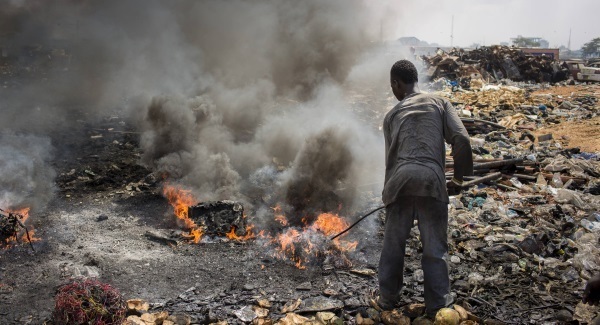
“The downside to this industry is there is a big unscrupulous element to this, a lot of the undocumented waste is — according to an Interpol report — handled by companies linked to the Mafia. A lot of the waste gets sent to the burning fields of West Africa,” says Higgins.
“In a PCB (printed circuit board) there might be €10 worth of gold on it and there will be lead and various other material; depending on the price of commodities, our processing costs for that could be €8 to recover.
“Unfortunately, the alternative is that it is given to a child in West Africa who sits with a pan at an open fire who gets 30c for extracting that same quantity of gold.”
Similarly the methods for extracting copper wires from the heavy duty UPVC is horrendous when burned, the carcinogens which are released are lethal.
“That’s the unscrupulous motive and this stuff at open fires is horrendous. The biggest threat is to human life and the second biggest threat is still to human life because toxins leach down into ground and the rainwater,” says Higgins.
“The burning fields are very well established and the basel action network group has found out that it isn’t going away. In the USA all the waste is being shipped to remote parts of China ... literally on a slow boat to China.”
Wisetek – facts
Wisetek’s goal is to return the optimal value to customers for their used data centre IT equipment, whilst ensuring strict data security disciplines for the handling of data carrying devices and ensuring all materials are assuredly processed to the highest possible environmental standards.
The highest possible environmental standard is the maximum possible recovery and processing of used components for further reuse in their originally designed purpose.
Wisetek’s environmental priority is to prepare components for reuse within their customers internal supply chain either for spare parts inventory or increasingly for Wisetek to incorporate fully functional components into new assemblies on their customer’s behalf. This delivers the highest value to their customer base as it both avoids the procurement costs of primary (first
time use) materials and secures long-term parts availability.
For materials not required by their customers, Wisetek’s reputation as a high quality processor of used IT systems enables them to market both components and configured systems, to their global buyer network.
Wisetek’s remarketing strength enables its customers to achieve strong financial returns for used IT assets. Only components deemed to have no internal reuse requirement by their customer or for which there is no market demand, will only then be classified as e-waste and enter the recycling process where components are refined to their basic raw material form.
Wisetek’s ‘Recovery for Reuse’ priority and associated capabilities is what distinguishes it in the data centre IT equipment category for waste management, positioning Wisetek as an exemplar practitioner that follows the principles of the burgeoning Circular Economy.
Wisetek’s advanced lean sigmabased process enables it to achieve 30%-40% reuse ratios from used IT systems, which is the considered ‘Best Practice’ benchmark within the entire Circular Economy concept, that currently varies across commodity types from 60% reuse from paper materials down to only 5% for plastic materials.
Interpol investigation
A comprehensive two-year investigation concluded in 2015 by Interpol into Europe’s used and waste electronics market found that illicitly traded or unregulated e-waste within the region represents some 10 times the quantity of undocumented e-waste exported from Europe.
The research found over 10 times the 400,000 tonnes of e-waste exported some 4.7m tonnes was wrongfully mismanaged or illegally traded within Europe itself.
It also found widespread theft of valuable components such as circuit boards and precious metals from waste electronics results in a serious loss of materials and resources for waste processors in Europe.
This annual estimated loss is valued at between €800m and €1.7bn.
“Electronic and electrical equipment represents the fastest-growing flow of the world’s waste streams. The weight of Europe’s mismanaged e-waste alone equals that of a 10m high brick wall stretching from Oslo to the toe of Italy.
"Valuable metals and components, including critical raw materials, need to be safely captured and recycled to the fullest possible extent,” said Pascal Leroy, secretary-general of the WEEE Forum.
Surveys by Interpol showed that on average each year, only 0.5% of EU e-waste exports were reported as having been stopped in operations leading to some form of sentencing, administrative fines or civil penalties, the report notes that penalties for infractions are insufficiently high enough to have deterrent value.
Highlighting cases of fraud, tax evasion, and money laundering, penalties should also be harmonised to simplify enforcement in trans-border cases, and to prevent criminals from shifting activities to lower-risk countries within the EU where legal and financial penalties for illicit e-waste trade vary greatly from country to country.
“As a profitable activity, with low risk of detection, the illicit trade in e-waste is vulnerable to exploitation, which governments can prevent more by employing a balanced mix of administrative and criminal penalties reflecting the value of illicit profits, as well as the large environmental and social harm involved” said David Higgins, assistant director of Interpol’s environmental security sub-directorate.
CONNECT WITH US TODAY



Be the first to know the latest news and updates