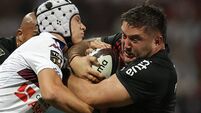
IRFU to limit foreign players
From the start of the 2013/14 season, there will be only one non-Irish eligible player allowed in each of the 15 field positions across those provinces. That means if Munster field a foreign tight-head prop (like their current number 3, BJ Botha) then both Leinster and Ulster will have to field an Irish tight-head.
And if Leinster field a foreign right winger like Isa Nacewa, then both Munster and Ulster will have to field Irish number 14s. Provinces will no longer be allowed to renew the contracts of foreign players, and, when those players move on, the province will have to replace them with Irish players. So when Munster’s South African props Botha and Wian du Preez see out their contracts, Munster will have to field two Irish props.
It’s certainly going to make life more difficult for the three provinces (Connacht are exempt because they recently commenced a new development agreement with the IRFU), but IRFU chief executive Philip Browne is adamant it’s a measure that simply had to be made.
“We want a balance that will allow us continued success at provincial level and greater success at international level. It’s critical for the international team we take these steps. And we can’t allow a situation to develop where our provinces become overly dependent on foreign players because, in the long-run, that creates a real problem for the national team and Irish rugby.
It’s imperative the Irish team remains competitive and successful and that requires us to have Irish qualified players gaining continued experience at provincial level.”
Not surprisingly, when the IRFU first discussed their plans with the provinces, they weren’t all that warmly received. “We spent a lot of time discussing it with the provinces and they would have preferred the status quo to remain,” admits Browne.
“The provinces tend to look at things in two or three year blocks, whereas we look at the longer term and in terms of World Cup cycles. It just wasn’t a runner to leave things as they were, particularly with the challenges around succession planning in a number of positions on the field.
“We just couldn’t hang the future of the international team on the hope that players would emerge in those positions. We have to proactively plan to bring the players through.
“We don’t want to upset the natural balance too much. We want the provinces to be successful and foreign players will still be critical to that success.”
The new system is likely to create some friction between the three provinces because there’s bound to be a scenario eventually where two or all three of them all want to recruit a foreign player in the same position.
“There’s no question that this will drive a lot of internal machinations by the provinces,” admits IRFU director of rugby, Eddie Wigglesworth.
“I’m sure there will be various conversations that will go on at the beginning, during and at the end of the season about where players are going to go.
“The important thing from our perspective is that this isn’t a sudden imposition on the provinces. They have, in the main, the players they want for next season and in many respects the following season as well. There’s plenty of time in the process to get things in order and move on.”
The IRFU will also impose two more restrictions on the provinces. All future injury replacement players will have to be Irish eligible, and all future foreign signings will have to be position specific.
“If you sign off on a player as a number 15, but want to play him in any other position when there are no exceptional scenarios that warrant that, then you will not get permission,” explains Wigglesworth.
“You’ll have to play him as a 15.”
Provincial coaches are unlikely to be pleased at having their hands tied in such a manner, and you’d wonder will it put off some of the most talented and ambitious from working with the Irish provinces in the future.
“We’ve got to make sure that doesn’t happen,” admits Browne. “Both ourselves and the provinces will have to sell the system that we have. The proof will be in the pudding.”
The provinces who adapt best to the new restrictions on foreign players will undoubtedly be those with the most productive academies, and Browne is hopeful this new contract policy will help ensure more and more academy graduates will progress to the top of the game.
“We’re spending about €2.5m a year on our academy structures and they’re churning out players,” he says. “The worst possible scenario for us is that we have nowhere for those players to play because there are blockages in the system.
“So what we’re trying to do is loosen up some of those blockages without changing the whole system.”


CONNECT WITH US TODAY



Be the first to know the latest news and updates