Five games into his tenure and Andy Farrell is still grappling with the same problems that have plagued Ireland since their annus mirabilis of 2018.
Failure to execute in big moments and convert opportunities into scores were the hallmarks of the last 12 months of Joe Schmidt’s otherwise spectacular six-year term as Ireland head coach as England, Wales, Japan, and New Zealand ruined best-laid plans for silverware, both in the 2019 Six Nations and the World Cup 12 months ago.
The 2020 Guinness Six Nations may have taken 276 days to complete its five rounds but the campaign and Saturday night’s 35-27 defeat to a rampant France side in Paris has given Schmidt’s successor further confirmation that the faults are not easy fixes.
They were exposed again at Stade de France on a night when the criteria for title success were eased before kick-off by England’s own failure to rack up the points in Italy. Instead of the bonus-point win that was expected to be the minimum requirement, Ireland were set the target of a seven-point margin of victory to regain the trophy.
Still a big challenge, of course, in a stadium where only two-point margins had been secured on each of their three wins in the last 20 years and an early piece of magic from Gael Fickou, supposedly playing out of position on the left wing, put in Antoine Dupont for the opening French try after just five minutes to underline the size of the task.
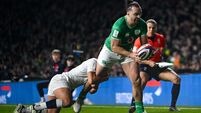
Further scores at pivotal moments, in the form of a penalty try on 29 minutes, and two excellent second-half scores on 45 and 70 minutes put that task beyond Ireland’s reach. Cian Healy grabbed a try in the 16th minute to mark his 100th Test cap as Ireland cancelled out the opening home score; Robbie Henshaw brought the visitors back into the game with a wonderful solo effort on 59 minutes; but by the time Jacob Stockdale scored Ireland’s third of the night the contest was over.
Romain Ntamack’s try just after the break, off a brilliant Antoine Dupont offload as the scrum-half pounced onto another Fickou kick ahead, and Virimi Vakatawa, this time off the back of Ntamack’s creativity, had illustrated the gap in class between these sides.
“It’s disappointing,” Farrell said. “It’s disappointing.
“We thought we were in with a shout today and we’ll certainly look back on that game when there was a trophy on the line and really take a good look at ourselves and the fact that it’s an opportunity missed.
“There were opportunities for us to win that match and yeah, we fluffed our lines at times.”
Worryingly for the head coach, he had pointed to a lack of belief from his players as one of the reasons for the fluffing of those lines.
“They didn’t have the edge in the first half to get the reward for the positions that we got ourselves in,” he explained. “I thought 100 per cent if we had had more intent with our game then that would have added to the belief.
“What I’m trying to say is, really, that there were six or seven tries in that game for us and we came away with three in the end.”
Whether Ireland can find that intent within themselves from one game to the next is the question Farrell needs to find an answer for in the coming days and he is in the rare position of being able to retain his players at the end of a tournament, with 12 days to prepare for the start of a new one, the Autumn Nations Cup which begins with the visit of Wales to Dublin a week on Friday night.
It is, though, a big question, as Farrell recognised on Saturday night.
“At the top level that’s the game isn’t it? If you want to win trophies, that is the game. When you get opportunities away from home in big games like that, that is the difference in the end.
“We had plenty of opportunities today that we didn’t capitalise on for a whole range of reasons.”
Farrell will certainly need his evolving attack to be better executed.
There have been glimpses of the potential firepower being developed with attack coach Mike Catt but running in handfuls of tries as they did against a poor Italian defence in round four and unlocking a Shaun Edwards-inspired defence were two very different challenges.
It meant that when Ireland undid the chances they created for themselves in Paris it was all the more galling for the coaching team.
There was further trouble for Ireland when they began to compound their errors during a pretty disastrous second half.
Hard-earned penalties were wasted, either by missed touch kicks from them, sloppy lineout play or basic handling.
“We killed our own momentum at times and then that stopped the fluidity of things, I suppose the errors that we made were across the board, it wasn’t just one area but I suppose being clinical in the last third of the pitch was the main point.”
Ireland were just not good enough with ball in hand and though they made a mockery of those comments that came to light last week from Rassie Erasmus at the 2019 World Cup that they were “softies”, the dominant tackle counts across the three games on Saturday will make for uncomfortable reading.
The three winning sides on the championship’s final day, Scotland, England and France, recorded seven, six and six respectively.
Italy managed 11 dominant tackles in defeat to the English but the other losers, Wales and Ireland, made just one apiece.
Farrell gave praise for the supplier of that lone act of meaningful resistance.
“You judge our team quite regularly really regarding whether we win the physical battle but I suppose there was one person that stood out in that regard,” he said. “James Ryan was absolutely immense physically today. Robbie Henshaw stuck his hand up as well.
“There were some good performances physically. I suppose you don’t have to be the biggest, you just have to have the most intent.”
Ireland will need to find a little more intent and a lot better execution if such nights are not to be repeated.
FRANCE: A Bouthier (T Ramos, 72); V Rattez, V Vakatawa (A Retière, 72), A Vincent, G Fickou; R Ntamack, A Dupont (B Serin, 77); C Baille (J-B Gros, 57), J Marchand (C Chat, 55), M Haouas (D Bamba, 55); B le Roux, P Willemse (R Taofifenua, 72); F Cros (D Cretin, 29), C Ollivon - captain, G Alldritt.
IRELAND: J Stockdale; A Conway, R Henshaw, B Aki (C Farrell, 52), H Keenan; J Sexton - captain (R Byrne, 68), C Murray (J Gibson-Park, 66); C Healy (E Byrne, 25-35 - HIA; 61), R Herring (D Heffernan, 57), A Porter (F Bealham, 68); T Beirne (U Dillane, 61), James Ryan; C Doris, W Connors (P O’Mahony, 52), CJ Stander.
Referee: Wayne Barnes (England)
CONNECT WITH US TODAY
Be the first to know the latest news and updates