THE REAL McCOY
AP McCoy is carrying a little more weight than usual.
Accustomed to travelling light, he arrives down to the lobby of a Dublin airport hotel bearing a compact overnight bag, a bottle of water and a copy of the Racing Post. But on this Sunday morning, as he prepares to head to Navan for a dayās racing, heās carefully holding up one conspicuous addition: the suit heāll wear at tonightās BBC Sports Personality Of The Year awards ceremony in Leeds.

As McCoy had fully expected, the 2013 title will, in fact, go to Andy Murray, but to mark the year in which he has racked up a staggering 4,000 career wins ā and counting ā McCoy will be honoured with a third-place finish to go with the supreme gong which, as the first jockey ever to do so, he won in 2010 after finally landing a victory in the Grand National at the 15th attempt.
But before he gets to sample the glitter of tonightās stellar event in Leeds, McCoy will have to negotiate the thrills and spills of the turf. And today, unfortunately, will provide more of the latter than the former, with one tumble and no winners ā unwelcome proof that even the champion of all champion jockeys still has to suffer the occasional bad day at the office. And, believe me, when you hear AP McCoy talk about the pain of losing, āsufferā is the word.
The previous day, at Cheltenham, had been better: two winners out of five. A decent return? āItās okay, youād take it every Saturday if you could get it,ā says McCoy, as we settle into the back of the car for the journey to Meath. āIf someone said you could have two winners every Saturday through the winter, I donāt know a jockey riding who wouldnāt say āIāll have thatā.ā
But talking to the man from Moneyglass, you quickly learn that, despite having broken more records than he has bones ā and thatās a helluva lot of splinters ā he always wants more.
āYour goals kind of change,ā he reflects. āObviously, at the beginning of this season my goal was to ride 4,000 winners. When I said that, a few of the journalists picked it up as ā is that going to be it then? But I meant it in the way that I had a hundred and twenty-something winners to ride to make 4,000 by the end of the season and if I donāt ride 120 winners then I aināt going to be champion jockey, for a start. So my next goal was to ride 4,000 winners but, first and foremost, my goal is always to be champion jockey. Thatās the aim at the beginning of every season.ā
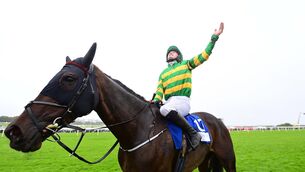
And his aim is true: for 18 consecutive seasons, McCoy has been champion jockey and, in the course of amassing that prodigious win record, has triumphed in all the big ones, from the puristsā choice, the Gold Cup, to the peopleās favourite, the Grand National. Naturally then, the innocent outsider could be forgiven for thinking that this is man with nothing left to prove, a man whose place in sports history is secure, a man who, at the age of 39, could even afford to ease up a little.
But that would be to discount The Fear. And, no, not fear of serious injury as, again, the civilian might be forgiven for thinking. For Tony McCoy, serial winner, the great motivator remains, paradoxically, fear of failure.
āIf you go a few days without a win,ā he says, āyou start to think, āthis is it, Iām on the slideā. In a big way. And, to be fair, Iāve always thought like that. Even last week I only had nine or ten rides and, after having Monday off ā my first day off in over two months ā I didnāt have a winner by Friday and so, for three or four days, the demons start setting in again and you start thinking āthis is the end, my career is gone.ā
āYou look forward to the next day, of course, to having another go and hopefully getting all that out of your system by having a winner, but when that day ends and you havenāt had a winner, the fear is there and would nearly keep you awake at night.
āFear of injury? I never think about that. Honestly, without trying to sound like a hero or anything like that ā because Iām not, Iāve been injured too many times to think Iām a hero ā but thatās the last thing that ever comes into my mind. The only thing I worry about isā¦being shit. Pardon my language. Being no good. Fear of failure ā thatās the worst.ā
To hear the leader in any field talk like this is always a tad disconcerting for those of us who have never managed to scale any of lifeās loftiest peaks. But itās hardly unprecedented.
Indeed, only a week previously, a certain other well-known sportsperson was speaking in almost identical terms on the box. So, did AP see the Vieira-Keane documentary?
āI did. I thought it was the best show Iāve seen on TVā.
And what Keane had to say about fear of failure ā that must have struck a chord with you?
āWorryingly,ā he says, with a thin smile.
Worryingly? Do you not like Keane?
āI love Keane, even though Iām an Arsenal fan and I love Patrick Vieira. Iām not saying Iām Roy Keane or anything, he was such a brilliant footballer. But I saw a lot of similarities, let me tell you. I donāt know whether I should be proud of saying that or not.ā
Because of the extremes heās driven to? And because you donāt want to be that guy?
āProbably. Not that he doesnāt care what anyone thinks about him but sometimes you think, God, do people think maybe Iāve as many demons as poor old Roy has. And, again, the worrying thing is that I probably have. I sat there and watched that interview and I could easily have sat and looked in the mirror all the way through it. He was asked about enjoyment. And he said the enjoyment is only there when you win and that it doesnāt last ā the next day itās gone. And heās right.ā
Is it the case then that you regret not enjoying your successes more than you might have done?
āDo you know, itās not that I didnāt enjoy it. Sure, aside from my two children being born, winning the Grand National was one of the greatest days of my life, the greatest day of my racing life, for sure. And the enjoyment did last ā we had a few parties and so on. But then it was gone.
āSo itās not that I didnāt enjoy it ā I enjoy every winner I ride. Thereās nothing like passing the winning post, even if itās at Plumpton on a Monday when thereās hardly anyone there. I still get the same enjoyment. But it only lasts for a certain amount of time. And when you wake up the next day youāre thinking, āwhat if I donāt ride any winners today?ā
āAnd thatās why you need to go to the extremes, to go that bit further than everyone else. You need to be able to say that no-one is going to go to the lengths Iām prepared to go to. Whether that thatās travel-wise, whether it be with injuries, whether it be with pain. Itās a physically demanding sport but itās mentally demanding too.
āAnd I see all that in myself. In my mind I have to be champion jockey so I never get a chance to mentally ease off. My life for the 18 years of being champion jockey has been all about the next day, the next ride. I canāt afford to have a day off. I canāt afford to have a day to relax. I canāt afford to have a day where Iām not frightened about not having winners. I have to have winners.ā
Does he think that, quite apart from the physical toll, heās paid too high a price in terms of happiness and peace of mind?
āIām making it sound like itās made me really unhappy but itās obviously what I need to do. Iām making it sound like itās made me really miserable but itās obviously what makes me happy. Making me sad obviously makes me happy (laughs). That is very contradictory and doesnāt sound right at all. But what hasnāt made me happy at times, has actually fulfilled me. At the end of day, it is my hobby and Iāve been so lucky to live my life through my hobby. Thereās so many lads would love to be doing what I do. So, you know, donāt be moaning. I could be working on a building site.ā
One thing to be said for toiling on a building site: it might be a dangerous working environment but itās about as threatening as a bouncy castle compared to the occupational hazards faced by National Hunt jockeys on a daily, even hourly, basis. Itās reckoned that Tony McCoy has broken or dislocated about 40 bones, including middle and lower vertebrae in his back, both shoulder blades, ribs, an ankle, cheekbones, a wrist, a collarbone and fingers. And teeth, of course. That little list comes from the ever-reliable Wikepedia so you know it must be true. And, if itās not, it probably errs on the side of understatement, since it neglects to mention other slings and arrows McCoy has suffered, from a punctured lung to bouts of concussion.
So, as the car bowls along this December morning en route to another date with one of the worldās most dangerous sports, letās talk about riskā¦
āThere was a great quote from Sheikh Mohammed after Dawn Approach won at Ascot: āthe greatest risk of all is to take no riskā. When I heard him say that I thought, āYouāre rightā. Because the greatest risk in life is not to take the risk. And, believe it or not, I donāt see the risk.ā
But your own injury list makes the risk painfully plain.
āIāve always had the mindset that, you know what, I can take it,ā he responds. āIāve said in a few interviews Iāve done ā and people whoāve read it probably think āheās not right in the headā ā that Iām unbreakable, that I can take the fall, I can hit the ground, get kicked everywhere and Iāll get up.ā
Remarkably ā and controversially, in light of the current debate about the effects of blows to the head in sport ā in his 2011 autobiography, McCoy even went so far as to suggest he could will himself out of a threatened concussion. āThis may sound ridiculous,ā he wrote, ābut I think I have programmed myself to not get knocked out cold.ā (It ought to be noted that, for perfectly valid health and safety reasons, there are immediate career implications for a jockey who sustains concussion: in the racing game, if youāre knocked out for less than a minute youāre automatically stood down for seven days. More than a minute and the enforced break is 21 days).
āPutting that in the book is not something Iām proud of but there are levels of concussion that are controllable, just like your pain threshold gets better,ā McCoy says now. āThe impact of a bang to the head is about alertness, about how alert you are to the blow thatās going to happen and about how alert you can stay. The reason I say Iām not proud of putting that in the book is you shouldnāt be telling people you can control concussion. Iām lucky in a way. I say I can control the concussion but at the same time ā and this is going to sound very contradictory ā I know the line where Iāve got too bad a bang on the head to be going out. Now I know people say that with a bang on the head you donāt actually know whether youāre here or there, but there is a point where Iāll know my head isnāt right and Iāll sit one out.ā
But not always: his book contains an account of a fall at Kempton in 1997 in which he sustained a blow to the head. But he still rode in the next race ā and to this day can remember very little about it.
āIt was like I kept sort of losing consciousness,ā he says. āI kept thinking I had a half an hour before the next race and that in half an hour Iād be grand. I knew where I was, I knew I was in Kempton. But then I forgot the way out. Then I was down at the starting line and the lads were about to jump off and I still wasnāt ready.ā
He raced anyway, badly, finishing sixth out of seven. Afterwards, he called trainer Paul Nicholls to apologise.
āIt was very selfish of me,ā he admits, āand I genuinely havenāt done it since. Iāve had a few bangs on the head and, where Iāve felt Iāve had a bad bang, I sit it out.ā
Does he ever worry that, with all the physical suffering his body has had to endure, he could be storing up significant long-term health problems?
āEven though ā and I donāt like to say it ā Iām going to be 40 in May, Iām physically pretty fit,ā he replies. āIāve always lived a healthy lifestyle, Iāve never smoked or taken a drink. And I think being naturally very fit has helped me recover from injury quicker. I only do actual fitness work when Iām injured. Because Iām riding every day, Iām fit from my job. I used to fear putting on weight when I retire but now I actually like being fit. If I have a week or ten days off or Iām injured or whatever and I put on ten or 12 pounds and get to 11 and half stone, I feel fat ā and itās not for me. I wouldnāt ever let myself get in that condition.ā
In his obsessive determination to become and then remain champion jockey, Tony McCoy has not only been hard on himself. His book āAP McCoy ā My Autobiographyā is a compelling and at times uncomfortable read, not least for the deeply unflattering self-portrait which emerges from the detailed account of his often troubled relationship with his then girlfriend, now wife, Chanelle Burke. And, by his own admission, the trouble was invariably instigated by the self-absorbed McCoy, who was never slow to engineer a row that would reduce her to tears. He disapproved of her smoking, for example, and thereās one description in the book of how he reacted after catching her sneaking out to have a furtive puff at a party. Immediately, he demanded she leave, drove her home and dropped her off, saying: āIām going back to the party, Iāll deal with you later.ā This was six years into the relationship but the very next day he made her pack her bags, drove her to the train station and left her standing on the platform with the words: āDonāt bother ringing me, itās over. Have a nice life.ā
Looking back at that time, he writes: āWhat a shit I was. What a bully. What a control freak. I wasnāt in a good place in my life, my head was wrecked, my fixation on being champion, the wasting that was frying my brain ā and Chanelle bore the brunt. It was a horrible way to behave, a terrible way to treat the person you are supposed to love.ā
It is not, to say the least of it, any easy read ā even in the knowledge that, against the odds, the relationship survived those grim episodes, and subsequent challenges, to evolve into a fulfilling marriage. I wondered if, in revealing all this in the book and being so unsparing of himself with the whip, McCoy was consciously engaging in an act of public atonement: being hard on himself to make up for having been so hard on others?
āObviously I was pretty hard ā mentally not physically ā on my girlfriend then, who is now my wife,ā he says. āBut now itās gone full circle. Whereas I nearly had total control over my life and my wife and everything that went on around me, now my wife has got total control over me and my life. Sheās paying me back for whatever hardship I put her through. Itās gone full circle and now Iām a total yes-man as far as that is concerned. And she deserves it. She put up with me for long enough. Sheās an amazing person, an amazing girl and a great mother. But I put all that in the book a bit for myself too. It was a public confession.
āThere were some other things Iām glad I put in there too. Obviously, we struggled to have our children and had to go for IVF. And I put that in the book because, in some ways, I felt like it was my fault. My career was nearly the cause of it, if you like, because of all the hot baths I have.ā
In the autobiography, writing about the daily regime of piping hot baths heād have to help keep his weight in check, he puts it like this: āYou are not thinking about the fact that you are boiling your balls every morning and that it might be having a detrimental effect on your ability to procreate.ā
It was in the summer of 2002 that he learned this was precisely the case, when a fertility check revealed he had a very low sperm count, and he was devastated to be told by a doctor that he might never have children.
āNot all jockeys will be affected,ā he points out now, āmore the bigger lads who struggle with their weight. When we said that weād been trying to conceive for a while, the doctor who did the treatment asked what my diet was like and what kind of lifestyle I had. I told him we have really hot baths every day. And he said that was it, that kills it. And Iām glad I put all that in the book because there have been jockeys who have since come to me and my wife and asked how did we get the treatment. Things like that were obviously very personal and I wondered if I should put it in the book but Iām glad I did.ā
Happily, the IVF worked, and Tony and Chanelle are now the besotted parents of six-year old Eve and four-month old Archie. And, not surprisingly, the impact on dad has been profound.
āIf youād have said to me seven or eight years ago, thereās something more important than my career, Iād have said āno chance ā thereāll never be anything more important than my career,ā McCoy tells me.ā But when you do have your own kids, thatās it ā they are actually the most important thing in your life. Thereās nothing more important in the whole world than Eve and Archie, as far as Iām concerned.
āAnd, I think theyāve actually helped my career too. Archie is only four months but Eve is six years old and sheās a little lady, the way she carries on. In a lot of ways, having kids has changed my outlook and perspective ā but for the better. Iām still as intense in my career but when I come home in the evening I donāt hang onto it. When I was younger, Iād come home and sit and watch replays at night. Iāve sat in a dark room at night because I had a bad day. I wouldnāt say that to too many people, but I have. Now when I come home at night, I very rarely watch the replays until the next morning when Iām in the bath. Because if get home at half-five or six, Eve is up until seven or half-seven, and sheās got an hour and a half or two hours of me. And Iām hers, as far as sheās concerned.ā
All of which has undoubtedly helped make Tony McCoy a better person. But in the year in which he has passed the 4,000 mark, is he now also a better jockey? Despite the significance of that milestone number, the tyranny of the stat tells him heās not.
āSomeone said to me a few weeks ago that I was riding as well as ever and I think Iām riding okay,ā he reflects. āBut in 2002 I rode 289 winners and broke Sir Gordon Richardsā record for the most winners that a flat or jump jockey has ever ridden. So, statistically, I was by far at my best in 2002. Now, since then Iāve won a Gold Cup, a Grand National, a Champion Hurdle and various other big races, so itās not that I donāt think Iām riding as well.
āBut Iām a kind of sad, statistical person and my dream would be to be as good as I was in 2002. That is the way it is. I donāt think Iām riding badly or whatever, but I must have been at my best in 2002, yāknow? And I wish, every day of my life, that I could be as good as I was then. I wish I could ride more than 289 winners. And Iāve tried for the last ten years and I canāt.ā
For the foreseeable future, at least, heāll keep on trying. But he also knows that his own finish-line as a jockey is drawing close ā and he simply dreads the thought of crossing it. If he could, he says heād love to be able to go back and start all over again.
āIām sure Iād do a lot of things different ā Iād ride a lot more winners,ā he offers with a smile. āBut, yeah, I hate the thought of retirement. Why? Because the thrill is gone. And thereās a lot of thrill in winning. Could I keep riding just to take part? Not really. I want to retire as champion jockey. If I thought I was slipping or wasnāt as good, I wouldnāt want to let myself down. Going out at the top is very important to me. And I know that means that I will probably end up retiring from my sport when Iām not happy to or not ready to. But because Iām such a stubborn person, I probably will do it then anyway. I can see myself having to force myself into retirement.ā
By now, weāre parked outside Navan racecourse. His first ride of the day is less than an hour away. Work calls again but, just for a moment, he allows the reins on his imagination to loosen.
āIf I could retire tomorrow,ā says Tony McCoy, gazing into the middle-distance, āhave a couple of days off, change my name and then come back as someone else and start riding again the next day ā Iād be happy.ā