Conor McGregor Interview: He wants the whole world to hear him
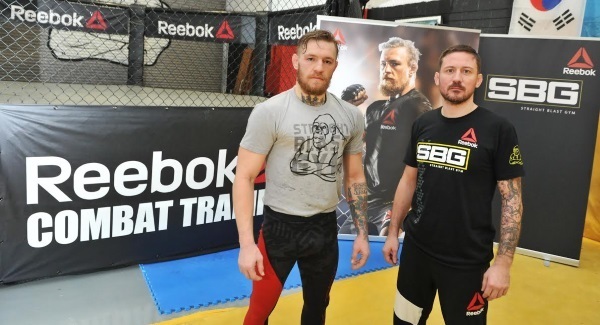
Then again, only in McGregor’s world can the flashes from incessant camera lights cause headaches and dizziness and the demands on his time become so dehumanising he feels like a piece of meat.
For the next six weeks he goes underground. And then there’s December 12...
1
HUMILITY:
It’s hardly the first word you’d ever associate with Conor McGregor. As you make your way to the back of the new Straight Blast Gym on the old Naas Road, a media ring around him is just breaking up. A few days earlier you’d been allotted a one-to-one slot but it being the mad crazy world that is Conor McGregor and with the rest of us seemingly just living in it, that arrangement was changed and now his handlers have heaped everyone in together. Only you’d made other appointments in the meantime, and you’ve headed out here on the chance that the all-in group interview hasn’t even started yet, or that he might be in the mood to talk some more to you afterwards as much as he could just breezily blow you off.
The extremely-cordial PR woman risks it. Could he speak for a while with the guy from The Examiner? Turns out McGregor is just as accommodating. He nods and smiles politely, shakes your hand. No problem, he says rather softly, he’ll talk away grand. Only he’d had a bit of a workout earlier; would you mind if he changed out of his gear and showered first? As he makes his way over to the changing rooms, he sees a friend from his Drimnagh childhood. Philip Sutcliffe Jnr from the great boxing family has popped in for some physio. The pair clasp hands, embrace, and laugh before Sutcliffe shows McGregor some shuffle-and-punch manoeuvre.
McGregor turns to the mirror but while he’s smiling there’s no preening or posing. The only modelling he’s doing here is the technique Sutcliffe’s just shared with him.
“I had many great training sessions with young Phil,” McGregor explains to you after that shower. “It was his dad, Phil, that taught me how to box. So were just bouncing things off each other there. That’s the beautiful thing about this game. [There are] Many, many great martial artists, many great fighters in this country. [I’m] just trying to learn off everybody.” Or anything, anywhere.
This is someone who studies animals and their movement, like the two gorillas he came across on TV one night, fighting (“It’s like freestyle wrestling, they’re arm dragging and their posture is so solid,” he’d once tell ESPN magazine about why he apes apes. “Posture for combat is so vital.”) He’s turned up unannounced at a well-known Brazilian jiu-jitsu gym in Los Angeles, asking if he could roll with their best grapplers so he could learn some new techniques from them. The same gym had never encountered such a request from a UFC fighter before; anyone else would have been too afraid of being embarrassed.
It’s one of the fundamental paradoxes of the man: for all the bling and bravado and brash talk and trash talk, underneath it all is that certain humility. That humility has been the platform for a confidence that he has transformed into a cockiness and even an arrogance that intrigues and appals, attracts and repels, beguiles and abhors.
“There is no ego in here,” he says about the SBG gym that his mentor John Kavanagh runs, though he is now speaking with his familiar confident, philosopher-holding-court drawl. “Nobody comes in here an expert. Everybody starts somewhere. That is the beautiful thing about this gym. Everyone who comes in here is taught how to train. And taught how to learn. You’re here to learn.
“Not a lot of people or pros in this game know how to train correctly. That’s why they don’t have a long career. Their body gets banged up. They get into a rhythm of heavy sparring and heavy work but through that, they’re limiting movement. People are afraid to almost move in a new way because there is so much intensity in the gym. So they don’t actually learn.
“[If you do that] Your skill level remains the same. You might be tough but you can only be so tough for so long, you know what I mean? The brain can only take so much damage. The body can only take so much damage.
“You must learn how to train correctly. We fight to win but we train to learn. To train smart. Allow situations to happen. Don’t force nothin’. That’s it. But it’s been a learning curve for me as well.
“Back in the day, I used to glove up six-ounce gloves. Six-ounce gloves, gumshield, shin pads, and fight 10 five-minute rounds straight. And that was a Tuesday morning session. Then [I’d] come back in on a Tuesday night. [No wonder] I was getting banged up! People think hard sparring will get you sharp. And you do get sharp in the gym. But anytime I’ve trained that way, I’ve actually been a little bit flatter in the fight. And the knockout shot hasn’t come. It’s almost because my training has been too hard.
“But since I’ve trained where I hold the trigger on every shot? Say I just put my foot right at your chin and hold it and place it back down, but then on fight night when it’s time to pull the trigger on that kick? It goes through the guard. Nobody can take it.”
His quest for constant learning and improvement though is rooted somewhat in humiliation as it is in humility. His fourth competitive fight was back in 2008 when he was a 20-year-old plumber. It was in Drimnagh, just up the road from where he grew up. He was fighting in front of his own, top of the bill for the first time. His Lithuanian opponent forced him into submission.
For months, he avoided Kavanagh. Didn’t even return his calls, let alone return to his gym. He owed his coach up to €600, blowing all the money he’d been handed when firing out fight tickets. He was partying. Hiding. Until one Saturday night, on McGregor’s mother Margaret’s request, Kavanagh called over to the house. McGregor looked like crap that had been eating only crap. “I just didn’t know what I wanted to do,” he’d say later.
He would though shortly, after Kavanagh allowed him back to train in the gym for free. He wanted to be Ireland’s first UFC fighter. A millionaire. He was giving up his dead-end job as a plumber for a dream his dad feared would have a dead end too. So he joined the dole — which he was still on up to only 30 months ago — and hit the gym.
The fight against the Lithuanian had taught him he hadn’t been taken the fight game serious enough. “I was [just] a boxer,” he’d reflect some years afterwards. “I had no respect for jiu-jitsu or the grappling arts.” Now the gym that he once avoided has been upgraded and moved here to larger, plusher premises.
Here he’s tried, discovered and honed moves that he didn’t even have when he backed up the hype in Vegas this past July and defeated Chad Mendes for the interim UFC featherweight championship belt. “I can now spin on both legs. I can now swing the heel around on both sides. If you shimmy to the left I can now swing a shot into your path. If you shimmy to the right, I can also swing a shot into your path.
“So now there is no escape. You must plant your feet and throw. If you plant your feet and throw, I will not be there. I will be away and I will be back in.
“So I have many setups and traps that I will lure him [his opponent] and will catch him with something devastating. That is the beauty of the game. I’m always growing. Still learning. Still getting better. Getting faster at it.” Yet perhaps his most impressive skills aren’t even physical.
2
ALI:
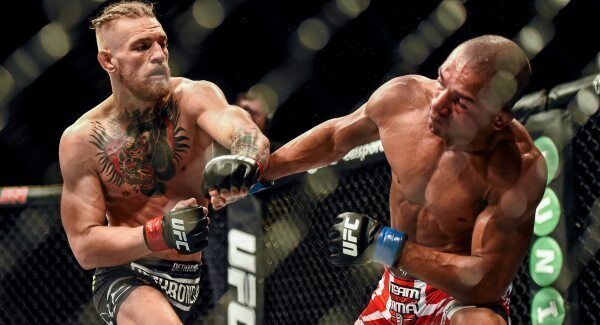
About the most offensive thing about Conor McGregor for some people is whenever he is compared to Muhammad Ali.
You can see why they’d baulk. Ali excelled in a division of a sport with a huge tradition and much larger participation base, following in the lineage of Johnson, Dempsey, Louis, Marciano, Liston. UFC is five years younger than 27-year-old McGregor.
Ali was a force for social change, a champion of the poor. McGregor in basking in all his bling, once remarked, “This solid gold-pocket watch? Three people died making this watch.” As much political ignorance and incorrectness as Ali sometimes spewed, he hardly said anything as crass as telling the Queen what to do with herself as he did the other night.
Ali wasn’t just the greatest, he was an original. Next to him, after him, someone like McGregor can seem like a mere, cheap imitator.
McGregor himself will be the first to acknowledge he’s not in Ali’s league. “He [Ali] is out in his own,” he said a few years ago, “and I cannot lay claim to something like that. He changed the cultural landscape of the world.... Muhammad Ali is a special, special man. I am on my own journey and doing what I do best.” Here’s the thing though. Whether you like McGregor or not, his mental strength is undeniable. His command of a range of mental skills is exceptional. How he reviews and learns from every session and fight. How he talks to himself and about himself, or self-talk as it’s technically known as. In his application of visualisation, a skill Ali brilliantly termed “future history”.
“I understand that if you see something and if you speak it aloud and say it with confidence and believe that it will come — or believe that it is already here — it will form itself into a reality,” McGregor tells you.
“And that is what has happened for me, many times over. Now I feel I’m an expert. I get better at it each time. I can almost pinpoint details of what will happen. If I say it, make no mistake, it will happen. I’m that damn good at it.”
How? Part of it comes from his natural, lippy personality and working-class Drimnagh upbringing. A good bit of it has developed through the coaching of John Kavanagh and SBG’s resident sport psychologist David Mullins. And some more from it has come from admiring and studying Ali.
He remembers when he was about 12 having a row with this other kid who suddenly swung at him.
McGregor initially stumbled but then started shuffling his feet and shouting the name of his idol: “Muhammad Ali!” Even when he’d miss with his follow-up punch and was duly hopped by five of his foe’s friends, he’d take strength that his bravado and Ali shuffle had gone the rounds around the area.
He’s watched all the documentaries. When he was a teenager his mother bought him Thomas Hauser’s classic biography which he devoured. On the kitchen wall in his parents’ home hangs the immortal photograph of Ali standing over Sonny Liston. Out in Vegas in what he terms the Mac Mansion, there is an Ali coffee-table book on, well, his coffee table.
One of the big things McGregor has taken from this fascination with Ali is this concept that you can create your own little self-fulfilling prophesies by how you talk to or about yourself. When Ali later reflected on the most famous affirmation of all time — “I Am The Greatest!” — he realised he had essentially been saying it to fake it to make it. And it’s a principle and example that McGregor says he abides by “100%”.
“Damn right. If you see it here [points to his head] and then you speak it? ... A lot of people see it but they don’t speak it. They are afraid to speak it. That alone is not going to allow it to manifest into a reality. You need to speak it. You need to be confident enough with it. And that’s what I do.” This is a nuanced, distinctive point. Almost every sport psychologist recommends to athletes that their internal dialogue should be predominantly positive. Even better, as McGregor notes, if they speak those positive thoughts out loud. But he goes even further. Almost all those sport psychologists work on the assumption that there’s no one else in the room. McGregor doesn’t care if there’s someone else in the room. He doesn’t mind if the whole world hears him. He wants the whole world to hear him saying it out loud.
This is where you mention Steve Collins to him. Probably our greatest boxer ever. When he morphed from an affable contender into the Celtic Warrior at the start of the Celtic Tiger, middle Ireland found his self-confidence and self-praise a turn-off. It much preferred sports people like Katie Taylor. Clearly she has an inner confidence; she wouldn’t be as good as she is without it. But outwardly, she’s humble and respectful to all. Is that something McGregor considered at all? How does he explain his own popularity here and beyond? “I don’t know,” he shrugs. “I’m just being who I am. I don’t necessarily believe that [about Irish people].
I just think we like our own. And people will like you and some people will not like you. I’ve come to accept that.”
Maybe he speaks to a younger, bolder Ireland. Maybe Ireland wasn’t ready for Collins but it is for McGregor, a theory Collins himself subscribes to. (“I just love the way he [McGregor] carries himself,” Collins has said. “He says what he’s going to do and then he goes out and does it.”) Or maybe it’s because he’s more playful and there can be real wit and even charm to his posturing; in a few seconds he can do or say something to make you laugh as easily as he could enrage. Mad as fuck helps cover up a lot for being as cocky as fuck.
What he can definitively say is that his big pronouncements and predictions are not just with the promotion in mind. His No 1 constituency is himself; when he speaks arrogantly to the rest of us, he is speaking confidently to himself. But he’s also talking to another key public. When Ali would proclaim to reporters, “Archie Moore, you’re going in four”, he was speaking to Archie more than the reporters. Subliminally he was dragging his opponent into the self-fulfilling prophesy. Is that strategy of The Greatest something duly noted by The Notorious?
Again he nods. “100%. When you speak with confidence and you tell a man the truth, it can send shivers through his whole body. I assess my opponents’ fighting ability. I let them know where their weaknesses are, I let them know where I’m going to attack, I let them know when I’m going to attack, and then I go out and do it. So, when they read the truth and they realise, ‘Wow, I do react a certain way, I do counter the same way, I do take a shot bad,’ it plays with their head. But it’s just me speaking the truth.” The conversation now leads onto how Ali didn’t just talk like he did to transmit some doubt into his opponents. Often he would talk positively to himself as a tool to help alleviate any doubts of his own.
There’s that memorable sequence in When We Were Kings when Ali is in his corner after the first round. There’s a look of unmistakable concern across his face as it dawns on him that maybe he can’t beat the man that everyone had told him was invincible. To win, to even survive, he has to summon within himself some source of strength. Then he starts the chant, for himself as much as the Zairian crowd. “Ali, Bomaye!” With that, a required energy and belief is triggered.
Has McGregor similarly had to counter momentary self-doubt with self-talk, like when he entered the July fight in Vegas with a torn ligament in his knee, though he didn’t tell anyone? Again, he nods.
“I’ve had many inner conversations. Many inner conversations. That was one of the toughest I’ve ever had to overcome. But every day I simply said to myself, ‘The true greats, they can conquer adversity. They can conquer anything that’s thrown at them.’ So, that’s what I kept saying to myself. ‘I am a true great. So I will go and conquer this.’ That was something I would say to myself all the time.
“He [Jose Aldo, who he was initially meant to fight before withdrawing due to a rib injury] ran from his adversity. I didn’t. I faced it head on and I conquered it.”
3
FAME: THE DOWNSIDE OF BEING THE NOTORIOUS...
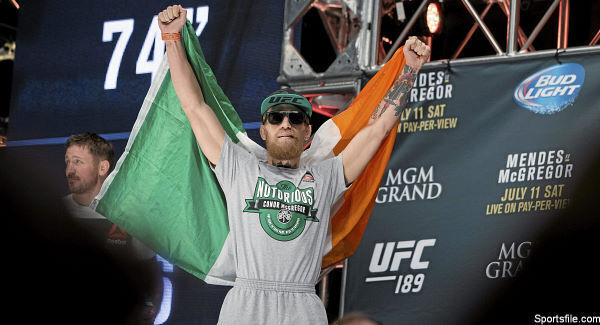
He’ll be honest: he’s feeling a bit jaded right now. He’s feeling a bit cranky right now. This interview is his last obligation as part of an intensive four-day promotion run around the country and that schedule has left him screaming for some peace and quiet and yearning for when he can just train here with the rest of the Tribe, away from the flashing lights. “I need to go back into the darkness,” he says.
The itinerary started off with him in the best of humour and with the best of intentions. He’d donated €25,000 to the Simon Community which will fund a mobile health clinic for a full year, and another €25,000 to Focus Ireland to further aid the homeless. To help raise awareness of the issues and charities, he was down in Waterford the first night, then Cork the next, squeezing flesh.
“I swear, by the second night I was getting dizzy from the flashes. I [just] lay on the bed. I must have signed a million pictures and had two million pictures taken.” The third night, thousands of fans descended on a nightclub in Swords for what they believed was going to be a meet and greet, not just a Q&A with McGregor and the rest of the SBG gym.
“I stayed on the stage after. People were coming up and I did autographs and a load of selfies and pictures. I must have been there an hour. Then I went upstairs to this little private room that they had for me. And there was about 400 people queuing all along the stairs. So I took some selfies, rang someone’s uncle in Canada who is a big fan, all that, but there was no way in hell I could have gone through everyone after a four-day run like that. I’d still have been there! So I had to go.
“Then when I left I was getting messages all night. About disabled kids that were crying all the way home in their parents’ car. And I was like, ‘This is fuckin’ ridiculous! How was this billed as a meet-and- greet when it was supposed to be a Q&A?’ So I felt like I let these people down when I done as much as I could. It really upset me last night. I felt I was let down by the people who set up the event. It was just a messed up situation.
“So I reached out to the people that I could reach out to and I had some people come down here [to the SGB gym] today. But at times I feel like I’m a piece of meat.” Even when he’s trying to just eat a piece of meat. He tells you about the other day when he was in a restaurant with a forkful of food in his mouth when a woman came straight over with her kids.
“She was going ‘Colin! Colin!’ Calling me the wrong name! ‘Colin! Colin! Can we take a picture with my kids?’ And me literally with a forkful of food in my mouth! But I said ‘Okay’, finished my food and done the thing. But then when one takes it? A million come over.
“So it’s all messing with my head a bit. That’s why I feel I just need to drift away for awhile. I need to say no sometimes. But then you’re damned if you do and damned if you don’t. I’m in a weird place in my head now.
“But when I come here [the gym]? The stresses of everyday life all go away. Once you’re in here and someone is trying to wrap around your throat or punch you in the face, you’re living in that moment. You’re not anywhere else. That is why I love this place.”
4
THE DATE, NOT THE OPPONENT: FREEDOM...
— Conor McGregor last June, after Jose Aldo cried off injured for UFC 189 and was replaced by Chad Mendes
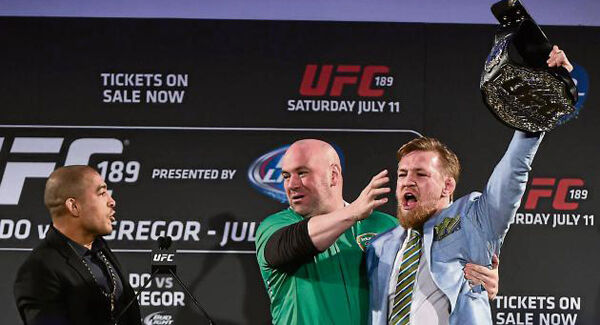
The big date now is December 12. This time the opponent in the MGM in Vegas will finally be Aldo. Again though, he says it’s primarily about himself. ‘You versus you.’ And this time he doesn’t have to contend with an undeclared injury. “I’m a different animal now. I was a wounded animal in the last one. I couldn’t train like I usually would train. So I went in there limited. I have many, many shots in my arsenal; all the parts of my body, I can strike with. But when I injured myself I had to tuck many of them into my back pocket. Put them away for awhile. Now I have taken them out of my back pocket. Now I am free to use them again.” But where does he strike the balance of the identity of the opponent not altering his level of competitive spirit and yet studying the guy and his style? Afterall, he’ll readily admit that an element of his pre-fight talk is to affect his opponent’s head as much as it is to enhance his own self-belief and pay-per-view sales.
“I don’t really study [them] crazy. I don’t build them up. I already know what way they move, what way they react; I already know everything about everyone in the fight game.
“So usually what happens when I sign to fight someone, I look at some specific clip and I might look at that same clip a few times over, and then I wouldn’t look at it again. I certainly wouldn’t watch a full fight. I might watch the first two minutes of the first round. See what way they enter. See what way they retreat. See what way they tend to react to certain shots. Then I’m done. I don’t need to watch the whole thing. I don’t listen to what they say. They don’t exist.”
After a fight though, he seems to have a different, more respectful view of his opponents, like Mendes the last time? “I respect any man that steps inside there. It’s all good [between us]. Fighting solves everything in this life. People say fighting solves nothing but in my game it solves a lot of things. So of course I’m okay with him. I wouldn’t ring him or anything, but I respect him. He got in there and he fought. He showed up when somebody else didn’t show up. So I respect that.
“But at the same time, if he came back around, I’d still slap the head off him. I’d still whip his ass, no hard feelings. This is the business I’m in. It is a ruthless business. You must take no prisoners in this game. You must kill all prisoners in this game.
“When it’s done, you shake hands and that’s it. You go on with your career and I go on with my career. I wish you well. If we cross paths again, it becomes business again.” But it seems more personal between himself and Aldo? Nah, he says. “It’s just gone on so long now. It should be done and dusted. If anything there should be a second fight by now. So I’m not trying to scare him anymore.”
So, for the next six weeks, it’s into the darkness. As his old icon Ali used say, that’s where the fight is won, long before he dances under those lights. But when it comes to dancing back under those lights? “I’m free,” he grins. “Someone said to me one time ‘Join us on my podcast when you’re free.’ I said to him, ‘The only time I’m free is when I’m inside that octagon. I’m not free any other time.’ You ask me how I feel or what I’m thinking, making that walk to the octagon?
“I’m thinking freedom.”

CONNECT WITH US TODAY



Be the first to know the latest news and updates